Facts
The Petitioner, a non-disabled candidate (non-PwD), applied for the M.Ed. course for the academic session 2025-26 under the Students Academic Management System (SAMS)
Source reference: p.2Despite scoring 57.50% marks in the entrance test, he was not selected in the regular list or the first phase of spot selection at Dibakar Patnaik Institute of Advanced Studies in Education (DPIASE), Berhampur
Source reference: p.2-3During the second spot selection on October 28, 2025, the institute admitted Opposite Party No. 5—a Person with Disability (PwD) candidate—who had secured only 28.75% marks
Source reference: p.4The Petitioner challenged this admission, contending that reservation policies do not apply to spot selections according to certain guidelines and that his merit was superior
Source reference: p.4-5The State (O.P. Nos. 1-4) countered that 5% of seats are strictly reserved for PwD candidates and cannot be converted to general category seats even during spot selection
Source reference: p.6-7Issues
1. Whether the reservation policy for Persons with Disabilities (PwD) remains applicable during the "spot selection" phase of admission for the M.Ed. course
Source reference: p.8 / para. 82. Whether a non-PwD candidate can claim a seat reserved for the PwD category if his merit is higher than the available PwD applicant
Source reference: p.9 / para. 9Law Applied
Reservation policy outlined in the Information Brochure [Annexure-C/3] and the SAMS guidelines [Annexure-A/3], which mandate a 5% compulsory reservation for PwD candidates that cannot be "de-reserved" as long as eligible PwD applicants are available
Source reference: p.8Statutory mandates of The Persons with Disabilities (Equal Opportunities, Protection of Rights and Full Participation) Act, 1995 and the Rights of Persons with Disabilities Act, 2016
Source reference: p.10Supreme Court precedent in Jeeja Ghosh v. Union of India regarding human dignity as a facet of Article 21
Source reference: p.10Supreme Court precedent in Rajeev Kumar Gupta v. Union of India regarding the mandatory nature of PwD reservation
Source reference: para. 10(ii)Supreme Court precedent in Disabled Rights Group v. Union of India regarding the effective implementation of the 2016 Act
Source reference: para. 10(iv)Reasoning
The court reasoned that the Information Brochure and the RTI disclosures clearly established that PwD seats are distinct from the general social category pool and are not subject to de-reservation
Source reference: p.9Although the Petitioner pointed to guidelines stating spot selection is based on "merit without application of reservation policy," the court interpreted this to mean that while social categories (SC/ST/SEBC) might be relaxed in spot selection, the 5% PwD statutory quota remains "compulsory" and "exclusive"
Source reference: p.9, 11The court found that because O.P. No. 5 was an eligible PwD candidate, the institute was legally bound to grant them admission over a high-scoring non-PwD candidate to satisfy the statutory mandate
Source reference: p.11-12The court emphasized that the right to reservation for disabled persons is a statutory and human right that cannot be infringed upon by general merit claims
Source reference: p.10-11Holding
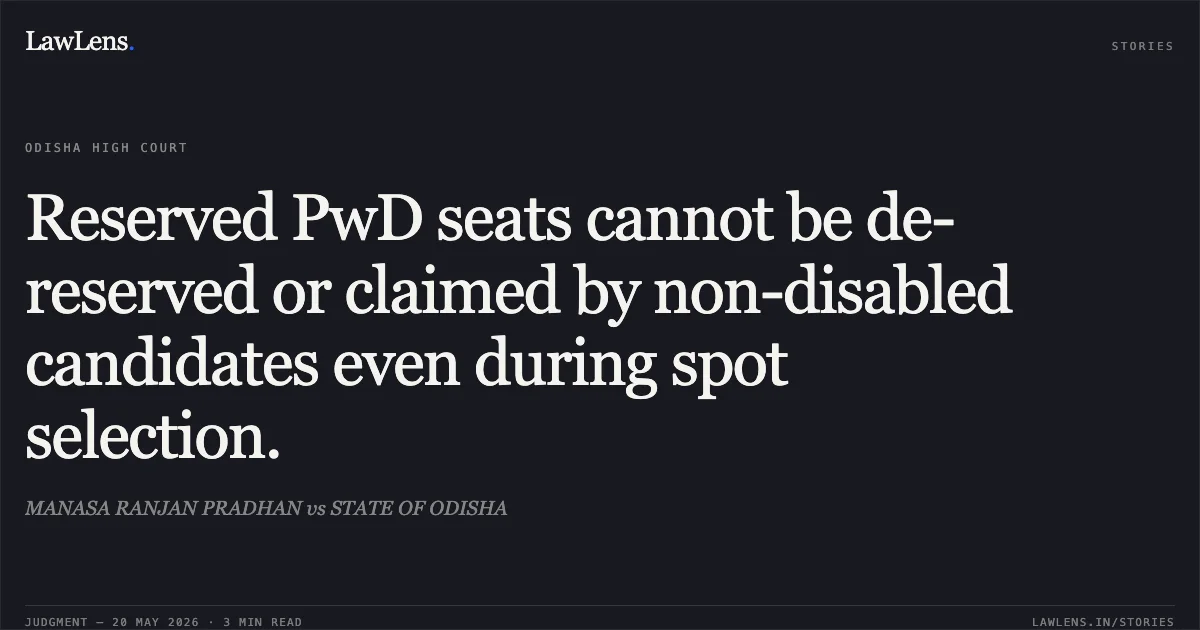
The court held that the Petitioner, being a non-PwD candidate, had no legal right to claim a seat reserved for the PwD category, regardless of his higher entrance marks
The court answered that the PwD reservation persists even during spot selection
Source reference: p.9Consequently, the court found no illegality in the admission of O.P. No. 5. The writ petition was dismissed on contest, and the prayer for cancellation of O.P. No. 5’s admission was rejected
Source reference: p.12Acts & Sections Cited
1 provisions across 1 statute referred to in this judgment. Linked provisions open on LawLens.
Right to Information Act, 20051
Original Court PDF
MANASA RANJAN PRADHANvsSTATE OF ODISHA
Click to open original judgment
Original judgment, available to read, download and summarize on LawLens.in