Facts
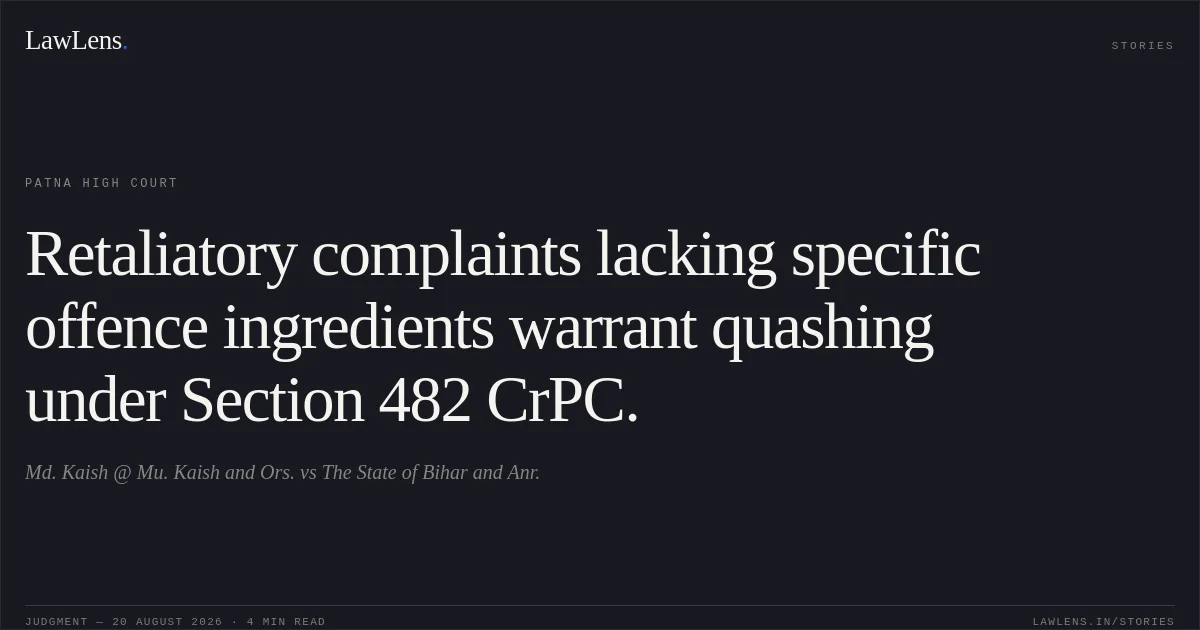
Opposite Party No. 2 filed Complaint Case No. 741C of 2017 alleging that the accused, allegedly acting in conspiracy with police and medical officials, fabricated Bettiah Nagar P.S. Case No. 719 of 2015, prepared a false injury report, ante-dated the fardbeyan, and conducted an illegal investigation to pressurise the complainant and his family to compromise earlier criminal cases.
Source reference: paras. 2–5; pp. 2–3The earlier police case had been investigated, charge-sheeted, and taken to trial; two of the complainant’s brothers were convicted, while the complainant himself was acquitted.
Source reference: para. 4; p. 3After an inquiry under Section 202 Cr.P.C., the Chief Judicial Magistrate took cognizance on 16 May 2018 of offences under Sections 420, 467, 471 and 120-B IPC against the petitioners and other accused persons.
Source reference: paras. 2, 5; pp. 2–3The petitioners sought quashing of the cognizance order and the consequential criminal proceedings under Section 482 Cr.P.C.
Source reference: para. 2; p. 2Issues
Whether the allegations in the complaint, taken at their face value, disclosed the ingredients of offences under Sections 420, 467, 471 and 120-B IPC against the petitioners?
Source reference: paras. 6, 19–20; pp. 3, 14–15Whether continuation of the complaint proceeding, founded substantially on allegations challenging the investigation and prosecution in the earlier police case, amounted to an abuse of the process of the Court and warranted quashing under Section 482 Cr.P.C.?
Source reference: paras. 6, 9, 11, 16–22; pp. 3, 6, 11, 14–16Law Applied
The Court applied Section 482 Cr.P.C., which preserves the High Court’s inherent power to prevent abuse of the process of any court and secure the ends of justice.
Source reference: para. 7; p. 3Relying principally on State of Haryana v. Bhajan Lal, 1992 Supp (1) SCC 335, and Indian Oil Corpn. v. NEPC India Ltd., (2006) 6 SCC 736, the Court reiterated that a complaint may be quashed where, even accepting its allegations in full, no offence is prima facie made out, the allegations are inherently improbable, or the proceeding is manifestly mala fide and instituted for an ulterior purpose; however, Section 482 must not be used to conduct a mini-trial or stifle a legitimate prosecution.
Source reference: paras. 7–8; pp. 3–6The Court further relied on State of Karnataka v. L. Muniswamy, (1977) 2 SCC 699, Naresh Aneja @ Naresh Kumar Aneja v. State of U.P., (2025) 2 SCC 604, Marippan v. State, 2025 SCC OnLine SC 364, and Anukul Singh v. State of U.P., 2025 SCC OnLine SC 2060, for the principle that persons should be protected from vexatious or retaliatory criminal prosecution.
Source reference: paras. 8–10, 17–18; pp. 4–8, 12–14The Court also invoked the principle that an appeal is a continuation of the trial, as recognised in Vishnu Kumar Gupta v. State of Madhya Pradesh, 2026 SCC OnLine SC 1443, making appellate proceedings the appropriate mechanism for challenging the earlier trial and its evidentiary findings.
Source reference: paras. 11–12; pp. 8–10Reasoning
The Court found that the complaint’s entire foundation was the assertion that the earlier police case had been fabricated, rather than a distinct and independently pleaded act of cheating, forgery, use of forged documents, or conspiracy by each petitioner.
Source reference: paras. 11, 13, 19; pp. 8–11, 14–15The earlier case had already undergone investigation and a full trial, during which the complainant had the opportunity to challenge the evidence, including the testimony of the investigating officer, witnesses and medical officer, through cross-examination.
Source reference: para. 11; pp. 8–9Any grievance concerning the investigation, injury report, alteration of offences, or evidentiary findings was required to be pursued in the proceedings arising from that case, including by appeal, and could not be converted into a fresh criminal prosecution on substantially the same facts.
Source reference: paras. 11–14; pp. 8–11The allegations against the petitioners were also found to lack the specific factual foundation necessary for Sections 420, 467 and 471 IPC, while the allegation of conspiracy lacked particulars demonstrating a meeting of minds.
Source reference: paras. 15, 19; pp. 11, 14–15The chronology and retaliatory character of the complaint supported the conclusion that the proceeding was instituted to reopen or re-litigate the earlier criminal case and thereby constituted an abuse of process.
Source reference: paras. 16–22; pp. 11–16Holding
The Court held that the complaint did not prima facie establish the offences under Sections 420, 467, 471 or 120-B IPC against the petitioners and that its continuation would amount to an abuse of the process of the Court.
Accordingly, the order dated 16 May 2018 taking cognizance in Complaint Case No. 741C of 2017, insofar as it concerned the petitioners, was set aside, and the entire consequential criminal proceeding against them was quashed under Section 482 Cr.P.C.
Source reference: para. 24; p. 17Opposite Party No. 2 was directed to deposit ₹1,00,000 with the District Legal Services Authority, West Champaran, Bettiah, within six weeks; in default, the amount was to be recovered as arrears of land revenue.
Source reference: paras. 25–27; p. 17The applications were allowed in those terms.
Source reference: para. 28; p. 18Acts & Sections Cited
7 provisions across 2 statutes referred to in this judgment. Each provision opens on LawLens.
Indian Penal Code, 18603
Code of Criminal Procedure, 19734
Original Court PDF
Md. Kaish @ Mu. Kaish and Ors.vsThe State of Bihar and Anr.
Click to open original judgment
Original judgment, available to read, download and summarize on LawLens.in