Facts
The parties asserted competing claims over land comprising Plot Nos. 1232, 1233 and 1234 at Sareya, Gopalganj, with the dispute centring on possession, a boundary wall and a gate.
Source reference: no citationThe petitioners claimed through registered sale deeds executed in 2015 by purchasers from 1983; opposite party No. 2 claimed through a separate chain of conveyances, including a purchase in 2016
Source reference: paras. 24–27; pp. 8–10After petitioner No. 1 lodged a police case concerning damage to the boundary wall, opposite party No. 2 filed the complaint at issue on 21 June 2016.
Source reference: paras. 3, 28–31; pp. 2, 10–11The Magistrate recorded the complainant’s solemn affirmation and examined inquiry witnesses, then took cognizance under IPC Sections 147, 148, 323, 504, 384 and 427/34 on 29 September 2016
Source reference: paras. 3, 28–31; pp. 2, 10–11The petitioners sought quashing under Section 482 CrPC, contending that the complaint was a retaliatory attempt to criminalise a civil property dispute
Source reference: paras. 4–12; pp. 3–5Issues
1. Whether the complaint and inquiry materials disclosed criminal offences warranting continuation of proceedings, or instead concerned a civil dispute over land, possession and boundaries
Source reference: paras. 23–27, 32–33; pp. 8–122. Whether the complaint was manifestly retaliatory or malicious, so that quashing was warranted under Section 482 CrPC
Source reference: paras. 29–36, 41–45; pp. 10–17Law Applied
Section 482 CrPC empowers the High Court to prevent abuse of the process of a court and secure the ends of justice, but the power is to be exercised sparingly
Source reference: paras. 1, 20; pp. 1, 7Under State of Haryana v. Bhajan Lal, 1992 Supp. (1) SCC 335, quashing may be appropriate, among other cases, where allegations are inherently improbable (category 5) or proceedings are manifestly mala fide and instituted to wreak vengeance (category 7)
Source reference: para. 43; pp. 16–17The judgment also relied on authorities including Indian Oil Corporation v. NEPC India Ltd., Inder Mohan Goswami v. State of Uttaranchal, Ganga Dhar Kalita v. State of Assam, Sarbjit Kaur v. State of Punjab, Shailesh Kumar Singh v. State of Uttar Pradesh, Ankul Singh v. State of Uttar Pradesh and Eicher Tractor Ltd. v. Harihar Singh for the principles that criminal proceedings should not be used to pressure parties in civil disputes or as a means of private retaliation
Source reference: paras. 37–42; pp. 13–16Reasoning
The Court viewed the parties’ competing conveyances and the disagreement over the boundary wall and gate as the central controversy, noting that a title suit was pending between them
Source reference: paras. 24–27, 32–33; pp. 8–12It found that the complaint followed shortly after petitioner No. 1’s police case and treated the timing, together with opposite party No. 2’s subsequent complaint, as evidence that the prosecution was retaliatory
Source reference: paras. 28–36; pp. 10–12On that basis, the Court concluded that continuation of the criminal case would constitute an abuse of process within the principles in Bhajan Lal
Source reference: paras. 41–44; pp. 15–17Holding
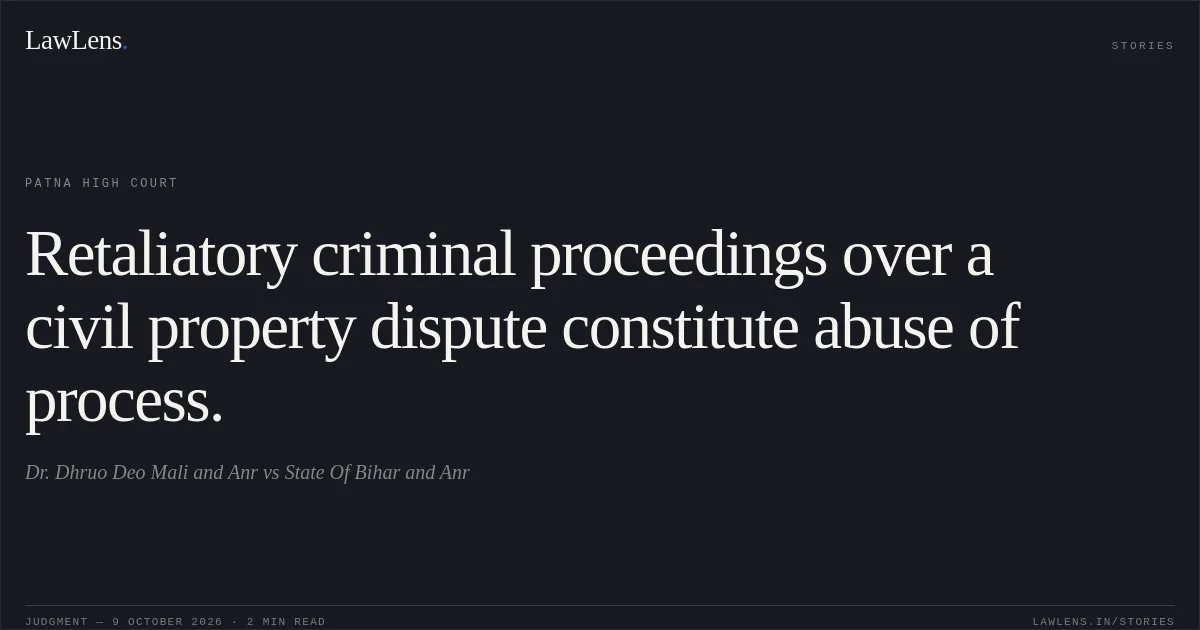
The Court held that the prosecution against the petitioners was vexatious and retaliatory, and that the cognizance order was legally unsustainable
It quashed the order dated 29 September 2016 taking cognizance under IPC Sections 147, 148, 323, 504, 384 and 427/34, and quashed the consequential criminal proceedings qua the petitioners.
Source reference: paras. 45–48; p. 18The application was allowed
Source reference: paras. 45–48; p. 18Acts & Sections Cited
13 provisions across 2 statutes referred to in this judgment. Each provision opens on LawLens.
Code of Criminal Procedure, 19732
Original Court PDF
Dr. Dhruo Deo Mali and AnrvsState Of Bihar and Anr
Click to open original judgment
Original judgment, available to read, download and summarize on LawLens.in