Facts
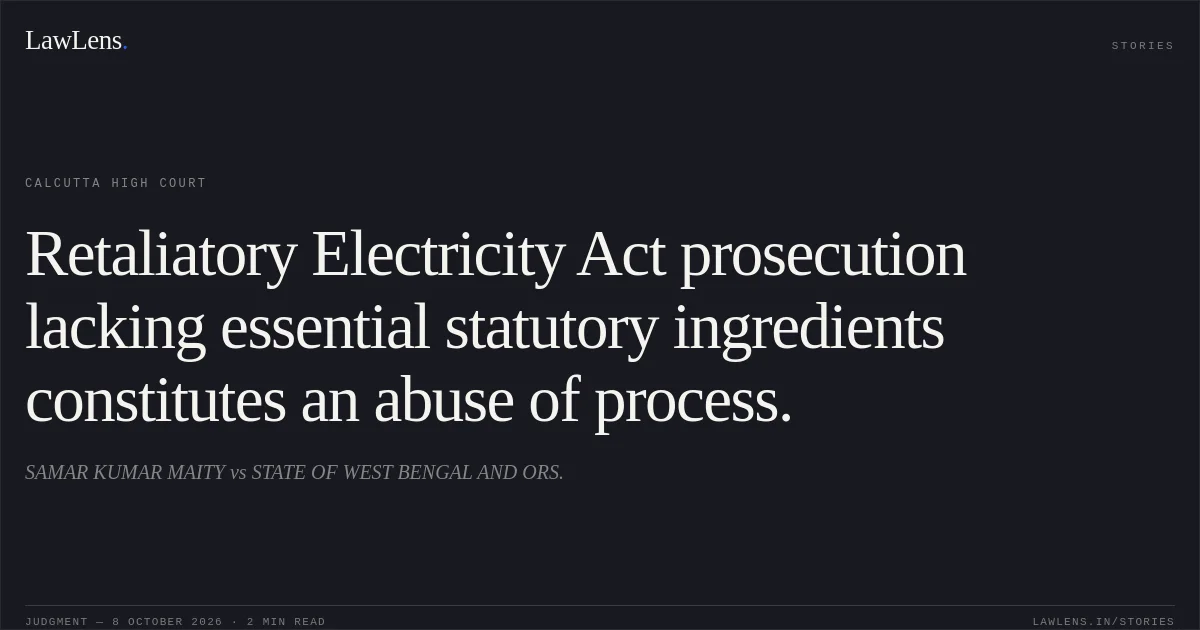
The petitioner challenged Chandipur P.S. Case No. 334 of 2022 and the resulting Sessions Case (Elec.) No. 856 of 2022, in which cognizance had been taken under Sections 136(1)(a), 136(1)(b) and 139 of the Electricity Act, 2003.
Source reference: paras. 2–4The prosecution alleged that he damaged an 8-metre PCC electricity pole during construction.
Source reference: paras. 2–4The petitioner relied on a written complaint to WBSEDCL dated 9 December 2016, stating that the pole was already damaged, and argued that the FIR was retaliatory because it was lodged on 15 September 2022, the day he escalated a separate electricity-supply grievance to a senior WBSEDCL official.
Source reference: paras. 2–4He also relied on a 2023 judgment directing restoration of the temple’s electricity connection.
Source reference: paras. 2–4The State opposed quashing, submitting that the pole’s condition and the circumstances of its damage were factual matters for trial.
Source reference: para. 7Issues
Whether the criminal proceeding arising from Chandipur P.S. Case No. 334 of 2022 disclosed the essential ingredients of the invoked offences and was free from mala fides, or instead constituted an abuse of process warranting quashing under Section 482 CrPC.
Source reference: para. 8Law Applied
The Court considered Sections 136 and 139 of the Electricity Act, 2003, treating them as requiring the relevant prohibited conduct involving electricity-supply materials and, as applicable, dishonest, malicious or culpably negligent conduct.
Source reference: para. 9It applied the principles in State of Haryana v. Bhajan Lal, under which proceedings may be quashed where they are manifestly mala fide or instituted with an ulterior motive to wreak vengeance, and Mahmood Ali v. State of Uttar Pradesh, concerning allegations that are absurd or inherently improbable.
Source reference: para. 11The Court also referred to R.P. Kapur v. State of Punjab on the exercise of inherent powers where criminal proceedings are unsustainable.
Source reference: para. 6Reasoning
The Court considered the petitioner’s 2016 written complaint that the pole was already damaged, together with the timing of the 2022 FIR—lodged hours after he raised a grievance against local WBSEDCL officials with the Regional Manager.
Source reference: para. 10It found these circumstances inconsistent with the allegation that the petitioner had damaged the pole in 2022 and indicative of a retaliatory prosecution.
Source reference: paras. 10–12The Court further regarded the earlier writ judgment concerning restoration of the temple’s electricity connection as supporting the petitioner’s bona fides.
Source reference: paras. 10–12It concluded that continuing the prosecution would amount to an abuse of process.
Source reference: paras. 10–12Holding
The Court allowed the revision and quashed Chandipur P.S. Case No. 334 of 2022, the corresponding Sessions Case (Elec.) No. 856 of 2022, and all consequential orders against the petitioner.
It also discharged him from his bail-bond liabilities, if any, and made no order as to costs.
Source reference: paras. 13–18Acts & Sections Cited
3 provisions across 2 statutes referred to in this judgment. Each provision opens on LawLens.
Electricity Act, 20032
Code of Criminal Procedure, 19731
Original Court PDF
SAMAR KUMAR MAITYvsSTATE OF WEST BENGAL AND ORS.
Click to open original judgment
Original judgment, available to read, download and summarize on LawLens.in