Facts
The applicant retired as a Senior Section Engineer from Northern Railway on 31.07.2021
Source reference: p. 2Following his retirement, the respondents issued orders on 30.07.2021 and 09.08.2021 withholding his Gratuity (Rs. 17,74,224) and Commuted Value of Pension (Rs. 17,24,674) to cover alleged stock deficiencies totaling approximately Rs. 33,03,735
Source reference: p. 3, 6These deficiencies arose from Stock Sheet No. 16 (dated 19.07.2010) and a subsequent shortage of 52 kg rails valued at Rs. 4,02,364
Source reference: p. 4, 6The applicant contended that the discrepancies were reconciled and that the Divisional Engineer (Track) had certified no financial loss to the Railway
Source reference: p. 2, 8The respondents maintained that the Accounts Department found the applicant’s explanations unsatisfactory, the stock ledgers were often unavailable due to vigilance probes, and the applicant had formally acknowledged the shortages
Source reference: p. 4-5, 9Issues
1. Whether the respondents have the authority to withhold gratuity and commuted value of pension (CVP) in the absence of formal disciplinary or criminal proceedings at the time of retirement
Source reference: p. 7-8, para 152. Whether the withholding of retiral benefits for the recovery of government dues (stock shortages) under Rule 15 of the Railway Services (Pension) Rules, 1993, is legally sustainable
Source reference: p. 11-12, para 23Law Applied
Rule 15 of the Railway Services (Pension) Rules, 1993, which empowers the government to assess and recover "government dues"—including losses caused by store shortages—from the retirement gratuity of an employee even without the pendency of a formal charge-sheet
Source reference: p. 6, 11-12The principle established in Chairman, Board of Mining Examination and Chief Inspector of Mines v. Ramjee (AIR 1977 SC 965), which holds that the principles of natural justice are flexible and depend on the specific facts and circumstances of each case
Source reference: p. 7, 12Reasoning
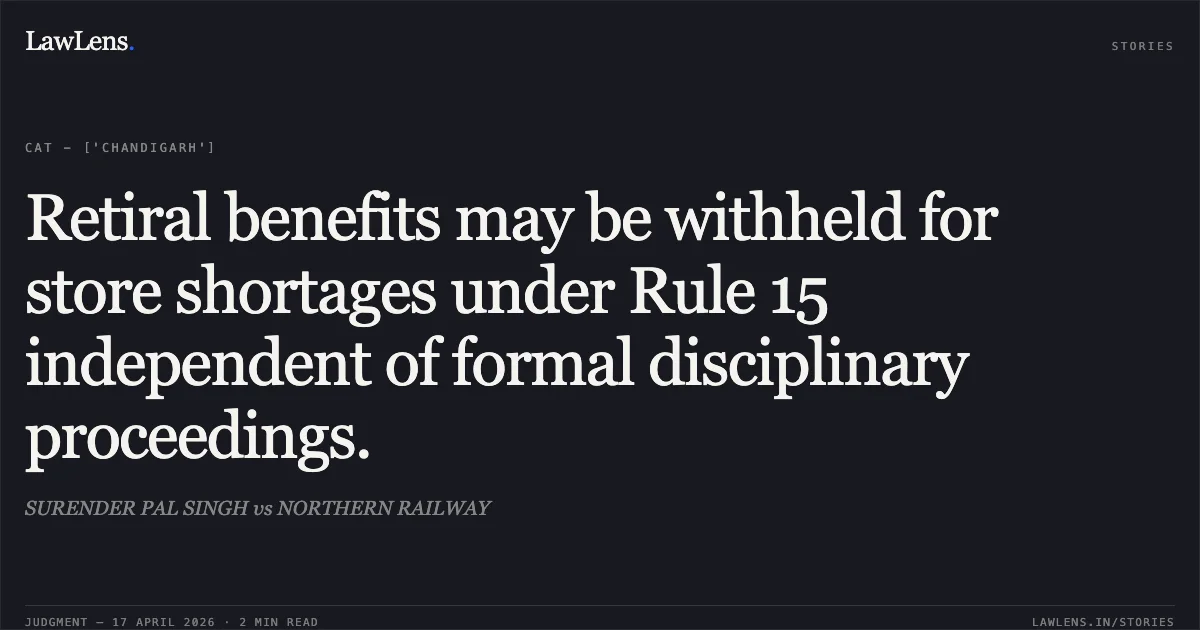
The Tribunal found that Rule 15 serves as an independent statutory framework that does not require the initiation of a formal disciplinary inquiry as a prerequisite for invoking recovery for store shortages
Source reference: p. 11-12, para 23While the applicant relied on a certificate from the Engineering Department claiming "technical" reconciliation, the Tribunal noted that the Accounts Department—the competent financial authority—had consistently rejected these explanations as unsatisfactory across a decade of correspondence
Source reference: p. 9-10, para 17-18The court observed that the applicant had explicitly acknowledged the deficiencies in 2010 and again during a 2021 inquiry regarding rail shortages
Source reference: p. 9-10Regarding natural justice, the Tribunal determined that since the applicant was engaged in correspondence regarding these shortages for several years (2013–2021), he was afforded sufficient opportunity to contest the claims
Source reference: p. 12, para 24Consequently, the quantification of dues by the Senior Divisional Engineer (Sr. DEN) just prior to retirement provided a valid legal basis for the withholding
Source reference: p. 11, para 22Holding
The Tribunal dismissed the Original Application, holding that the action of the respondents was in accordance with the Railway Services (Pension) Rules, 1993
The court ruled that the respondents were justified in withholding the applicant’s gratuity and commuted value of pension because the stock discrepancies and resulting government dues remained unresolved at the time of his superannuation
Source reference: p. 12-13Acts & Sections Cited
1 provisions across 1 statute referred to in this judgment. Each provision opens on LawLens.
Administrative Tribunals Act, 19851
Original Court PDF
SURENDER PAL SINGHvsNORTHERN RAILWAY
Click to open original judgment
Original judgment, available to read, download and summarize on LawLens.in


![Subsequent exoneration does not retrospectively invalidate a finalized promotion select list.. UNNIKRISHNAN M vs M/o Environment And Forests. CAT - ['Ernakulam']. LawLens](/stories/thumbnails/subsequent-exoneration-does-not-retrospectively-invalidate-a-finalized-promotion-select-li-ce80a0e84f2f4887857271e8b4341c42.webp)