Facts
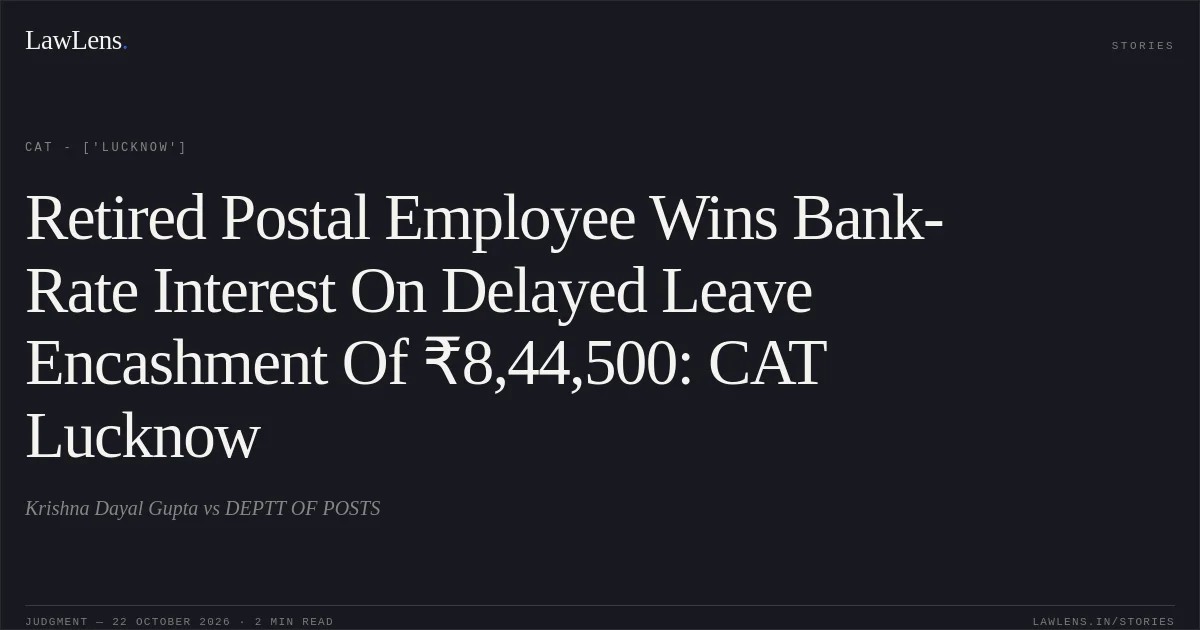
The applicant retired on 30 June 2021. After he did not receive his retirement benefits, he filed OA No. 376/2021.
Source reference: p. 1–2By order dated 12 January 2024, the Tribunal directed the respondents to finalize his pension and release retirement benefits, with interest on delayed payment at the rate and in the manner applicable to General Provident Fund under Rule 65 of the CCS (Pension) Rules, 2021.
Source reference: p. 1–2The respondents subsequently released his retirement dues, including leave encashment, which had been sanctioned by letter dated 3 October 2022.
Source reference: p. 2The applicant then sought interest on the delayed leave-encashment payment, claiming 12% per annum; the respondents argued that no provision authorized such interest.
Source reference: p. 1–2Issues
Whether interest is payable on delayed payment of leave encashment despite the absence of a specific provision for interest under the CCS (Leave) Rules.
Source reference: p. 2–4Whether the applicant was entitled to interest for the period between the date leave encashment became due and its actual payment.
Source reference: p. 4–5Law Applied
The Department of Pension & Pensioners’ Welfare Office Memorandum dated 1 May 2012 recorded that the CCS (Leave) Rules contained no specific provision for interest on delayed leave encashment, but did not prohibit such interest.
Source reference: p. 2–3The Tribunal applied S.K. Dua v. State of Haryana, (2008) 3 SCC 44, which recognizes that, even in the absence of statutory rules or administrative instructions, an employee may claim interest on delayed retiral benefits under Articles 14, 19 and 21 of the Constitution.
Source reference: p. 4It also followed the Delhi High Court’s decision in Narottam Singh Shami v. Govt. of NCTD & Ors., W.P.(C) No. 13129/2019, which held that delayed leave encashment may attract interest notwithstanding the absence of a specific statutory provision.
Source reference: p. 3–4Reasoning
The respondents relied on the absence of a specific provision for interest under the CCS (Leave) Rules. The Tribunal treated that absence as no bar to an interest claim, relying on the reasoning in Narottam Singh Shami and the principle in S.K. Dua that delayed retiral benefits are not a bounty and may attract interest even without a specific rule.
Source reference: p. 3–4Finding the controversy materially similar to those authorities, the Tribunal saw no reason to take a different view.
Source reference: p. 4Holding
The Tribunal allowed the OA and directed the respondents to pay the applicant interest on the delayed leave-encashment payment at the applicable bank rate, from the date the amount became due until its actual payment, within three months of receiving a certified copy of the order.
The parties were directed to bear their own costs, and the associated MAs were disposed of.
Source reference: p. 5Original Court PDF
Krishna Dayal GuptavsDEPTT OF POSTS
Click to open original judgment
Original judgment, available to read, download and summarize on LawLens.in