Facts
The petitioner superannuated from service on 31 October 2024. A charge-sheet was served on him on 15 May 2025, and, following General Court Martial proceedings conducted at Tibri Military Station, Punjab, he was found guilty of six charges on 8 October 2025 and sentenced to dismissal and seven years’ rigorous imprisonment.
Source reference: p. 1He filed Original Application No. 22 of 2026 before the Armed Forces Tribunal, Mumbai Bench, challenging the charge-sheet and the court-martial outcome. The Tribunal dismissed the application for lack of territorial jurisdiction, holding that neither the relevant events nor the petitioner’s posting or attachment fell within the Mumbai Bench’s jurisdiction. The petitioner challenged that dismissal in the High Court.
Source reference: pp. 2–3; p. 1Issues
Whether the Mumbai Bench of the Armed Forces Tribunal had territorial jurisdiction to entertain the petitioner’s application under Rule 6(2) of the Armed Forces Tribunal (Procedure) Rules, 2008, notwithstanding that the cause of action and his service postings were outside its territorial limits.
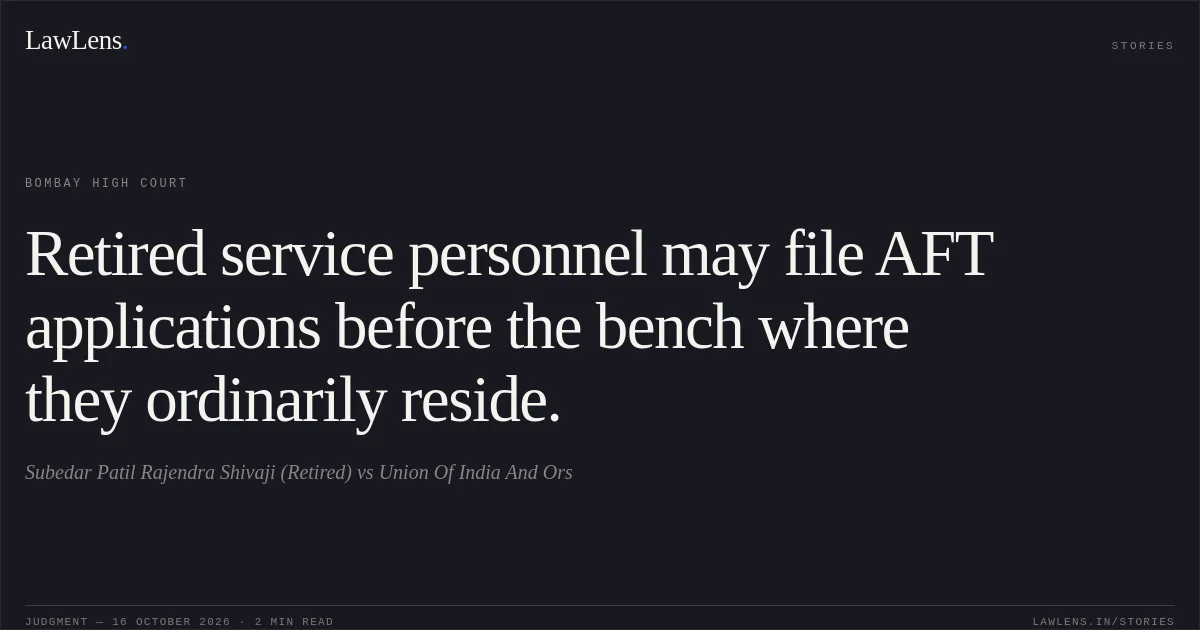
Source reference: pp. 3–5Whether the Tribunal’s dismissal of the application could stand when it had not considered Rule 6(2), which permits a person who has ceased to be in service to file an application before the Bench within whose jurisdiction that person ordinarily resides.
Source reference: pp. 4–5Law Applied
Section 14 of the Armed Forces Tribunal Act, 2007 confers jurisdiction on the Tribunal in relation to service matters, while Section 15 provides for appeals concerning court-martial orders, decisions, findings or sentences.
Source reference: p. 3Rule 6(1) of the Armed Forces Tribunal (Procedure) Rules, 2008 ordinarily links the place of filing to the applicant’s posting or attachment, or to where the cause of action wholly or partly arose. Rule 6(2), which begins with a non-obstante clause, independently gives a person who has ceased to be in service by retirement or other specified means the option to file before the Bench within whose jurisdiction that person ordinarily resides at the time of filing.
Source reference: pp. 4–5Reasoning
The Tribunal relied on Rule 6(1), finding that the incident occurred in Amritsar and the court-martial proceedings took place in Punjab, and that the petitioner’s relevant posting or attachment was outside Mumbai.
Source reference: p. 2The High Court held that this reasoning was incomplete because the petitioner had retired before filing the application and Rule 6(2) applied independently of Rule 6(1). As a retired person, the petitioner could exercise the option to file in the jurisdiction where he ordinarily resided at the time of filing; the Tribunal’s failure to consider that provision rendered its jurisdictional conclusion unsustainable.
Source reference: pp. 4–5; p. 5Holding
The High Court held that the Tribunal had erred in dismissing the application without applying Rule 6(2).
It quashed the Tribunal’s order dated 25 September 2026 and restored Original Application No. 22 of 2026 for adjudication on the merits. The petitioner was granted liberty to move the Tribunal for interim relief.
Source reference: p. 5; p. 6Acts & Sections Cited
2 provisions across 1 statute referred to in this judgment. Each provision opens on LawLens.
Armed Forces Tribunal Act, 20072
Original Court PDF
Subedar Patil Rajendra Shivaji (Retired)vsUnion Of India And Ors
Click to open original judgment
Original judgment, available to read, download and summarize on LawLens.in