01Facts
The petitioners were retired lecturers/teachers of Government-aided colleges in Haryana.
Teaching staff of Government Colleges, Government-aided Colleges and Universities had participated in a 36-day strike from 04.08.1987 to 08.09.1987.
The strike period had been treated as duty for teachers of Government Colleges and Universities, with consequential leave-encashment benefits.
After repeated representations, the Director of Higher Education, Haryana, issued communication dated 30.08.2022 extending the same benefit to retired employees of Government-aided colleges whose earned leave had earlier been sanctioned.
¶ 3–5Subsequently, the authorities directed that payment of leave encashment for the strike period be withheld.
¶ 6By order dated 21.07.2023, the 30.08.2022 decision was withdrawn, the strike period was again directed to be treated as leave of the kind due, and recovery was ordered where payment had already been made.
¶ 7The petitioners challenged the withdrawal order under Articles 226 and 227 of the Constitution.
¶ 202Issues
i.Whether the respondents could withdraw the benefit of leave encashment for the 36-day strike period after consciously extending that benefit to retired employees of Government-aided colleges through the communication dated 30.08.2022.
¶ 10, 13–15ii.Whether employees of Government-aided colleges were entitled to leave encashment for the strike period at par with employees of Government Colleges and Universities.
¶ 16–18, 22iii.Whether the respondents could direct recovery of amounts already paid pursuant to the withdrawn benefit.
¶ 2303Law Applied
The Court relied on the principle of parity in service conditions between employees of Government-aided colleges and their counterparts in Government Colleges.
In Dr. Karan Singh Rathee v. State of Haryana, CWP-3732-2001, decided on 20.08.2007, and Dr. K.L. Johar v. State of Haryana, CWP-12179-2011, decided on 10.11.2016, it was held that employees of privately managed Government-aided colleges are entitled to gratuity and leave encashment at par with Government College employees.
¶ 16, 17The Supreme Court’s decision in State of Rajasthan v. S.R. Higher Secondary School, Lachhmangarh, Civil Appeal No. 9166 of 2003, affirmed that service-condition provisions applicable to aided educational institutions should be construed to improve the conditions of teaching staff and that leave-encashment parity could not be unjustifiably denied.
¶ 17The State subsequently accepted this principle through its communication dated 14.08.2018.
¶ 18The Court also applied the principle in R.T. Rangachari v. Secretary of State, AIR 1937 Privy Council 27, that a decision taken by a competent authority after due consideration and acted upon cannot ordinarily be reopened without a lawful basis, such as fraud, misrepresentation, lack of jurisdiction or another legally recognized ground.
¶ 21Administrative withdrawal of an accrued benefit must therefore be supported by cogent and legally sustainable reasons.
¶ 2004Reasoning
The Court found that the communication dated 30.08.2022 was not an isolated or spontaneous administrative mistake; it followed several representations concerning a benefit already granted to similarly situated Government College employees.
¶ 13–15The State’s reliance on the earlier instructions dated 13.05.2002 and 19.09.2002 did not justify withdrawal because the State had subsequently recognized parity through its 14.08.2018 decision and had consciously extended the benefit to the petitioners in 2022.
¶ 14, 18–19.1The respondents neither addressed the 2018 policy nor identified any fraud, lack of jurisdiction, misrepresentation or other lawful ground invalidating the 2022 decision.
¶ 19.1, 21Since the petitioners had participated in the same strike as Government College employees and no rational basis for differential treatment was shown, denial of leave encashment violated the recognized principle of parity.
¶ 22Once the withdrawal itself was held unsustainable, the consequential direction for recovery also could not survive.
¶ 2305Holding
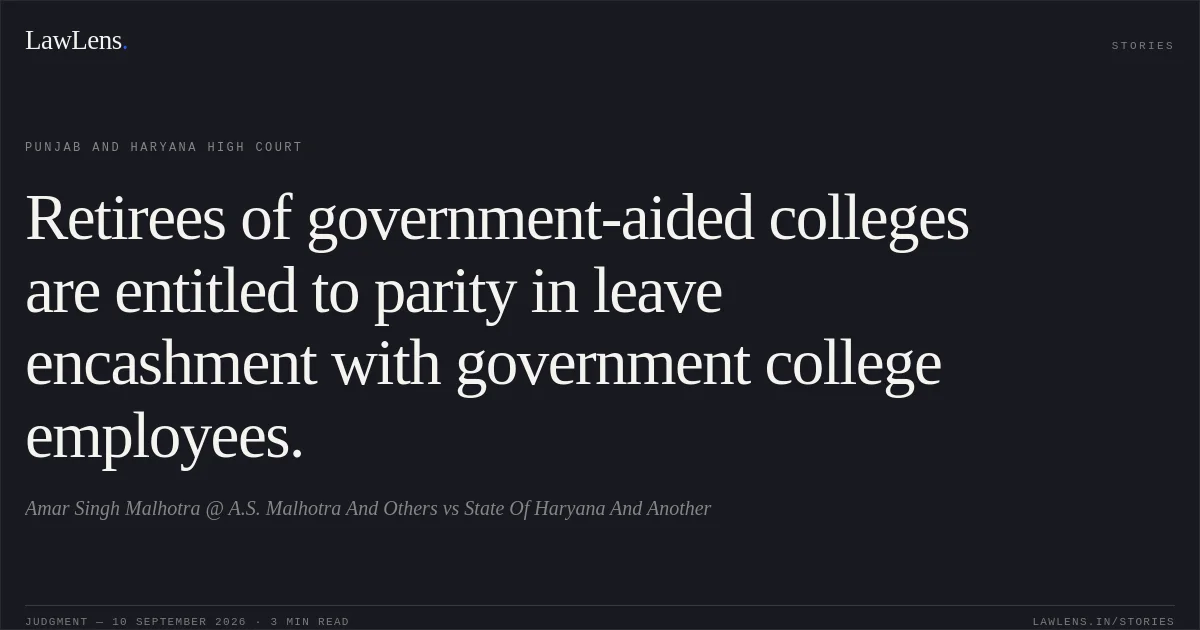
The Court allowed all three writ petitions and quashed the order dated 21.07.2023 insofar as it withdrew the leave-encashment benefit and directed recovery.
¶ 24–25The respondents were directed to treat the period from 04.08.1987 to 08.09.1987, comprising 36 days, as duty for the purpose of leave encashment and to release the consequential benefit in terms of the communication dated 30.08.2022.
¶ 25Any amount already recovered was ordered to be restored to the concerned petitioners.
¶ 26The monetary benefits were directed to be calculated and released within four months of receipt of a certified copy of the judgment, together with interest at 6% per annum from the date of filing of the respective writ petitions until actual payment.
¶ 27Original Court PDF
Amar Singh Malhotra @ A.S. Malhotra And OthersvsState Of Haryana And Another
Click to open original judgment
Original judgment, available to read, download and summarize on LawLens.in