Facts
The petitioner, formerly Secretary of the fourth-respondent Primary Agricultural Co-operative Credit Society, retired on 30 June 2025.
Source reference: no citationHis retirement benefits remained substantially unpaid despite representations.
Source reference: no citationIn an earlier writ petition, the High Court relegated him to the statutory revision remedy under Section 153 of the Tamil Nadu Co-operative Societies Act, 1983, following K. Marappan v. Deputy Registrar of Co-operative Societies, 2006 (4) CTC 689.
Source reference: para. 1; p.2The Registrar thereafter rejected effective relief on the ground that the Society was in financial crisis, had suffered a loss of approximately ₹3.69 crore, and could settle the petitioner’s benefits only according to seniority; the Registrar also observed that the petitioner and other employees were responsible for the loss.
Source reference: para. 1; pp.2–4The Society contended that it had substantial financial liabilities and that the petitioner, as Secretary, had contributed to the financial deterioration and had failed to settle the terminal benefits of earlier retirees.
Source reference: paras. 3–4; pp.5–7During the hearing, however, the Society acknowledged that ₹29,23,959 was payable to the petitioner, of which ₹4,45,000 had been paid, leaving ₹24,78,959 outstanding.
Source reference: para. 5; pp.7–8Issues
Whether the Registrar was justified in refusing immediate relief regarding the petitioner’s retirement benefits on the basis of the Society’s financial crisis and unsubstantiated allegations that the petitioner was responsible for its losses?
Source reference: paras. 8–9, 14; pp.9, 13–14Whether the Society could withhold or indefinitely defer payment of accrued retirement benefits without conducting an appropriate enquiry or initiating surcharge proceedings against the petitioner?
Source reference: paras. 8–9, 14; pp.9, 13–14Whether the Society’s undertaking regarding phased payment of the admitted outstanding amount should be accepted and recorded for disposal of the writ petition?
Source reference: paras. 5, 14–15; pp.7–8, 13–14Law Applied
The Court considered the statutory revision remedy under Section 153 of the Tamil Nadu Co-operative Societies Act, 1983, as recognized in K. Marappan v. Deputy Registrar of Co-operative Societies, 2006 (4) CTC 689.
Source reference: para. 1; p.2It applied Section 87 of the Act, which provides the mechanism for recovering losses attributable to an employee through surcharge proceedings; therefore, responsibility for a Society’s loss cannot be presumed merely from the employee’s designation or the existence of an audit loss.
Source reference: para. 9; p.9The Court also referred to the need for an enquiry under Section 81 before attributing the Society’s loss to the petitioner.
Source reference: para. 14; p.13It noted the petitioner’s reliance on S.K. Dua v. State of Haryana, 2008 (3) SCC 44, for the principle that delayed payment of retiral benefits may attract interest.
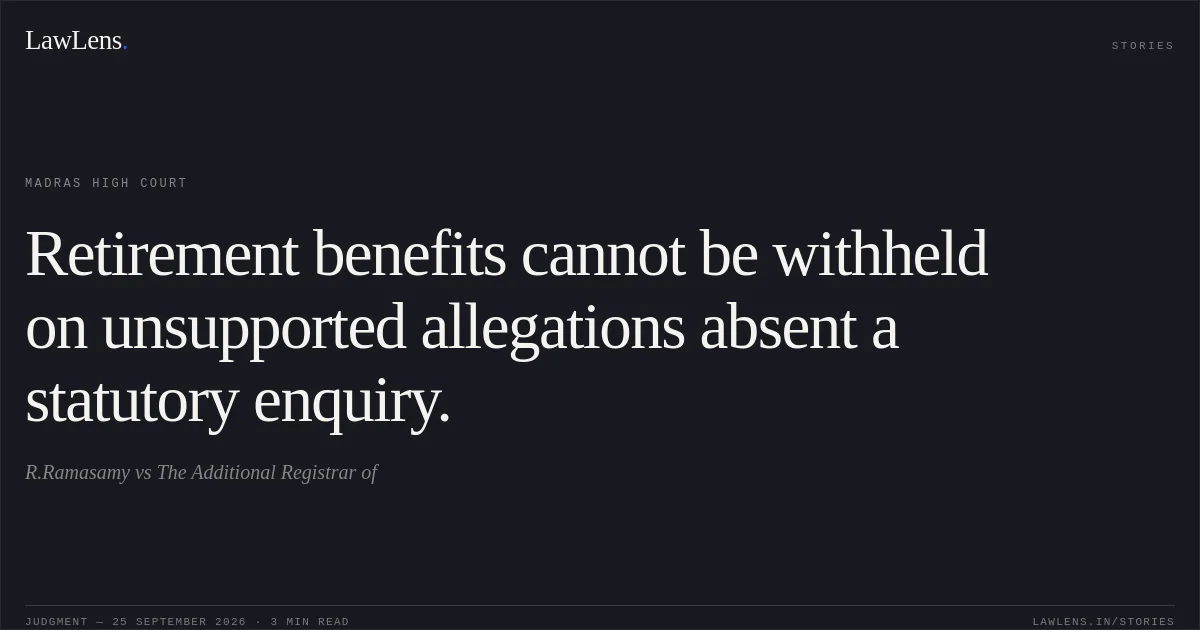
Source reference: para. 2; pp.4–5The Court further proceeded on the principle that accrued retirement benefits cannot be withheld on the basis of unsupported allegations, particularly where the employee retired without adverse remarks and no disciplinary or surcharge proceedings had been initiated.
Source reference: paras. 8–9, 14; pp.9, 13–14Reasoning
The Court found that the petitioner had retired without adverse remarks, yet nearly one year later the respondents alleged that he was responsible for the Society’s losses without producing an enquiry report, specific findings, or supporting material.
Source reference: para. 8; p.9The Society’s financial condition could explain difficulty in payment but did not establish a lawful basis for withholding the petitioner’s accrued benefits.
Source reference: no citationIf the petitioner had caused or contributed to the loss, the statutory procedure was to conduct an enquiry under Section 81 and pursue recovery through surcharge proceedings under Section 87; neither had been undertaken.
Source reference: paras. 9, 14; pp.9, 13The Court also observed that the supervisory authorities had failed to monitor the Society despite the non-payment of retirement benefits to earlier employees.
Source reference: para. 10; p.10Nevertheless, as the Society admitted the outstanding amount and placed a payment proposal before the Court, the Court considered it appropriate to dispose of the writ petition by recording that undertaking rather than order an immediate lump-sum payment.
Source reference: paras. 5, 14–15; pp.7–8, 13–14Holding
The Court held that the allegations attributing the Society’s losses to the petitioner were unsupported by any enquiry or statutory finding and could not, by themselves, justify denial of his retirement benefits.
The writ petition was disposed of by recording the fourth respondent Society’s undertaking to disburse the admitted balance of ₹24,78,959 in the proposed manner, including payments linked to realization of the LIC gratuity claim and other Society receipts, with the remaining amount to be paid progressively at approximately ₹4,00,000 per year, subject to the stated conditions.
Source reference: paras. 5, 14–15; pp.7–8, 13–14No costs were awarded, and the connected miscellaneous petition was closed.
Source reference: para. 15; p.14The Court also forwarded the order to the Government and the Registrar of Co-operative Societies, directing attention to the proper functioning and preservation of Primary Agricultural Co-operative Credit Societies.
Source reference: para. 16; p.14Acts & Sections Cited
3 provisions across 1 statute referred to in this judgment. Linked provisions open on LawLens.
Tamil Nadu Co-Operative Societies Act, 19833
Original Court PDF
R.RamasamyvsThe Additional Registrar of
Click to open original judgment
Original judgment, available to read, download and summarize on LawLens.in