Facts
The respondent-landlord leased premises to respondent No. 1, M/s AAA Hospitality, under a registered lease deed executed on the firm’s behalf by its authorised partner, Umesh Sharma.
Source reference: para. 5–6After Sharma retired and respondent Deepa Kumar joined the firm, appellants Anil Tarare and Ashok Kabra disputed their continuing liability for rent, electricity charges and mesne profits, asserting that Kumar had assumed exclusive control of the business and premises.
Source reference: para. 5–6The Trial Court decreed the claims against the firm and its partners, holding the appellants jointly and severally liable for dues incurred before and after Kumar’s induction, subject to specified limits on GST recovery.
Source reference: para. 5–6, 30–38The appellants challenged the decree, contending that the suit was defective for non-joinder of Sharma, that they had been absolved of liability after Kumar joined, and that they were unfairly denied an opportunity to lead evidence.
Source reference: para. 39–50Issues
1. Whether the suit was bad for non-joinder of former partner Umesh Sharma
Source reference: para. 52(i)2. Whether the appellants were absolved of liability to the landlord upon Deepa Kumar’s induction as a partner and their asserted withdrawal from the firm
Source reference: para. 52(ii)3. Whether closure of the appellants’ right to lead evidence, and refusal to recall that order, warranted appellate interference
Source reference: para. 52(iii)Law Applied
Order XXX Rule 1 CPC permits a partnership firm to sue or be sued in the firm name, without requiring every partner to be impleaded individually.
Source reference: para. 54Under Kasturi v. Iyyamperumal, (2005) 6 SCC 733, a necessary party is one against whom relief is sought and in whose absence no effective decree can be passed.
Source reference: para. 56Section 25 of the Partnership Act makes partners jointly and severally liable for acts of the firm.
Source reference: para. 34Section 31(2) limits an incoming partner’s liability for acts of the firm occurring before admission, absent agreement to the contrary.
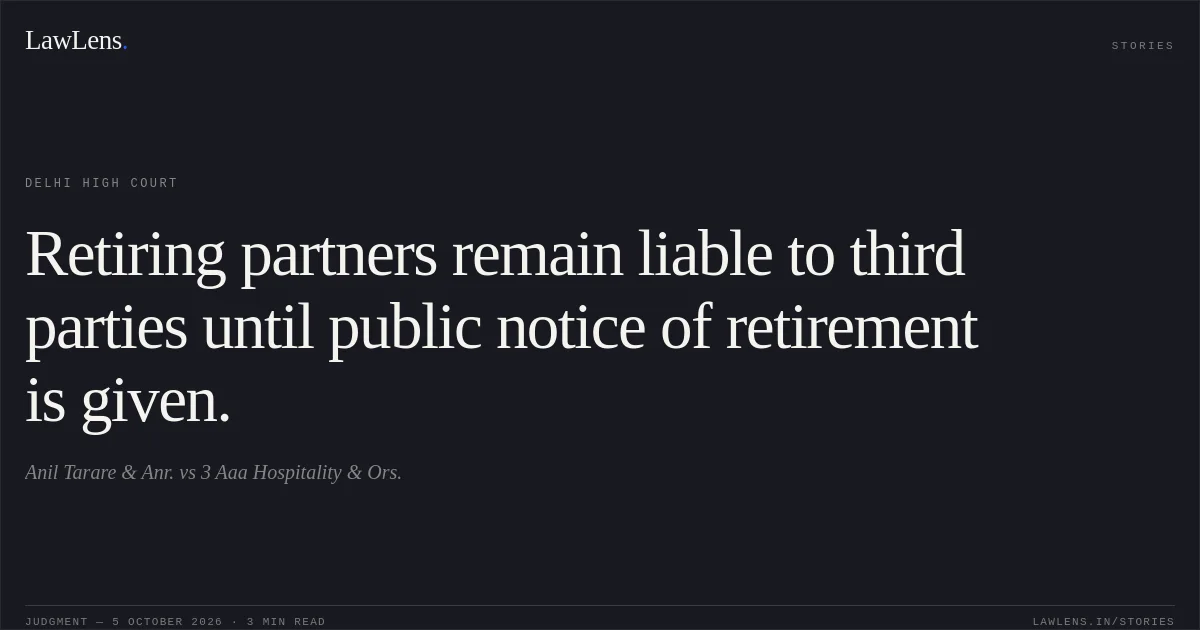
Source reference: para. 36Section 32(3) continues a retiring partner’s liability to third parties for firm acts until public notice of retirement is given.
Source reference: para. 67Internal arrangements among partners do not, without the creditor’s agreement, alter their liability to that creditor.
Source reference: para. 59, 65, 70Under Rafiq v. Munshilal, (1981) 2 SCC 788, protection for a litigant affected by counsel’s default is for the diligent litigant, not one who fails to ascertain the status of the case.
Source reference: para. 75Reasoning
Sharma signed the lease as the firm’s authorised representative, not in his individual capacity; the landlord could therefore sue the firm without impleading him, and the decree remained effective in his absence.
Source reference: para. 55–57The firm continued after Sharma’s retirement, with Kumar acquiring his share, while the appellants remained partners.
Source reference: para. 61–72The partnership deed’s operational allocation to Kumar did not exclude the appellants from financial and other firm matters, and in any event could not bind the landlord.
Source reference: para. 61–72The appellants’ proposed indemnity arrangement was not accepted by the landlord; nor did they give public notice of retirement, so their asserted withdrawal did not discharge their liability to the landlord.
Source reference: para. 61–72The appellants had multiple opportunities over several months to file evidence, and their proposed defences relied on documents already in evidence; accordingly, the closure caused no material prejudice.
Source reference: para. 74–76Holding
The Court held that the suit was not defective for non-joinder of Sharma, the appellants remained jointly and severally liable as partners for the firm’s relevant dues, and the refusal to reopen their evidence disclosed no error warranting interference.
The appeal was dismissed, and pending applications were disposed of.
Source reference: para. 78Acts & Sections Cited
11 provisions across 4 statutes referred to in this judgment. Each provision opens on LawLens.
Code of Civil Procedure, 19081
Indian Institutes of Information Technology (Public-private Partnership) Act, 20176
Negotiable Instruments Act, 18811
Indian Partnership Act, 19323
Original Court PDF
Anil Tarare & Anr.vs3 Aaa Hospitality & Ors.
Click to open original judgment
Original judgment, available to read, download and summarize on LawLens.in