Facts
The case pertains to the 2006 Malegaon bomb blasts that resulted in 31 deaths.
Source reference: p. 5Initially, the Maharashtra Anti-Terrorism Squad (ATS) and later the CBI investigated the matter, filing charge-sheets against 13 Muslim accused (A1 to A13), alleging they were SIMI members who used RDX stored in a godown.
Source reference: p. 8-9In 2011, the National Investigation Agency (NIA) took over the case and filed a supplementary charge-sheet projecting a contradictory theory: that the blasts were carried out by a different Hindu extremist group including the current appellants (A14 to A17).
Source reference: p. 10The NIA’s case relied primarily on a retracted confession by an individual named Aseemanand and disclosure statements/spot identifications made by the appellants six years after the incident.
Source reference: p. 11, 19The Special NIA Court framed charges against the appellants on September 30, 2025, under 19 heads, including the IPC, UAPA, and Explosive Substances Act.
Source reference: p. 4-5The appellants challenged this order seeking discharge.
Source reference: p. 12Issues
1. Whether there is sufficient admissible evidence on record to proceed with the trial against the appellants under Section 227/228 of the Cr.P.C.
Source reference: p. 5-6 / para. 42. Whether the NIA could conduct a de-novo/fresh investigation that completely contradicts the previous findings of the ATS and CBI.
Source reference: p. 13 / para. 103. Whether disclosure statements made in police custody and Test Identification Parades (TIP) conducted after a six-year delay hold sufficient probative value to frame charges.
Source reference: p. 14-16 / para. 12-13Law Applied
The Court applied the principles of discharge under Section 227 and framing of charge under Section 228 of the Cr.P.C., emphasizing that a Judge must not act as a "Post Office" but must sift evidence to ensure "sufficient ground" for proceeding.
Source reference: p. 6It relied on Vinay Tyagi v. Irshad Ali regarding the impermissibility of de-novo investigation under the guise of "further investigation".
Source reference: p. 13Sajjan Kumar v. CBI, which mandates that while the court doesn't conduct a mini-trial, it must discharge the accused if two views are possible and the evidence only gives rise to "suspicion" rather than "grave suspicion".
Source reference: p. 23Sections 25 and 26 of the Indian Evidence Act were applied to exclude confessions made to police, with Section 27 restricted only to the discovery of fresh facts unknown to the agency.
Source reference: p. 14, 20Reasoning
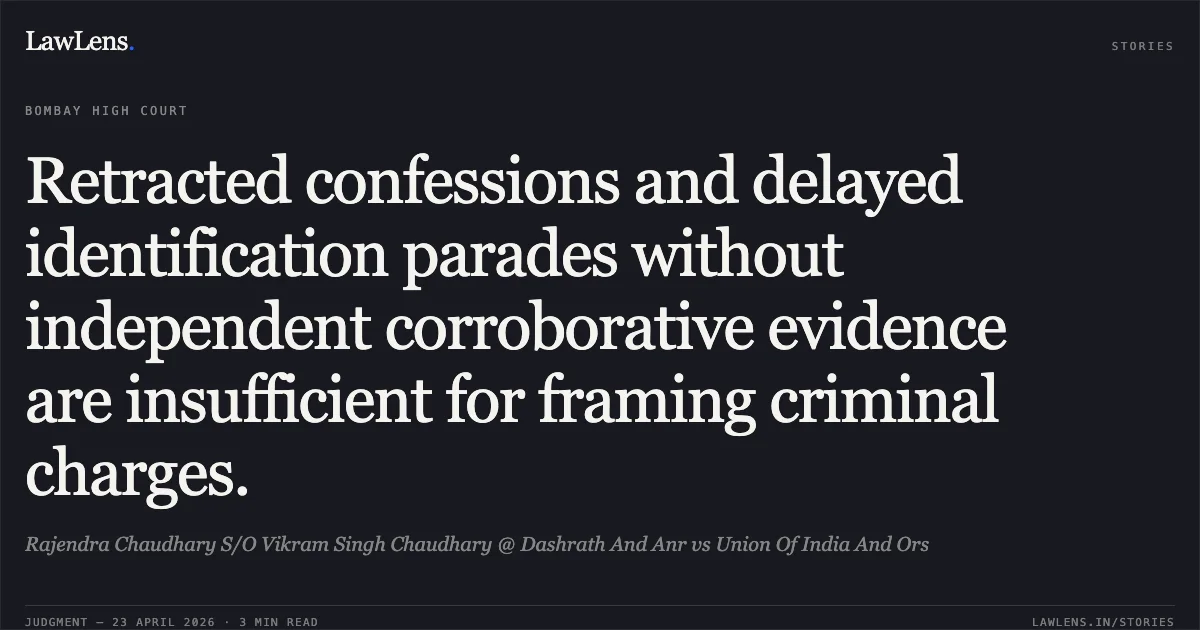
The Court found that the NIA’s "new story" was fundamentally flawed as it rested on inherently weak evidence. First, the NIA relied on disclosure statements to "discover" crime scenes and bicycle shops already known to previous agencies, which fails the test of Section 27 of the Evidence Act.
Source reference: p. 20The Test Identification Parade conducted six years after the incident was deemed to have zero probative value due to the extreme delay and lack of prior descriptive features provided by witnesses.
Source reference: p. 15-16The Court noted a fatal legal contradiction: the NIA relied on retracted statements of previous accused (A1-A13) to implicate the appellants, while the original forensic evidence (FSL reports matching RDX in A2’s godown) collected by the ATS still remained on record and directly contradicted the NIA's new theory.
Source reference: p. 17, 21The Court reasoned that a witness who provides two versions and retracts is unreliable, and the NIA failed to collect any "fresh" material, merely recycling hearsay and inadmissible custodial statements.
Source reference: p. 24Holding
The Court held that there was no "sufficient material" to proceed against the appellants as the NIA’s evidence was either inadmissible or lacked the "grave suspicion" required to sustain a charge.
The High Court allowed the appeals and set aside the order dated September 30, 2025. Consequently, the four appellants—Manohar Narwaria, Rajendra Chaudhary, Dhan Singh, and Lokesh Sharma—were discharged of all criminal liabilities.
Source reference: p. 24-25Acts & Sections Cited
35 provisions across 8 statutes referred to in this judgment. Each provision opens on LawLens.
National Investigation Agency Act, 20081
Code of Criminal Procedure, 19736
Indian Penal Code, 1860
Unlawful Activities (Prevention) Act, 1967
Maharashtra Control of Organised Crime Act, 19992
Passports Act, 19671
Original Court PDF
Rajendra Chaudhary S/O Vikram Singh Chaudhary @ Dashrath And AnrvsUnion Of India And Ors
Click to open original judgment
Original judgment, available to read, download and summarize on LawLens.in


![Subsequent exoneration does not retrospectively invalidate a finalized promotion select list.. UNNIKRISHNAN M vs M/o Environment And Forests. CAT - ['Ernakulam']. LawLens](/stories/thumbnails/subsequent-exoneration-does-not-retrospectively-invalidate-a-finalized-promotion-select-li-ce80a0e84f2f4887857271e8b4341c42.webp)