Facts
The petitioner, an Assistant Professor at JNU since 1988, was granted Extraordinary Leave (EOL) without pay starting July 3, 2012, to serve as a founding member of Shiv Nadar University (SNU).
Source reference: para. 2-4JNU issued an Office Order on April 3, 2012, permitting her to retain university accommodation during her EOL as per Rule 10.2 of the JNU House Allotment Rules.
Source reference: para. 7In June 2017, the University accepted the petitioner’s request for voluntary retirement with retrospective effect from July 3, 2012.
Source reference: para. 5She vacated the premises on September 29, 2017.
Source reference: para. 5Subsequently, the respondent issued demands (dated August 5, 2022, and April 11, 2023) seeking INR 32,97,814 as penal rent, arguing that her retrospective retirement rendered her occupation unauthorized.
Source reference: para. 1, 6Issues
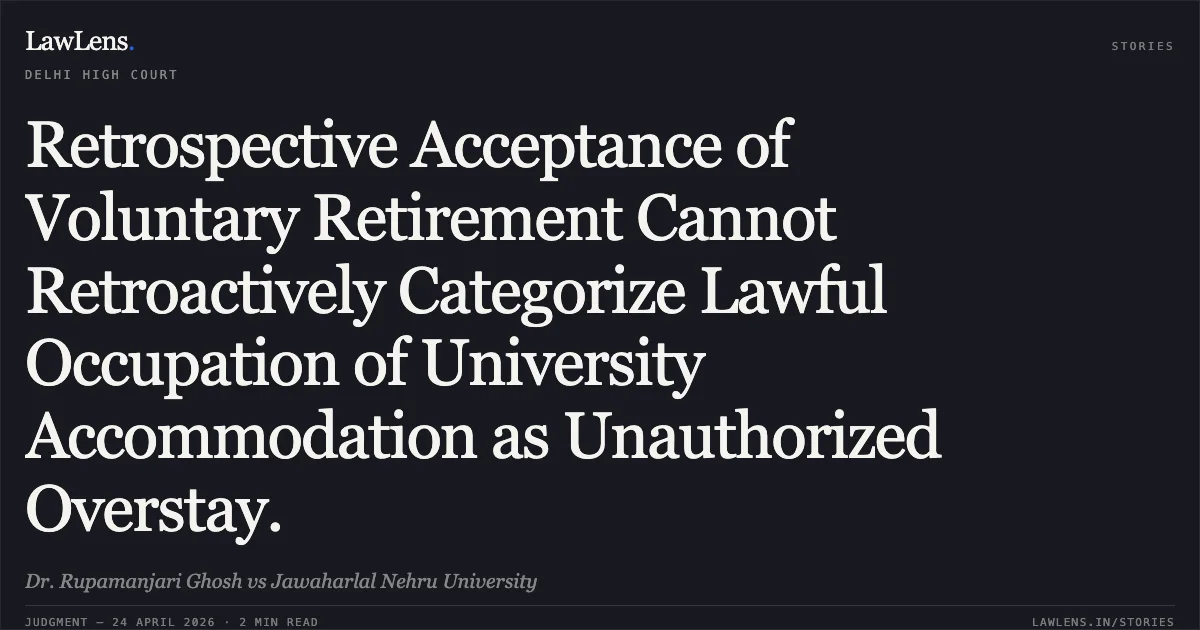
1. Whether the retrospective acceptance of voluntary retirement can legally convert a previously authorized occupation of university accommodation into an unauthorized one for the purpose of imposing penal rent.
Source reference: para. 9, 112. Whether the receipt of a Housing Rent Allowance (HRA) from a third-party employer (SNU) automatically triggers Rule 10.4 of the JNU House Allotment Rules regarding penal rent.
Source reference: para. 10Law Applied
The Court applied Rule 10.2(vii) of the JNU House Allotment Rules, which expressly permits an employee to retain university accommodation for the duration of a contract, assignment, or EOL.
Source reference: para. 8It further interpreted Rule 10.4, which mandates penal rent at double the market rate only for overstaying beyond permissible limits without prior approval.
Source reference: para. 6The Court also relied on the principle of vested rights, holding that an administrative act given retrospective effect cannot prejudice or alter a right (to accommodation) that was lawfully enjoyed under existing orders.
Source reference: para. 11-12Reasoning
The Court reasoned that the petitioner's stay was specifically authorized by the Office Order dated April 3, 2012, which granted her permission to occupy the residence during her EOL.
Source reference: para. 9Under Rule 10.2(vii), she had a valid legal right to occupy the premises until July 2, 2017.
Source reference: para. 8-9The Court found that the university could not use the "fiction" of retrospective retirement to retroactively categorize her stay as "unauthorized" under Rule 10.4.
Source reference: para. 11Regarding the HRA received from SNU, the Court noted that the impugned demand failed to show any rule where such acceptance would invalidate the authorization granted under the housing rules.
Source reference: para. 10Since the occupation was "lawful when enjoyed," it could not be transformed into a violation by a subsequent administrative act.
Source reference: para. 11-12Holding
The Court held that the demand for penal rent was unsustainable as the petitioner’s occupation was governed by a valid Office Order and Rule 10.2(vii).
The Court set aside the Office Orders dated August 5, 2022, and April 11, 2023. The petition was allowed, and the demand for INR 32,97,814 was quashed.
Source reference: para. 6, 13-14Original Court PDF
Dr. Rupamanjari GhoshvsJawaharlal Nehru University
Click to open original judgment
Original judgment, available to read, download and summarize on LawLens.in