Facts
Usha Rani was appointed as a Lower Division Clerk in Safdarjung Hospital in 1978 and promoted as an Upper Division Clerk in 1992. She received Second ACP benefits with effect from 21 July 2001. Following implementation of the VI Central Pay Commission, her pay was fixed at ₹10,700 in PB-2 with Grade Pay of ₹4,200 from 1 January 2006, and was subsequently revised to ₹12,090 with arrears. She was later granted third financial upgradation under the MACP Scheme with Grade Pay of ₹4,600 from 1 September 2008.
Source reference: pp. 2–3On 20 February 2017, the Petitioners retrospectively re-fixed her pay at ₹10,700 from 1 January 2006, allegedly pursuant to an error in pay fixation. Recovery of approximately ₹15,000 per month was initiated without prior notice or communication of the alleged overpayment.
Source reference: p. 3Usha Rani’s representations dated 11 January 2019 and 15 March 2019 were rejected by orders dated 31 January 2019 and 8 April 2019.
Source reference: p. 3The Central Administrative Tribunal, Principal Bench, allowed her Original Application, quashed the re-fixation and rejection orders, restrained recovery, and directed re-fixation of pay and pension with consequential benefits and arrears.
Source reference: pp. 1–2, 8–9The Union of India challenged that decision under Article 226 of the Constitution.
Source reference: p. 1Before the High Court, the Petitioners relied on audit objections dated 6 June 2017 and contended that the re-fixation complied with Rule 7 and Note 2A of the CCS (Revised Pay) Rules, 2008.
Source reference: p. 4They also argued that State of Punjab v. Rafiq Masih did not apply because recovery had commenced more than three years before retirement.
Source reference: p. 4Issues
1. Whether the Petitioners could retrospectively re-fix the Respondent’s pay and commence recovery without first issuing a show-cause notice and providing an opportunity of hearing.
Source reference: pp. 5–6, paras. 11–172. Whether a subsequent audit objection could justify or validate the unilateral reduction of pay and consequential recovery.
Source reference: pp. 4, 10–11, para. 183. Whether the restrictions on recovery laid down in State of Punjab v. Rafiq Masih and Thomas Daniel v. State of Kerala independently applied to the case.
Source reference: p. 11, para. 20Law Applied
The Court applied the principles of natural justice, particularly the rule that an administrative order producing adverse civil consequences—such as reduction of pay or recovery of amounts already paid—cannot ordinarily be passed without prior notice and an opportunity to show cause.
Source reference: pp. 6, 9–10, paras. 11, 14Relying on Bhagwan Shukla v. Union of India, (1994) 6 SCC 154, the Court held that retrospective reduction of an employee’s pay after the employee has been paid on the basis of an earlier fixation requires procedural fairness.
Source reference: pp. 6, 9–10, paras. 11, 14The Court also relied on the CAT’s reasoning in Malti Kathuria v. Union of India, which treated recovery based on an audit objection, without a prior show-cause notice, as legally unsustainable.
Source reference: pp. 6–9The Court noted the principles in State of Punjab v. Rafiq Masih (White Washer), (2015) 4 SCC 334, and Thomas Daniel v. State of Kerala concerning limitations on recovery of excess payments, but held that it was unnecessary to decide their independent application because the foundational re-fixation itself violated natural justice.
Source reference: pp. 4–5, 11, para. 20Rule 7 and Note 2A of the CCS (Revised Pay) Rules, 2008, relied upon by the Petitioners, did not dispense with the requirement of a prior opportunity of hearing where the proposed correction had adverse civil consequences.
Source reference: p. 4; paras. 15–18Reasoning
The High Court found that the re-fixation order dated 20 February 2017 directly reduced the Respondent’s established pay retrospectively and resulted in recovery of amounts already paid, and was therefore not a mere ministerial or clerical correction.
Source reference: p. 9, para. 14Since the Respondent had been drawing salary for several years on the basis of the earlier fixation, the action had clear civil and financial consequences.
Source reference: no citationThe Petitioners admittedly issued no show-cause notice setting out the alleged error, the basis of the proposed re-fixation, or the proposed recovery.
Source reference: p. 5, para. 12; p. 10, para. 15The later representations could not substitute for the pre-decisional hearing required by Bhagwan Shukla, because they were made only after the adverse decision had been taken and implemented.
Source reference: p. 10, paras. 16–17The Court further held that the audit objection dated 6 June 2017 could not authorise automatic reduction of pay or cure the denial of natural justice.
Source reference: no citationIt also noted the chronological anomaly that the re-fixation order preceded the audit objection by nearly four months, undermining the Petitioners’ contention that the order was based on that audit objection.
Source reference: p. 5, paras. 9–10Because the recovery flowed directly from the invalid re-fixation, it could not survive independently; it was a consequential action founded upon an order passed in breach of natural justice.
Source reference: pp. 10–11, paras. 18–21Holding
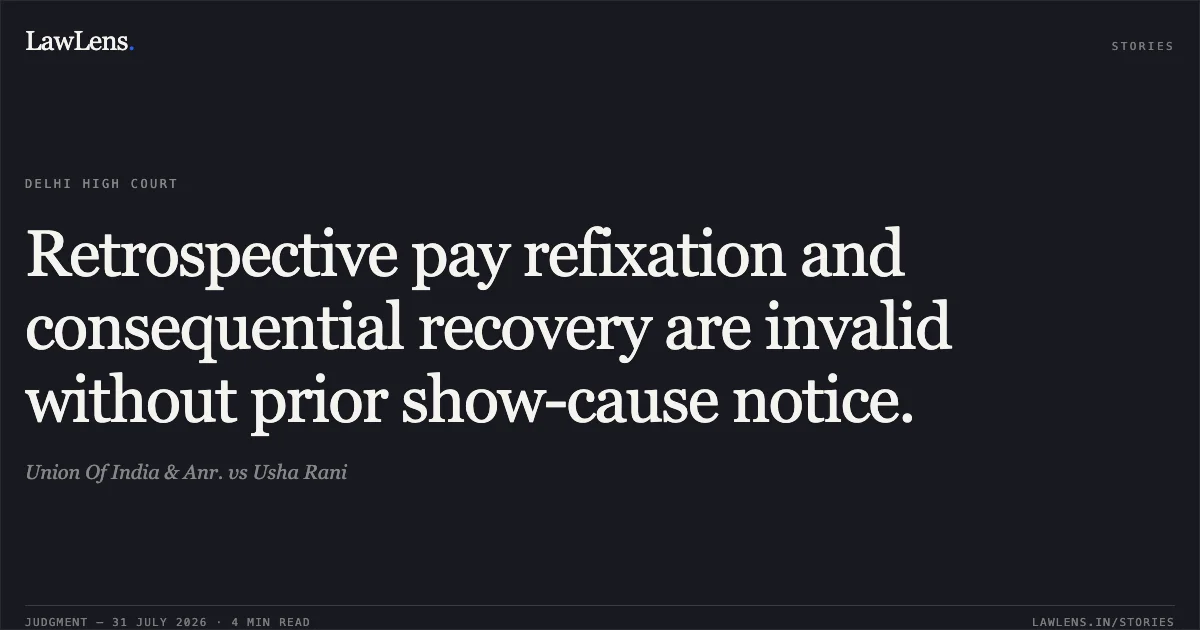
The Court answered the principal issue against the Petitioners and held that the Respondent’s pay could not be retrospectively reduced, nor recovery commenced, without a prior show-cause notice and meaningful opportunity of hearing.
The CAT’s order was upheld as free from legal infirmity.
Source reference: p. 9, para. 13; p. 11, para. 20The writ petition and pending applications were dismissed in limine.
Source reference: p. 12, para. 23Consequently, the orders dated 20 February 2017, 31 January 2019, and 8 April 2019 remained quashed; the Petitioners were required not to recover any amount and to undertake appropriate re-fixation of pay and pension with consequential benefits and arrears within three months, as directed by the CAT.
Source reference: pp. 8–9, para. 12; p. 12, para. 23Original Court PDF
Union Of India & Anr.vsUsha Rani
Click to open original judgment
Original judgment, available to read, download and summarize on LawLens.in


![Authorities must decide pensionary and retiral-benefit claims through a reasoned order within eight weeks.. Habibullah khan vs HOME DEPARTMENT. CAT - ['Srinagar']. LawLens](/stories/thumbnails/authorities-must-decide-pensionary-and-retiral-benefit-claims-through-a-reasoned-order-wit-d0cbe8a8119c48fbabe7df9f2d353488.webp)