Facts
The appellant was arrested on 14.04.2026 in a double-murder case and remanded to custody for offences under Sections 103, 109, 126(2), 191(2), 191(3) and 296(b) of the Bharatiya Nyaya Sanhita, 2023, and Sections 3(1)(r), 3(1)(s) and 3(2)(v) of the SC/ST (Prevention of Atrocities) Act.
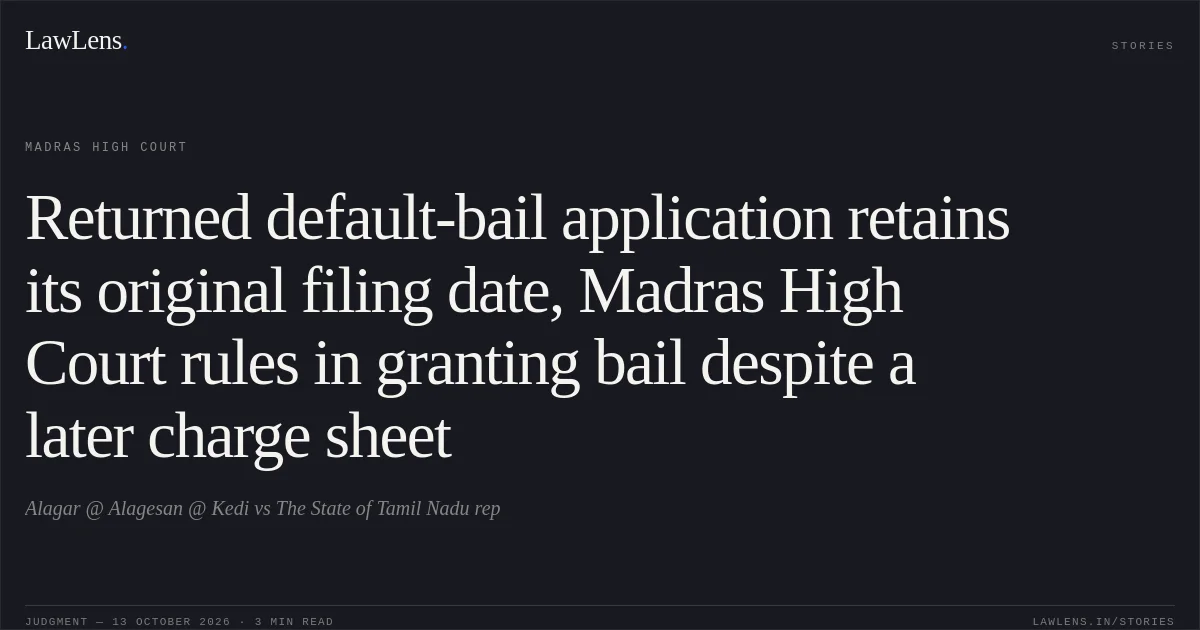
Source reference: pp. 2, 6He presented an application for statutory bail under Section 187(3)(i) of the BNSS on 17.07.2026, but it was returned for defects; it was re-presented on 25.08.2026. In the meantime, the final report was filed, and the trial court dismissed the application as not maintainable.
Source reference: pp. 6–7The appellant challenged that order under Section 14-A(2) of the SC/ST Act.
Source reference: p. 1Issues
Whether the appellant’s returned statutory-bail application, originally presented before the final report was filed, preserved his indefeasible right to default bail despite its later re-presentation.
Source reference: pp. 6–8, 22–23Whether the subsequent filing of the final report extinguished that right where the appellant had presented an application for statutory bail before the final report was filed.
Source reference: pp. 8–9, 22–23Law Applied
Section 187(3)(i) of the BNSS provides for release on bail where the investigation is not completed and the final report is not filed within the prescribed 90-day period.
Source reference: pp. 9–13The right to default bail is an indefeasible right arising upon expiry of the statutory period; under Uday Mohanlal Acharya v. State of Maharashtra, as quoted in Bikramjit Singh v. State of Punjab, the right is availed when the accused applies for bail and offers to furnish bail, and a later filing of the charge sheet does not defeat a right already availed.
Source reference: pp. 9–13Rakesh Kumar Paul v. State of Assam holds that, in matters of personal liberty, a written application is not indispensable and an oral application may suffice; the court should not adopt an unduly technical approach.
Source reference: pp. 7–8, 16–21The Court also relied on K. Muthirul v. Inspector of Police and Rahim v. State of Tamil Nadu in addressing the effect of re-presentation and the timing of a statutory-bail application.
Source reference: p. 22Reasoning
The Court found that the appellant had presented his statutory-bail application on 17.07.2026, before the final report was filed, and treated the later re-presentation of the returned application as relating back to its original presentation date once accepted and numbered.
Source reference: pp. 6–7, 22Applying the rule that the right is availed by applying for bail after the statutory period and offering to furnish bail, the Court held that the subsequent filing of the final report could not extinguish the right already accrued.
Source reference: pp. 7–9, 22–23It also rejected a technical approach to the returned application, relying on the principle that matters affecting personal liberty should not be decided on hyper-technical grounds.
Source reference: pp. 7–9, 22–23Holding
The Court held that the appellant had acquired an indefeasible right to statutory bail upon presentation of the application before the final report was filed, and that the later filing of the report did not defeat that right.
It set aside the trial court’s order dated 09.09.2026 and granted statutory bail, subject to a bond of Rs.20,000 with two sureties, identity and residence proof, an undertaking not to commit future offences, daily reporting before the trial court at 10.30 a.m. (subject to the stated exception), and the prosecution’s liberty to seek cancellation for breach of conditions.
Source reference: p. 23Acts & Sections Cited
8 provisions across 3 statutes referred to in this judgment. Each provision opens on LawLens.
Bharatiya Nyaya Sanhita, 20235
Bharatiya Nagarik Suraksha Sanhita, 20232
Code of Criminal Procedure, 19731
Original Court PDF
Alagar @ Alagesan @ KedivsThe State of Tamil Nadu rep
Click to open original judgment
Original judgment, available to read, download and summarize on LawLens.in