Facts
On 9 April 2021, at approximately 10:30 p.m., the appellant allegedly abused persons while passing through a residential lane.
Source reference: pp. 2–3; paras. 2–3When PW3 objected, the appellant threatened him, left the spot, returned shortly thereafter with a knife, and inflicted multiple stab injuries on PW3’s arm, chest and abdomen.
Source reference: pp. 2–3; paras. 2–3PW1, the injured’s brother, lodged the first information statement, on the basis of which FIR No. 157/2021 was registered at Police Station Shahbad Dairy.
Source reference: pp. 2–3; paras. 2–3PW1, PW2 and PW3 supported the prosecution version, while the medical evidence described the injuries as “dangerous”.
Source reference: pp. 8–16; paras. 15–20The appellant pleaded false implication and alleged that PW3 had harassed the wife of DW1.
Source reference: p. 4; para. 7The Sessions Court convicted him under Section 307 IPC, acquitted him under Section 174A IPC, and sentenced him to seven years’ rigorous imprisonment with a fine of ₹50,000.
Source reference: pp. 5–6; para. 10The appellant challenged the conviction and sentence, contending that the incident arose from a sudden quarrel and, at most, constituted an offence under Section 324 IPC.
Source reference: pp. 6–7; para. 11Issues
Whether the prosecution established that the appellant possessed the requisite intention or knowledge to attract Section 307 IPC, rather than merely Section 324 IPC, in view of the alleged sudden altercation?
Source reference: p. 7; para. 14; pp. 18–24; paras. 23–25Whether the defence of false implication raised through DW1 created a reasonable doubt regarding the appellant’s involvement?
Source reference: pp. 24–26; paras. 26–27Whether the sentence of seven years’ rigorous imprisonment required modification in the circumstances of the case?
Source reference: pp. 26–27; paras. 28–29Law Applied
Section 307 IPC applies where the accused performs an act with the intention or knowledge that, if death were caused by that act, he would be guilty of murder; the actual consequence of the act is not decisive, and intention or knowledge may be inferred from the weapon used, the body parts targeted, the persistence of the assault, the nature of the injuries and the surrounding circumstances.
Source reference: pp. 18–21; paras. 23–23.3The Court relied on Om Parkash v. State of Punjab, 1961 SCC OnLine SC 72, for the principle that the act need not immediately cause death; Sreedharan v. State of Kerala, 1969 SCC OnLine Ker 46, for the inference of mens rea from the weapon, preparations, declarations and nature of injuries; and Parsuram Pandey v. State of Bihar, (2004) 13 SCC 189, along with Bipin Bihari v. State of M.P., (2006) 8 SCC 799 and Anjani Kumar Chaudhary v. State of Bihar, AIR 2014 SC 2740, for the proposition that intention or knowledge, rather than the actual result, is material under Section 307 IPC.
Source reference: pp. 19–21; paras. 23.1–23.3The Court also held that non-compliance with the hearing contemplated by Section 232 Cr.P.C. does not automatically vitiate the trial absent proof of serious and substantial prejudice.
Source reference: p. 4; para. 8Reasoning
The Court found the presence of the appellant, the knife assault and the injuries to PW3 established through the consistent testimony of PW1, PW2 and PW3, which was not materially impeached in cross-examination.
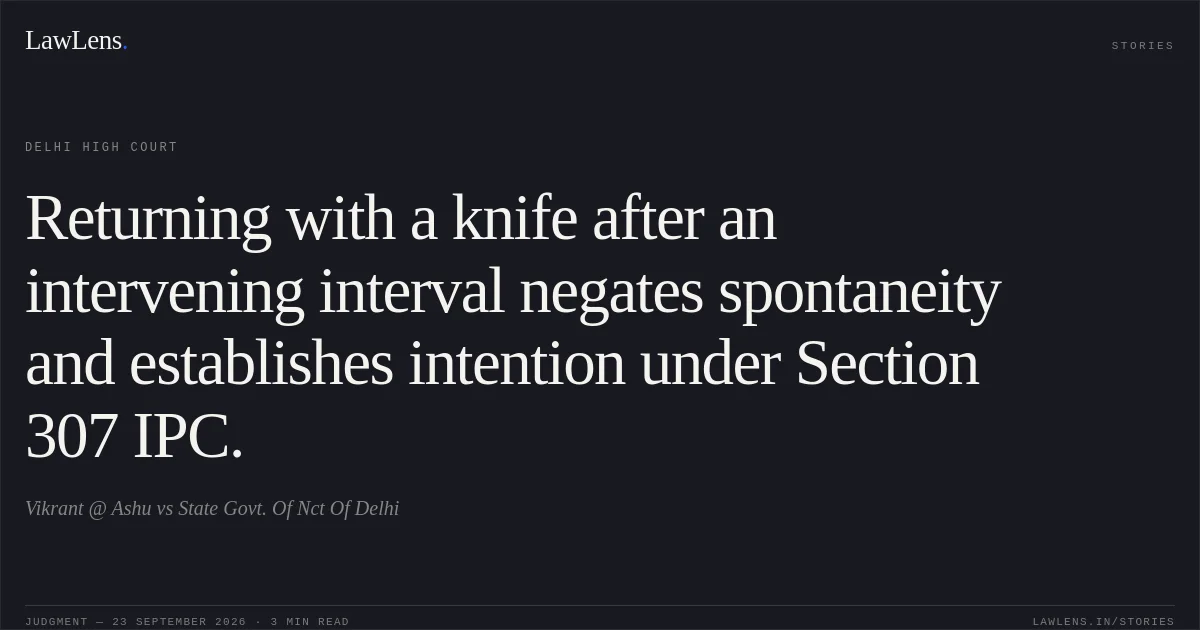
Source reference: p. 22; para. 24The appellant’s departure from the scene, procurement of a knife and return within approximately five minutes constituted an intervening circumstance indicating deliberation and negated the plea that the assault was an instantaneous reaction to provocation.
Source reference: pp. 22–23; para. 24The use of a knife, repeated stabbing attempts, targeting of the chest and abdomen, and the dangerous nature of the injuries demonstrated the requisite intention or knowledge for Section 307 IPC, notwithstanding the absence of prior enmity.
Source reference: pp. 23–24; para. 25The defence of false implication was rejected because it was not put to PW1, PW2 or PW3 during cross-examination and was therefore treated as an afterthought; DW1’s presence at the scene was also doubtful because his stated employment shift coincided with the time of the incident.
Source reference: pp. 24–26; paras. 26–27Although the conviction was upheld, the Court considered a six-year sentence appropriate after taking account of the overall facts and circumstances, despite the appellant’s criminal antecedents and unsatisfactory conduct in custody.
Source reference: p. 26; para. 28Holding
The appeal was partly allowed.
The conviction of the appellant under Section 307 IPC was affirmed, and his acquittal under Section 174A IPC remained undisturbed.
Source reference: pp. 5–6, 26–27; paras. 10, 28–29However, the sentence was reduced from seven years’ rigorous imprisonment to six years’ rigorous imprisonment; the fine imposed by the trial court was not otherwise disturbed.
Source reference: p. 27; para. 29Acts & Sections Cited
10 provisions across 3 statutes referred to in this judgment. Each provision opens on LawLens.
Bharatiya Nagarik Suraksha Sanhita, 20231
Code of Criminal Procedure, 19736
Indian Penal Code, 18603
Original Court PDF
Vikrant @ AshuvsState Govt. Of Nct Of Delhi
Click to open original judgment
Original judgment, available to read, download and summarize on LawLens.in