Facts
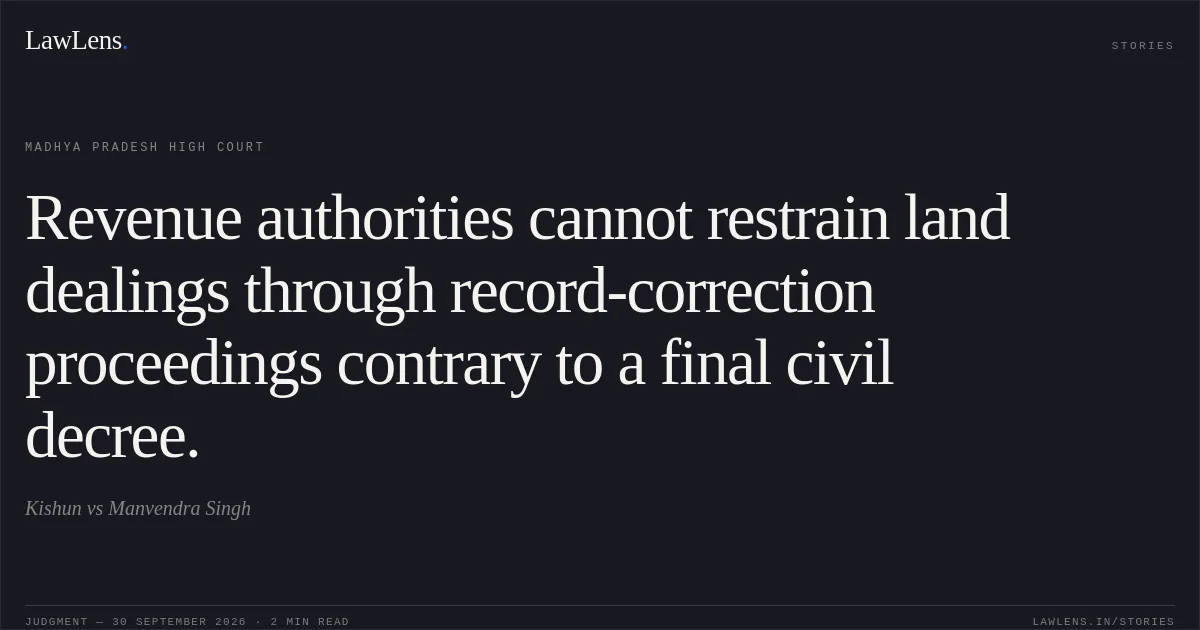
The petitioners challenged an order dated 19 June 2026 by the Sub-Divisional Officer (Revenue), Nowgaon, which prohibited sale of the disputed lands and directed that a notice be entered in the Khasra records. The order followed an application by respondent No. 1 seeking correction of revenue entries relating to land recorded in the petitioners’ names.
Source reference: para. 2, 4The petitioners relied on a civil-court decree dated 22 December 2021 declaring them owners and possessors of a one-fifth share each in the suit lands and declaring certain sale deeds null and void; the decree had attained finality.
Source reference: para. 3The SDO’s letter of 25 June 2026 directed Punjab National Bank to stop transactions in the petitioners’ accounts pending the revenue proceedings, and the Bank froze the accounts.
Source reference: para. 6, 8The petitioners contended that the SDO lacked authority to initiate correction proceedings concerning entries more than five years old without the Collector’s permission and had acted without hearing them.
Source reference: para. 5Issues
1. Whether the SDO could entertain the application and issue a prohibitory order concerning long-standing revenue entries without the Collector’s permission and despite the final civil-court decree.
Source reference: para. 5, 10–132. Whether the order directing a freeze on the petitioners’ bank accounts could be sustained.
Source reference: para. 6–8, 14Law Applied
The Court referred to Section 32 of the Madhya Pradesh Land Revenue Code, 1959, which preserves Revenue Courts’ inherent power to make orders necessary for the ends of justice or to prevent abuse of process.
Source reference: para. 11It also stated that correction of revenue entries sought after five years requires permission from the competent authority, namely the Collector; however, the judgment does not identify the specific statutory provision containing that requirement.
Source reference: para. 5, 11, 13The Court treated the final civil-court decree as binding on revenue authorities and relied on Abdul Rejak Laskar v. Mafizur Rahman, 2024 SCC OnLine SC 3845, for the principle that where a dispute concerning title or possession is raised, revenue authorities should leave its determination to the competent civil court.
Source reference: para. 12Reasoning
The civil decree had conclusively declared the petitioners’ shares in the suit lands, and the relevant revenue entries had stood for decades.
Source reference: para. 3, 10In the Court’s view, the SDO could not use revenue proceedings to reopen rights settled by that decree, particularly where the entries were more than five years old and no Collector’s permission had been obtained.
Source reference: para. 10–13The SDO’s order was therefore without jurisdiction; the consequential direction to stop transactions in the petitioners’ bank accounts, founded on the pendency of those proceedings, could not stand.
Source reference: para. 8, 13–14Holding
The Court allowed the petition, quashed the SDO’s order dated 19 June 2026, and directed the respondents to defreeze the petitioners’ bank accounts with immediate effect.
Acts & Sections Cited
1 provisions across 1 statute referred to in this judgment. Each provision opens on LawLens.
MP Land Revenue Code 19591
Original Court PDF
KishunvsManvendra Singh
Click to open original judgment
Original judgment, available to read, download and summarize on LawLens.in