Facts
Late Shyam Sunder Sharma died bachelor without Class-I heirs on 11.05.2016.
Source reference: para. 2Petitioners (nephew and brothers) obtained a mutation order from the Tehsildar via natural succession on 17.09.2021.
Source reference: para. 2Respondent No. 3 appealed to the Sub-Divisional Officer (SDO), claiming a right based on a notarized Will dated 11.03.2016.
Source reference: para. 2The SDO dismissed the appeal on 13.07.2023, holding that Revenue Authorities cannot adjudicate the validity of a Will.
Source reference: para. 2The Additional Commissioner, in a second appeal, set aside these orders on 24.07.2024 and remanded the case to the Tehsildar to record evidence regarding the Will.
Source reference: para. 2Petitioners challenged this remand order under Article 226 of the Constitution.
Source reference: para. 1Issues
1. Whether a second appeal was maintainable under Section 44(3) of the M.P. Land Revenue Code, 1959, when the first appellate authority had affirmed the original order.
Source reference: para. 3, 102. Whether Revenue Authorities have the jurisdiction to adjudicate the genuineness and validity of a disputed Will in summary mutation proceedings.
Source reference: para. 7, 9Law Applied
Section 44(3)(a) of the Madhya Pradesh Land Revenue Code, 1959, which stipulates that a second appeal lies only if the first appellate authority varies or reverses the original order.
Source reference: para. 3, 10The settled legal principle that mutation entries are for fiscal purposes (revenue collection) only and do not create or extinguish title.
Source reference: para. 7The doctrine that complicated questions of title and testamentary succession (validity of a Will) fall exclusively within the jurisdiction of a competent Civil Court, not a Revenue Officer.
Source reference: para. 7, 9Reasoning
The Court reasoned that the Additional Commissioner lacked jurisdiction to entertain the second appeal because the SDO had affirmed (not reversed or varied) the Tehsildar’s order, thus failing the statutory requirement of Section 44(3)(a).
Source reference: para. 10The Court found the Additional Commissioner’s direction to the Tehsildar—to record evidence on the Will—legally flawed as Revenue Authorities lack the procedural mechanism and legal authority to determine the validity of a disputed Will in summary proceedings.
Source reference: para. 8, 9The Court observed that remanding the matter would serve no legal purpose as it would force an incompetent authority to decide a controversy that strictly belongs to a Civil Court.
Source reference: para. 11, 12Holding
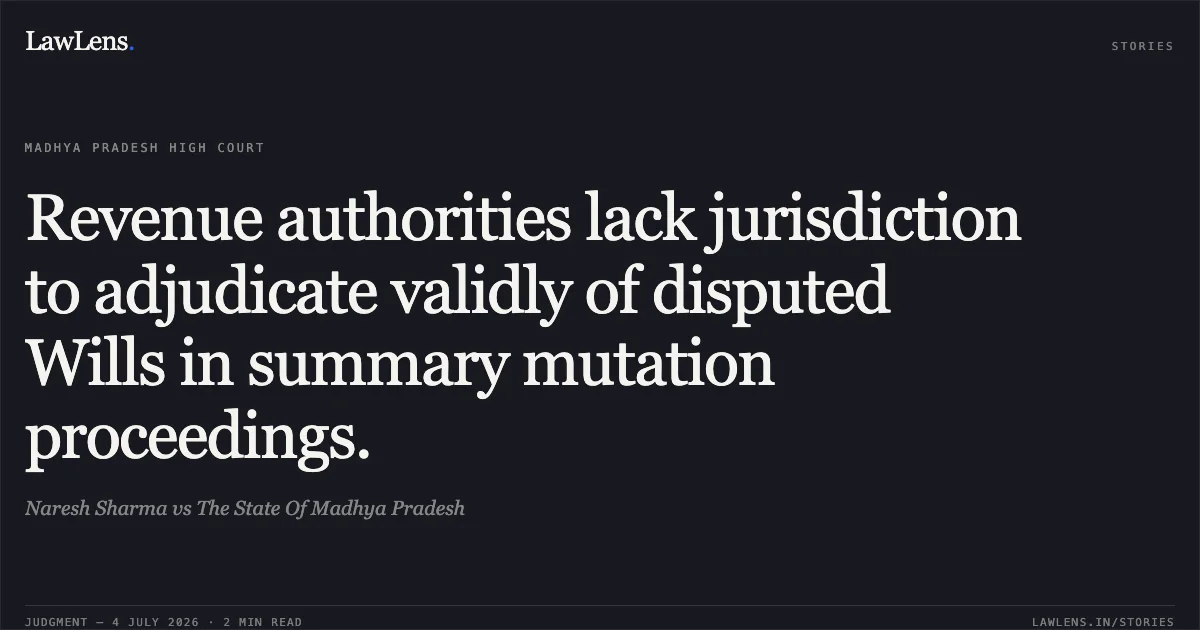
The Court answered that the second appeal was legally untenable and Revenue Authorities cannot adjudicate the validity of Wills.
The High Court set aside the Additional Commissioner’s order dated 24.07.2024 and upheld the mutation in favor of the petitioners based on natural succession.
Source reference: para. 13The final holding specifies that mutation entries are for fiscal purposes only and do not declare title; parties were relegated to the competent Civil Court to establish their rights regarding the alleged Will.
Source reference: para. 13, 14, 15Acts & Sections Cited
1 provisions across 1 statute referred to in this judgment. Each provision opens on LawLens.
MP Land Revenue Code 19591
Original Court PDF
Naresh SharmavsThe State Of Madhya Pradesh
Click to open original judgment
Original judgment, available to read, download and summarize on LawLens.in