Facts
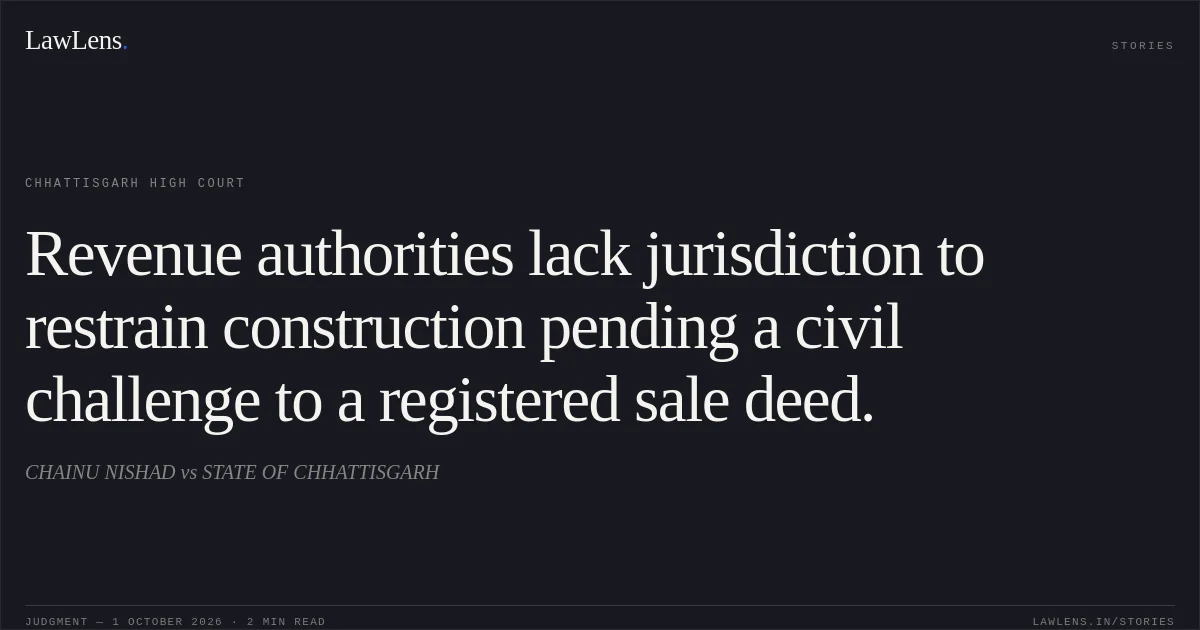
The petitioner challenged the Tahsildar’s order dated 22 July 2026 directing stoppage of construction on Khasra No. 272/5, measuring 0.283 hectare, and a consequential memorandum dated 31 July 2026.
Source reference: paras. 2–3The order followed Respondent No. 6’s complaint alleging that the registered sale deed executed in favour of the petitioner’s wife had been obtained by fraud.
Source reference: paras. 2–3The State did not oppose the petitioner’s prayer.
Source reference: para. 4Issues
Whether the Tahsildar had jurisdiction to direct stoppage of construction on the basis of a complaint alleging fraud in the execution of a registered sale deed.
Source reference: paras. 6, 11Whether the petitioner could obtain relief under Article 226 despite any available alternative remedy, where the impugned order was alleged to be without jurisdiction.
Source reference: para. 10Law Applied
A registered document alleged to be voidable remains operative unless set aside by a competent Civil Court; revenue authorities cannot cancel such a document or adjudicate its validity.
Source reference: para. 7The Supreme Court’s decision in Khursheed and Another v. Shaqoor, 2024 SCC OnLine SC 2929, distinguishes voidable documents—which require adjudication by a competent Civil Court—from void documents, which may in appropriate circumstances be disregarded by revenue authorities.
Source reference: para. 7The Court also relied on Maya Lalchandani (Mrs.) v. Board of Revenue, (2009) 3 MPLJ 660, and Seraj Ahmad v. State of Chhattisgarh, 2017 (4) C.G.L.J. 559, for the principle that revenue authorities cannot grant injunctions; Sections 32 and 43 of the M.P. Land Revenue Code do not confer such power.
Source reference: paras. 8–9The Civil Court’s jurisdiction to determine rights and grant declaratory or injunctive relief was also noted with reference to Sections 34, 37 and 39 of the Specific Relief Act and Order 39 Rules 1 and 2 CPC.
Source reference: para. 8Under Whirlpool Corporation v. Registrar of Trade Marks, (1998) 8 SCC 1, the availability of an alternative remedy does not bar a writ petition where the impugned order or proceedings are wholly without jurisdiction.
Source reference: para. 10Reasoning
The complaint sought action on the basis that the registered sale deed had been procured by fraud—a challenge to the deed’s validity that the Court held must be determined by the competent Civil Court, not by the Tahsildar exercising revenue jurisdiction.
Source reference: paras. 6, 11Because the direction to stop construction operated in the nature of an injunction, the Tahsildar exceeded his jurisdiction in issuing it.
Source reference: paras. 6, 8–9The jurisdictional defect also permitted the High Court to consider the writ petition notwithstanding any alternative remedy.
Source reference: para. 10The Court did not decide the merits of the sale-deed dispute.
Source reference: para. 13Holding
The High Court held the Tahsildar’s order dated 22 July 2026 to be without jurisdiction and quashed it.
It did not quash the consequential memorandum dated 31 July 2026; regarding the allegation that an FIR had been directed by that memorandum, the petitioner was left at liberty to approach the competent court.
Source reference: para. 12The petition was disposed of without any opinion on the merits.
Source reference: paras. 13–14Acts & Sections Cited
6 provisions across 3 statutes referred to in this judgment. Each provision opens on LawLens.
Specific Relief Act, 19633
Code of Civil Procedure, 19081
MP Land Revenue Code 19592
Original Court PDF
CHAINU NISHADvsSTATE OF CHHATTISGARH
Click to open original judgment
Original judgment, available to read, download and summarize on LawLens.in