Facts
The petitioner claimed ownership of 2 acres 27 guntas in Survey No. 775/4, Kolhar Village.
Source reference: p. 3Although his suit for declaration was dismissed, the first appellate court declared him owner of that extent; the Karnataka High Court dismissed the defendant’s second appeal, and the Supreme Court dismissed the subsequent special leave petition.
Source reference: p. 3–4After the petitioner sought mutation of the revenue records, the Tahasildar did not act on his representation.
Source reference: p. 4In an earlier writ petition, the High Court directed the Tahasildar to consider it.
Source reference: p. 4The Tahasildar then rejected the request, citing uncertainty about pending litigation and the petitioner’s failure to produce an 11E sketch.
Source reference: p. 2, 5The petitioner challenged that endorsement and sought entry of his and his brother’s names in the record of rights.
Source reference: p. 2, 5Issues
1. Whether the Tahasildar’s rejection of the petitioner’s mutation request on the stated grounds was justified despite the civil court decree declaring the petitioner owner of the land.
Source reference: p. 5–62. Whether the Tahasildar could be directed to enter the petitioner’s name in the record of rights in accordance with that decree.
Source reference: p. 2, 6–7Law Applied
The petition invoked Articles 226 and 227 of the Constitution of India.
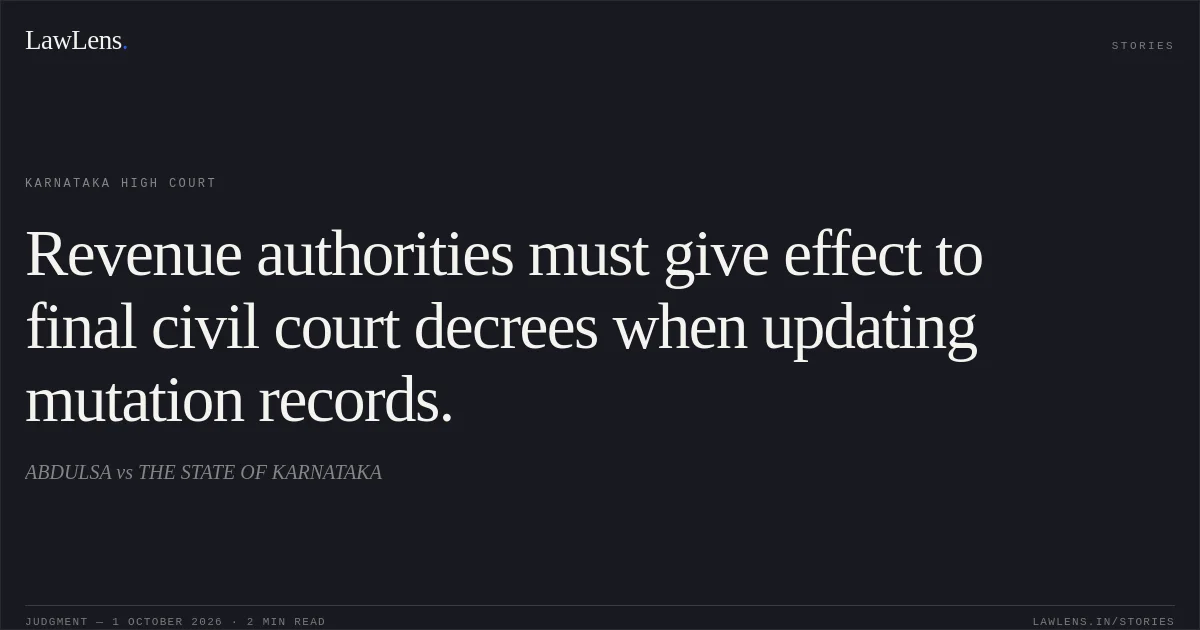
Source reference: p. 2The Court’s reasoning applied the principle that a revenue authority considering a mutation request must verify the relevant records and give effect to a subsisting civil court decree concerning ownership; rejection on grounds inconsistent with the materials already produced or without appropriate verification is not justified.
Source reference: p. 5–6The judgment cited no statute or precedent beyond the constitutional jurisdiction invoked.
Source reference: no citationReasoning
The petitioner had produced the prior court orders, culminating in the civil court decree declaring him owner of the specified extent, and the Tahasildar had been directed to consider his representation.
Source reference: p. 4–5The Court held that the stated concern about pending litigation was not an appropriate basis for rejection in light of those orders.
Source reference: p. 5–6It also found that requiring an 11E sketch was not proper in the circumstances, since the petitioner’s name had appeared in the revenue records for the relevant extent before the suit.
Source reference: p. 5–6The Tahasildar was required instead to verify the records and implement the decree.
Source reference: p. 5–6Holding
The High Court allowed the writ petition and quashed the Tahasildar’s endorsement dated 16 April 2026.
It directed the Tahasildar to enter the petitioner’s name in accordance with the decree in R.A. No. 8 of 2015, as confirmed by the Supreme Court, within three months of receiving a copy of the order.
Source reference: p. 6–7No costs were ordered.
Source reference: p. 6–7Original Court PDF
ABDULSAvsTHE STATE OF KARNATAKA
Click to open original judgment
Original judgment, available to read, download and summarize on LawLens.in