Facts
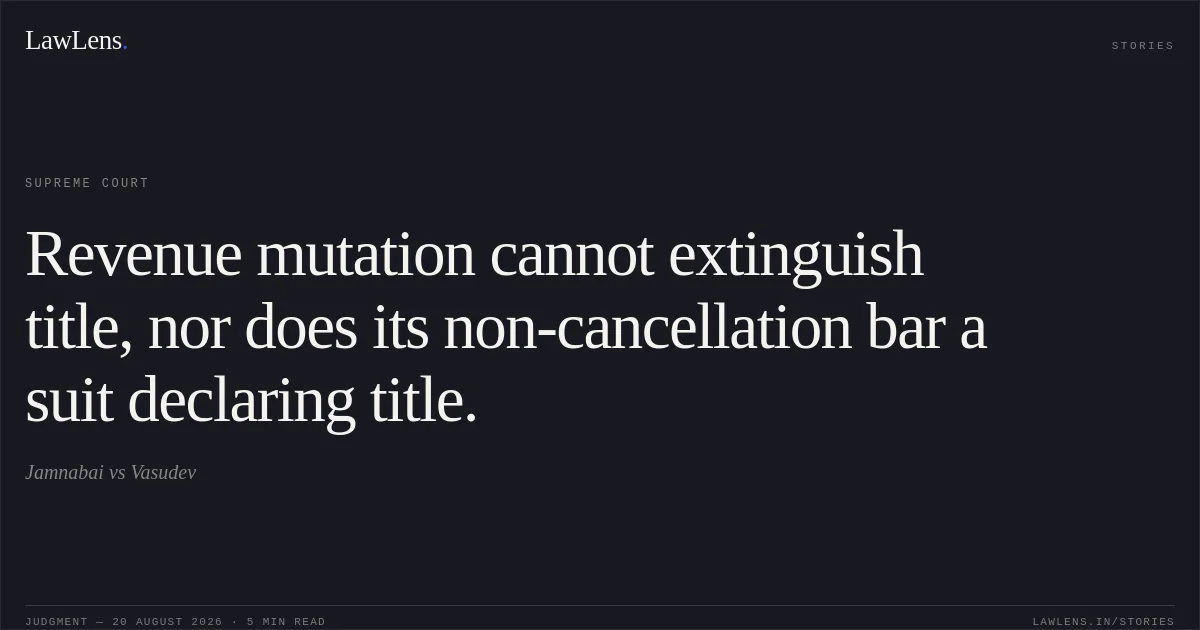
The dispute concerned agricultural land bearing Survey No. 307, measuring approximately 12.41 acres, situated at Village Kanadia, Indore, along with a house standing thereon. The property originally belonged to Bhagwansingh and, upon his death, devolved upon his two sons, Ramprasad and Vasudev, whose names were initially recorded jointly in the revenue records.
Source reference: paras. 4–5Ramprasad’s legal heirs alleged that he retained an equal proprietary interest in the property and that Vasudev had procured the deletion of Ramprasad’s name through revenue proceedings in 1990. They claimed to have discovered the mutation only after a public notice dated 26.01.2008 and by obtaining certified revenue records on 30.01.2008.
Source reference: para. 6The trial court decreed the suit, holding that the alleged relinquishment was not proved and recognising the appellants’ co-ownership and entitlement to a one-tenth share each, subject to lawful partition.
Source reference: para. 9The first appellate court, after admitting additional revenue evidence under Order XLI Rule 27 CPC, affirmed the decree and found the execution and authenticity of Ex.D5 and the connected documents unproved.
Source reference: para. 10The High Court, in second appeal under Section 100 CPC, reversed the concurrent findings and dismissed the suit, holding that Ex.D5 established Ramprasad’s consent, that the 1990 mutation had remained unchallenged for eighteen years, and that the suit was barred by limitation and the proviso to Section 34 of the Specific Relief Act, 1963.
Source reference: paras. 11–12Issues
Whether the High Court was justified in disturbing the concurrent findings of fact of the trial court and the first appellate court while exercising jurisdiction under Section 100 CPC?
Source reference: paras. 15–17Whether Ex.D5 and the revenue proceedings culminating in Ex.D22 proved that Ramprasad had voluntarily relinquished his proprietary interest in the suit property?
Source reference: paras. 15, 18–22Whether the mutation entry made pursuant to Ex.D22 extinguished Ramprasad’s title or conferred title upon the respondents?
Source reference: paras. 15, 21–22Whether the appellants’ suit instituted in 2008 was barred by limitation under Articles 58 or 100 of the Limitation Act, 1963?
Source reference: paras. 15, 23–26Whether the suit was barred by the proviso to Section 34 of the Specific Relief Act, 1963 for failure to seek specific cancellation of the mutation order?
Source reference: paras. 15, 23–27Law Applied
Section 100 CPC restricts second-appeal jurisdiction to cases involving a substantial question of law; concurrent findings of fact cannot ordinarily be disturbed unless they are perverse, based on inadmissible evidence, omit vital evidence, or are conclusions that no reasonable court could reach.
Source reference: paras. 16–17; Bholaram v. Ameerchand, (1981) 2 SCC 414; Kulwant Kaur v. Gurdial Singh Mann, (2001) 4 SCC 262; P. Kishore Kumar v. Vittal K. Patkar, (2024) 13 SCC 553The party asserting relinquishment bears the burden of proving the underlying transaction, and a revenue entry by itself neither creates nor extinguishes title; it is primarily maintained for fiscal purposes.
Source reference: paras. 19–22; Sawarni v. Inder Kaur, (1996) 6 SCC 223Under Section 117 of the Madhya Pradesh Land Revenue Code, 1959, the presumption attached to revenue entries is rebuttable and does not amount to a presumption of title.
Source reference: para. 22Between co-owners, possession by one co-owner is ordinarily possession on behalf of all; ouster requires an open and unequivocal assertion of hostile title, exclusive possession, and knowledge thereof by the other co-owner.
Source reference: para. 25; P. Lakshmi Reddy v. L. Lakshmi Reddy, (1956) 2 SCC 759Article 58 of the Limitation Act applies when the right to seek a declaration first accrues, while Article 100 applies to a suit to set aside a specified act or order of a civil or government officer.
Source reference: para. 26Section 34 of the Specific Relief Act prevents a bare declaration where consequential relief is available, but does not require a separate prayer for cancellation of a revenue entry when the substantive relief sought is declaration of title with partition, possession, and injunction.
Source reference: para. 27Section 114(e) of the Evidence Act permits a presumption of regularity of official acts, but not of the bona fides or validity of the underlying private transaction.
Source reference: para. 28Reasoning
The Supreme Court held that the High Court impermissibly reappreciated the evidence and substituted its own factual conclusions for those concurrently recorded by the courts below.
Source reference: paras. 17, 29–30Ex.D5 was not independently proved: the first appellate court had identified its vagueness, the absence of an attesting or independent witness, the inconsistency in the evidence, and the fact that the stamp paper had been purchased months before the stated date of execution.
Source reference: paras. 20–21The High Court’s treatment of DW3 as an attesting witness and its conclusion that Ex.D5 was undisputed were factually erroneous, particularly when the document and the signatures on the connected revenue papers had been denied.
Source reference: para. 20The Court further held that Ex.D22 could regulate revenue records but could not operate as a conveyance or relinquishment of proprietary rights.
Source reference: paras. 19, 22Since the respondents failed to prove the transaction by which Ramprasad allegedly surrendered his share, the mutation could not extinguish his title.
Source reference: paras. 19, 22The limitation analysis also failed because the 1990 mutation was not itself the operative event displacing title. There was no finding of open and unequivocal ouster of Ramprasad during his lifetime, nor proof that the appellants had actual knowledge of the alleged relinquishment or revenue proceedings before 2008.
Source reference: paras. 25–26The suit was substantively one for declaration of co-ownership by succession, partition, possession, and injunction, rather than a direct suit to set aside Ex.D22; therefore, the absence of a separate cancellation prayer did not attract either Article 100 or the proviso to Section 34.
Source reference: paras. 26–27Holding
The Supreme Court allowed the appeal and held that the High Court had exceeded its jurisdiction under Section 100 CPC by disturbing concurrent findings without demonstrating perversity or a qualifying error of law.
It held that Ex.D5 and the revenue proceedings did not establish any valid relinquishment by Ramprasad, and that the mutation entry neither extinguished his title nor barred the appellants’ suit.
Source reference: paras. 20–27The High Court’s judgment dated 09.05.2025 was set aside, and the judgments and decrees of the trial court and first appellate court were restored.
Source reference: para. 31The appellants and the other legal heirs of Ramprasad were declared entitled to the shares granted under the decree, subject to lawful partition under the Madhya Pradesh Land Revenue Code; the respondents were restrained from alienating the property or creating third-party rights contrary to the decree until partition.
Source reference: para. 32No order as to costs was made.
Source reference: para. 33Acts & Sections Cited
6 provisions across 4 statutes referred to in this judgment. Each provision opens on LawLens.
Code of Civil Procedure, 19081
Specific Relief Act, 19631
Limitation Act, 19632
MP Land Revenue Code 19592
Original Court PDF
JamnabaivsVasudev
Click to open original judgment
Original judgment, available to read, download and summarize on LawLens.in