Facts
The Appellants (original plaintiffs) filed a suit for declaration and permanent injunction regarding agricultural land in Survey No. 417, Block No. 410, village Panikhadak
Source reference: p. 2They claimed ownership via mutation entry No. 327 and stated a portion was donated for a school
Source reference: p. 2The Respondents (defendants) contested the suit, claiming a 1/2 share through an alleged oral partition and asserting actual possession
Source reference: p. 4The Trial Court dismissed the suit on 30th April 2003, relying on admissions of the defendants' possession made by the plaintiffs in separate criminal proceedings
Source reference: p. 4, 14The Appellants challenged this dismissal, relying on a 1999 Mamlatdar order (RTS Case No. 2 of 1999) which had cancelled the defendants’ names from revenue records after finding no evidence of their title or legal possession
Source reference: p. 11Issues
1. Whether the plaintiffs successfully proved their title and possession of the suit land to entitle them to a permanent injunction
Source reference: p. 112. Whether the Trial Court erred in relying on statements from criminal proceedings to determine the issue of possession in a civil suit
Source reference: p. 14Law Applied
The court applied Section 96 of the CPC regarding the wide powers of a First Appellate Court to re-appreciate evidence
Source reference: p. 8It relied on Section 38(3) of the Specific Relief Act, 1963, regarding the grant of perpetual injunctions when a defendant invades a plaintiff's right to property
Source reference: p. 6Under Section 35 of the Indian Evidence Act, 1872, revenue records were treated as public documents carrying a presumption of correctness, as affirmed in State of Haryana v. Amin Lal
Source reference: p. 12The court further applied the principle that "possession follows title" in the absence of evidence to the contrary
Source reference: p. 12Reasoning
The High Court found that the Trial Court's reliance on criminal court documents (Exh. 143) to determine civil possession was "wholly misplaced," as criminal findings are not conclusive in civil Title disputes
Source reference: p. 14The court analyzed the Mamlatdar’s 1999 order (Exh. 126), which explicitly held that the defendants had no right, title, or interest in the land and ordered the removal of their names from revenue records—an order that remained unchallenged and attained finality
Source reference: p. 11-12A fresh status report from the Mamlatdar (dated 19.04.2026) confirmed that the plaintiffs were in actual physical possession of the residences and agricultural land on the suit block
Source reference: p. 13Since the defendants admitted in cross-examination that no mutation entry supported their "partition" theory, the court concluded the plaintiffs held both title and subsequent possession
Source reference: p. 14Holding
The High Court allowed the appeal and set aside the Trial Court's judgment
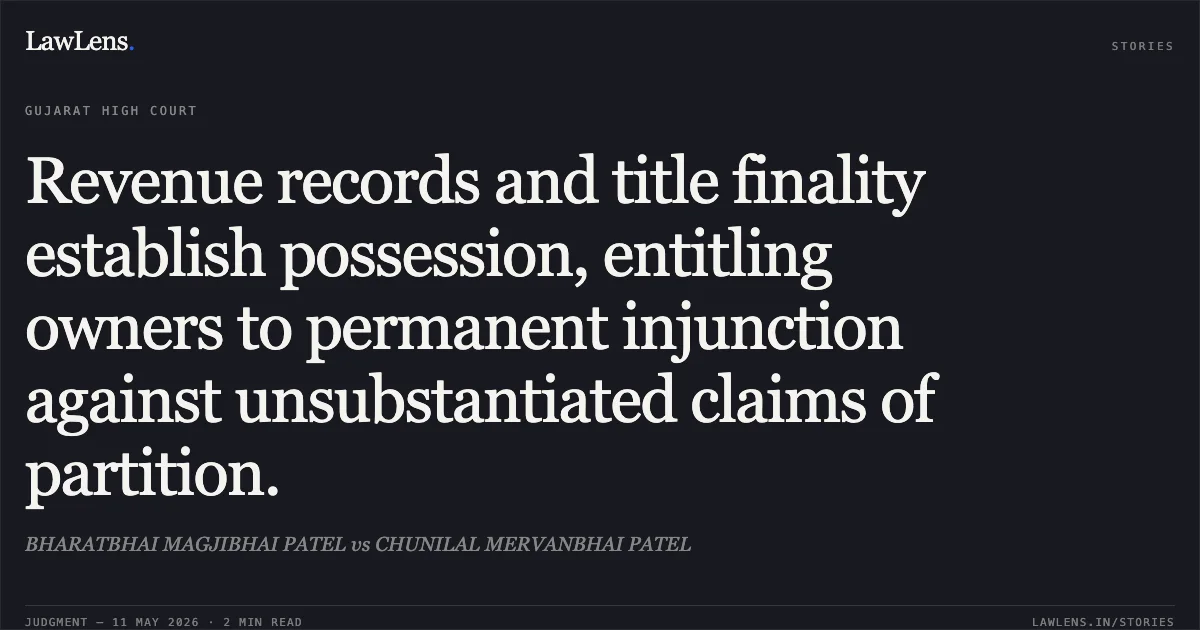
The court held that the plaintiffs proved their ownership and the defendants failed to establish any legal right or partition
Source reference: p. 14-15The court granted the declaration of the plaintiffs' rights and a perpetual injunction against the defendants, restraining them from interfering with the peaceful possession of the suit property
Source reference: p. 15No order as to costs was made
Source reference: p. 15Acts & Sections Cited
2 provisions across 2 statutes referred to in this judgment. Each provision opens on LawLens.
Code of Civil Procedure, 19081
Specific Relief Act, 19631
Original Court PDF
BHARATBHAI MAGJIBHAI PATELvsCHUNILAL MERVANBHAI PATEL
Click to open original judgment
Original judgment, available to read, download and summarize on LawLens.in