Facts
The petitioners are the legal heirs of the late Lal Mohan Datta, who was the recorded owner of land acquired by the State under a notification dated 02.11.2017 for the widening of NH-208 under the National Highways Act, 1956.
Source reference: p. 2-3While compensation for the land was paid to the original owner, a dispute arose regarding the compensation for structures (shops) standing on the acquired land.
Source reference: p. 3The petitioners contended that they constructed the shops and rented them to private respondents (Respondents No. 3-9).
Source reference: p. 4Conversely, the private respondents claimed they constructed the structures at their own expense while continuing as tenants.
Source reference: p. 5A Tehsildar’s report supported the tenants' claim, which the petitioners challenged as perfunctory.
Source reference: p. 3, 6Following a previous High Court direction in WP(C) 711 of 2024 to consider the petitioners' claim, the official respondents rejected the representation on 16.01.2025.
Source reference: p. 4, 6The petitioners then filed the present writ seeking a mandamus for compensation and a reference to arbitration.
Source reference: p. 2Issues
1. Whether the petitioners, as landowners, or the private respondents, as tenants, are entitled to the compensation awarded for the structures standing on the acquired land.
Source reference: p. 3, 72. Whether the dispute regarding the ownership and valuation of the structures should be determined by an Arbitrator under the relevant statutes.
Source reference: p. 3, 8Law Applied
The court applied the principles of justice, equity, and good conscience.
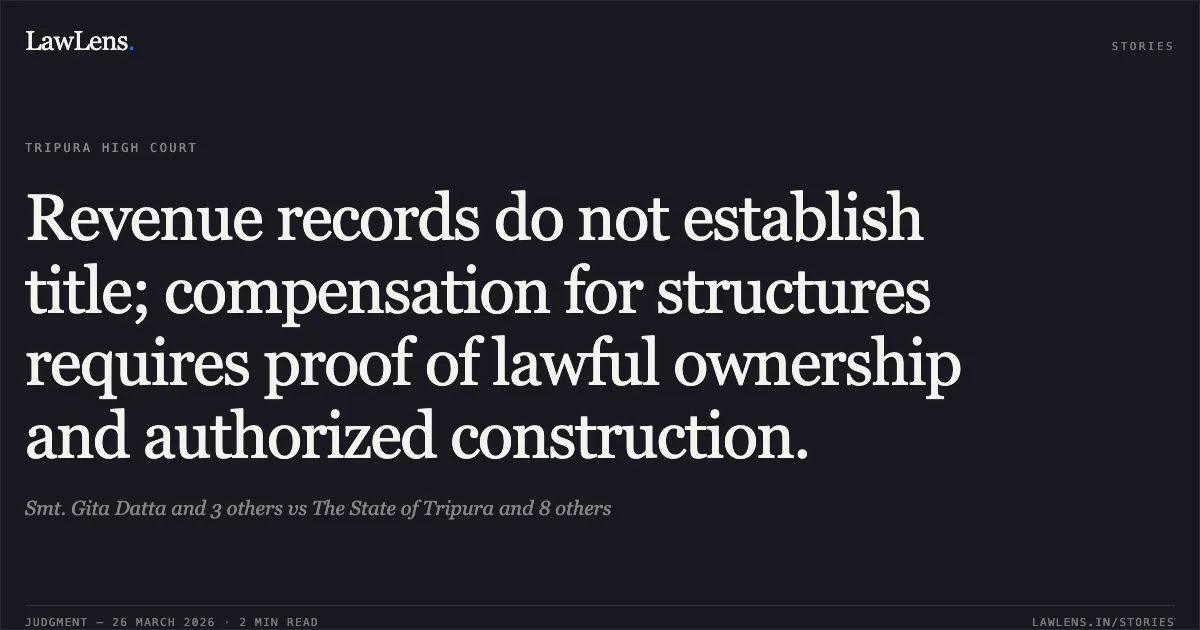
Source reference: p. 6It reiterated the established legal principle that revenue records, such as a Khatian, do not constitute legally enforceable title documents and cannot solely form the basis for paying compensation.
Source reference: p. 7The court emphasized that compensation for structures is contingent upon proving valid title, authorization, or permission from government or local bodies to raise such structures.
Source reference: p. 7Furthermore, the court noted that any person in possession without valid right or title who raises unauthorized construction may be considered a "trespasser" and is not entitled to public funds.
Source reference: p. 7-8Reasoning
The court examined the conflicting claims: the petitioners relied on their status as landowners and the Khatian, while the tenants relied on the Tehsildar's report and a Tenancy Agreement clause suggesting they bore the construction costs.
Source reference: p. 4, 6The court reasoned that the determination of the "genuine lawful owner" of the structures requires a rigorous evidentiary assessment that cannot be concluded solely via revenue records.
Source reference: p. 7It observed that while the landowner is entitled to land compensation, the structure's compensation belongs only to the party who can prove they raised the structure with valid authorization.
Source reference: p. 7Given the factual disputes and the need for diligence in disbursing public money, the court found it appropriate to refer the matter to specialized adjudication.
Source reference: p. 8Holding
The High Court of Tripura disposed of the writ petition by remanding the matter to the Arbitrator.
The court directed the Arbitrator to examine the case in its entirety, specifically focusing on the eligibility of the parties to receive compensation for the structures and the validity of their supporting documents.
Source reference: p. 8The Arbitrator is ordered to pass a final order in accordance with the law.
Source reference: p. 8Pending applications, if any, were also disposed of.
Source reference: p. 8Original Court PDF
Smt. Gita Datta and 3 othersvsThe State of Tripura and 8 others
Click to open original judgment
Original judgment, available to read, download and summarize on LawLens.in