Facts
The Original Application (O.A. No. 514/2025) was disposed of on 22.05.2025, wherein the Tribunal quashed the impugned order and remitted the matter to the respondents (the Union of India) to reconsider the applicants' representations in light of the Allahabad High Court’s judgment in Rajeev Mohan’s case.
Source reference: para. 1, 7During the O.A. proceedings, the respondents were granted three opportunities to file a counter-affidavit but failed to do so.
Source reference: para. 6Subsequently, the Union of India filed the present Review Application along with a delay condonation application (M.A. No. 6391/2025).
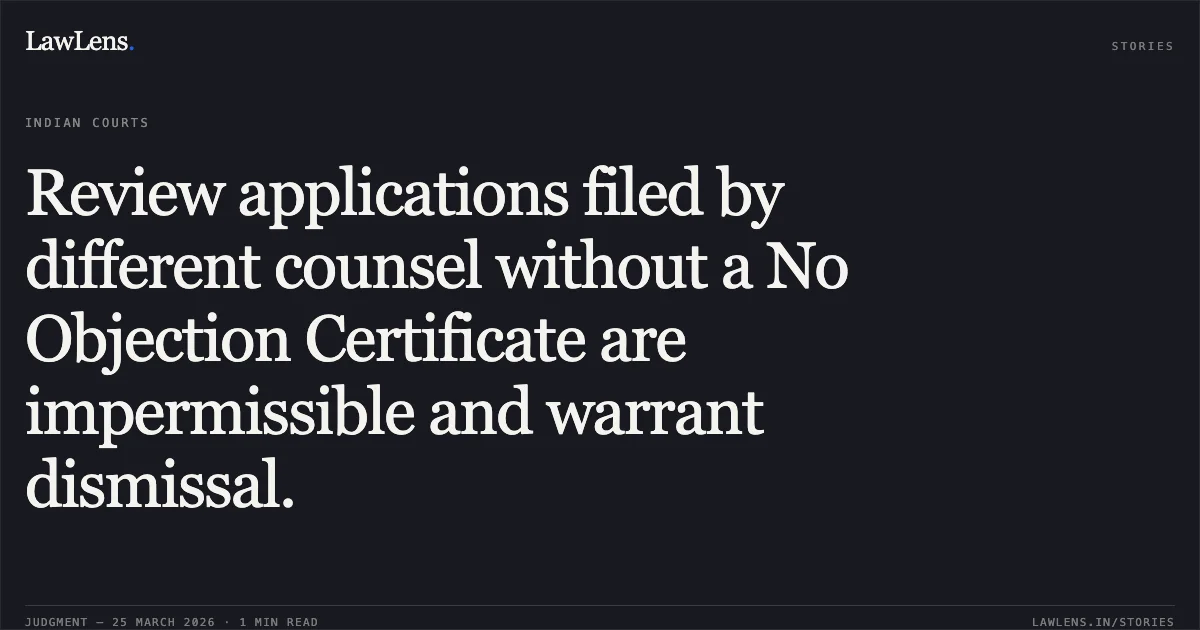
Source reference: para. 2Notably, the Review Application was filed by a different counsel (Shri Raghvendra Pratap Singh) than the one who represented the Union in the O.A. (Shri Chakrapani Vatsyayan), and no "No-Objection Certificate" (NOC) was obtained from the previous counsel.
Source reference: para. 3Issues
1. Whether the Review Application is maintainable when filed by a new counsel without an NOC from the previous counsel who argued the main case.
Source reference: para. 3-42. Whether the review applicants established an "error apparent on the face of record" as required under review jurisdiction.
Source reference: para. 63. Whether the practice of changing counsel to re-argue a decided matter constitutes an abuse of the judicial process.
Source reference: para. 7Law Applied
The Tribunal applied Rule 17(1) of the Central Administrative Tribunal (Procedure) Rules, 1987, which governs the filing of review applications.
Source reference: para. 2It relied on the Supreme Court precedent in Tamil Nadu Electricity Board & Anr. v. N. Raju Reddiar & Anr. (1997), which held that changing advocates to file review petitions without consent of the original advocate is a practice to be deprecated and that review is not a rehearing on merits.
Source reference: para. 3It further cited Vinita Bhatnagar v. Union of India (2018) and Yuvraj Singh v. Harninder Singh (2024) to affirm that review jurisdiction cannot be invoked to re-litigate issues already adjudicated.
Source reference: para. 4-5Finally, it referenced Ajay Shankar Srivastava v. Bar Council of India regarding the preservation of the integrity of the justice delivery system.
Source reference: para. 11Reasoning
The Tribunal observed that the Review Applicants (UOI) had intentionally neglected to file a counter-affidavit during the original proceedings despite multiple opportunities.
Source reference: para. 6It was determined that the Review Application was an attempt to re-argue the merits of the case rather than pointing out a specific "error apparent on the face of the record".
Source reference: para. 6-7The Tribunal strongly criticized the procedural impropriety of engaging new counsel without an NOC, noting that this practice undermines the purity of legal administration.
Source reference: para. 3, 7The court reasoned that since the matter had already been decided on the basis of available records due to the respondents' own defaults, they could not now use a review petition to reopen the case.
Source reference: para. 7Holding
The Tribunal dismissed both the delay condonation application (M.A. No. 6391/2025) and the Review Application as devoid of merit.
A cost of Rs. 20,000/- was imposed on the deponent, Shri Amit Banerjee (Income Tax Officer), to be deposited with the CAT Bar Association, Allahabad, within eight weeks.
Source reference: para. 9Additionally, the Tribunal issued a general direction to the Registry to henceforth refuse any Vakalatnama unless the requisite copies of the petition are filed for service upon respondents to maintain procedural discipline.
Source reference: para. 12-13Original Court PDF
M/O FINANCEvsRANJEET SHARMA
Click to open original judgment
Original judgment, available to read, download and summarize on LawLens.in


![Authorities must decide pensionary and retiral-benefit claims through a reasoned order within eight weeks.. Habibullah khan vs HOME DEPARTMENT. CAT - ['Srinagar']. LawLens](/stories/thumbnails/authorities-must-decide-pensionary-and-retiral-benefit-claims-through-a-reasoned-order-wit-d0cbe8a8119c48fbabe7df9f2d353488.webp)