Facts
The respondents brought a civil suit seeking recovery of ₹14,87,500 and damages, alleging that the petitioner had received ₹11 lakh towards preliminary expenses for a proposed partnership business that was never formed.
Source reference: para. 2–3The trial court found that the respondents had paid ₹11 lakh under Ex. P/1 and awarded the amount with interest if it was not repaid within three months; the petitioner’s first appeal was dismissed, while the respondents’ cross-objections were allowed to grant interest from 15 July 2011.
Source reference: para. 2–3The petitioner sought review of the appellate judgment, arguing, among other things, that Ex. P/1 was inadmissible for insufficient stamp duty and that the suit was barred under Section 69 of the Partnership Act, 1932.
Source reference: para. 4Issues
Whether the review petition established an error apparent on the face of the record or another ground warranting review under Order XLVII Rule 1 CPC.
Source reference: para. 6–7, 15Whether the petitioner’s objections concerning the admissibility of Ex. P/1 and the maintainability of the suit justified review of the appellate judgment.
Source reference: para. 4, 15–16Law Applied
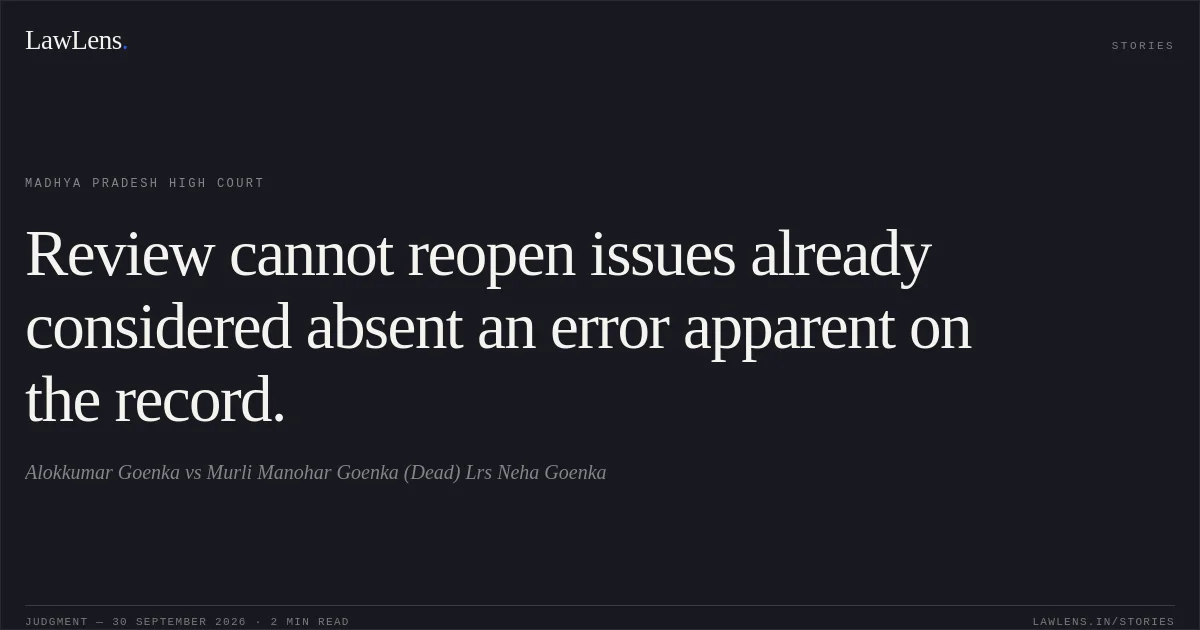
Section 114 and Order XLVII Rule 1 CPC permit review on limited grounds, including discovery of new and important evidence, an error apparent on the face of the record, or another sufficient reason.
Source reference: para. 7, 11Under Kamlesh Verma v. Mayawati, review is not a rehearing or an appeal in disguise.
Source reference: para. 8–9Under Moran Mar Basselios Catholicos v. Most Rev. Mar Poulose Athanasius, a review cannot reopen concluded arguments or reassess evidence, and the error must be manifest and material.
Source reference: para. 8–9State of West Bengal v. Kamal Sengupta and Arun Dev Upadhyaya further establish that an apparent error must be evident without detailed examination or a long-drawn process of reasoning; an allegedly erroneous view of law is not, by itself, a ground for review.
Source reference: para. 13–14Reasoning
The Court found that the petitioner’s challenge to the admissibility of Ex. P/1 had already been specifically considered in the first appeal: question 13(b) addressed admissibility, and the appellate judgment discussed the matter in paragraphs 18–19.
Source reference: para. 15The basis of the suit and the related issues had also been considered in paragraphs 21–24 of that judgment.
Source reference: para. 15The review grounds therefore sought reconsideration of matters already decided, rather than identifying new evidence or a patent error.
Source reference: para. 15Applying the restricted scope of review, the Court held that the petitioner’s arguments—including reliance on Sunkari Tirumal Rao v. Penki Aruna Kumar—did not disclose a reviewable ground.
Source reference: para. 16Holding
The Court held that no ground for review under Order XLVII Rule 1 CPC had been established.
It rejected the review petition, leaving the appellate judgment dated 30 January 2024 undisturbed.
Source reference: para. 16Acts & Sections Cited
2 provisions across 2 statutes referred to in this judgment. Each provision opens on LawLens.
Code of Civil Procedure, 19081
Indian Partnership Act, 19321
Original Court PDF
Alokkumar GoenkavsMurli Manohar Goenka (Dead) Lrs Neha Goenka
Click to open original judgment
Original judgment, available to read, download and summarize on LawLens.in