Facts
The parties married on 15 January 1999 and were subsequently divorced by decree dated 21 September 2012 on the grounds of cruelty and desertion.
Source reference: para. 3–4The Family Court, by judgment dated 19 May 2016, awarded the respondent-wife permanent alimony comprising medical expenses, ₹20 lakh to facilitate acquisition of residential accommodation, monthly maintenance, assistance for a nurse or maid, and litigation expenses under Section 25 of the Hindu Marriage Act, 1955.
Source reference: para. 5In appeal, the High Court, by judgment dated 14 September 2023, set aside all components except the lump-sum award of ₹20 lakh as permanent alimony.
Source reference: para. 6–7In July 2026, the husband sought review, alleging that the wife had concealed ownership of a residential property in Kolkata valued at approximately ₹3 crore and a 2019 investment of ₹28,20,440 in a 3-BHK flat in the CSSOS Officers Enclave, Dwarka.
Source reference: para. 8–13He claimed that these facts came to his knowledge only on 3 July 2026 and sought condonation of a 998-day delay in filing the review petition.
Source reference: para. 42–44Issues
Whether the alleged discovery of the respondent’s residential assets and investment constituted “new and important matter or evidence” which, despite the exercise of due diligence, could not previously have been produced, so as to warrant review under Section 114 read with Order XLVII Rule 1 CPC.
Source reference: para. 16–18, 23–28Whether the review petition was liable to be rejected on account of the petitioner’s failure to establish due diligence and the unexplained delay of 998 days under Article 124 of the Limitation Act, 1963.
Source reference: para. 42–50Whether the respondent’s subsequent investment in residential accommodation justified reviewing or setting aside the ₹20 lakh permanent-alimony award.
Source reference: para. 39–40Law Applied
The Court applied Section 114 and Order XLVII Rule 1 CPC, under which review is permissible only upon discovery of new and important matter or evidence that, despite due diligence, was not within the applicant’s knowledge or could not be produced earlier; an error apparent on the face of the record; or any other sufficient reason.
Source reference: para. 17–18Relying on Lily Thomas v. Union of India , (2000) 6 SCC 224, and Kamlesh Verma v. Mayawati , (2013) 8 SCC 320, the Court reiterated that review is not an appeal in disguise and cannot be used for rehearing, reappreciation of evidence, or substituting another possible view.
Source reference: para. 19–22Under State of West Bengal v. Kamal Sengupta , (2008) 8 SCC 612, and S. Tirupathi Rao v. M. Lingamaiah , (2024) 20 SCC 188, newly discovered evidence must both satisfy the due-diligence requirement and be material enough potentially to alter the judgment.
Source reference: para. 24–26The Court also relied on Malleeswari v. K. Suguna , 2025 INSC 1080, reaffirming the narrow scope of review.
Source reference: para. 27–28Article 124 of the Limitation Act prescribes 30 days for seeking review of a judgment of a court other than the Supreme Court, subject to condonation under Section 5 where sufficient cause is shown.
Source reference: para. 42–44Reasoning
The Court held that the petitioner made only a bald assertion that he received “reliable information” on 3 July 2026, without identifying the source, manner of discovery, or the steps allegedly taken during the nearly two decades of matrimonial and appellate proceedings to ascertain the respondent’s assets.
Source reference: para. 29–38The Kolkata property was asserted to be pre-existing, while the CSSOS membership certificate was dated 31 August 2019—approximately four years before disposal of the appeal—yet no explanation was provided for why the information could not have been obtained earlier.
Source reference: para. 34–36The petitioner’s post-discovery verification did not establish the legally relevant requirement that the evidence could not have been discovered or produced earlier despite due diligence.
Source reference: para. 37–38The Court further found the 998-day delay unexplained, particularly because the petitioner appeared before the Court in February 2026 concerning payment of the same ₹20 lakh award but did not then allege concealment or seek review.
Source reference: para. 42–49On merits, the Court observed that the 2019 investment in residential accommodation was consistent with the very purpose of the ₹20 lakh award and could not retrospectively invalidate the relief granted in 2016 and upheld in 2023.
Source reference: para. 39–40Allowing the review would impermissibly enable the petitioner to fill lacunae in his original case.
Source reference: para. 51Holding
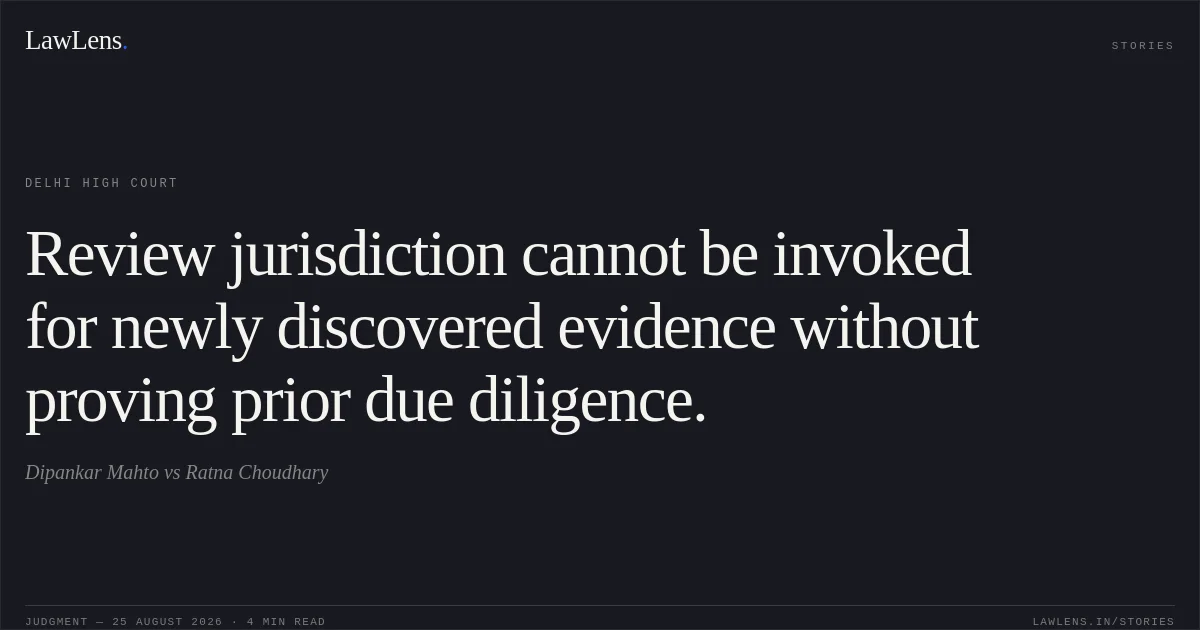
The Court answered the issues against the review petitioner. He failed to establish the discovery of qualifying new and important evidence, failed to demonstrate due diligence, and did not provide sufficient cause for the 998-day delay.
The subsequent acquisition-related investment by the respondent did not justify interference with the permanent-alimony award because it was consistent with the purpose of that award.
Source reference: para. 39–40The application for review was consequently dismissed.
Source reference: para. 53Acts & Sections Cited
5 provisions across 3 statutes referred to in this judgment. Each provision opens on LawLens.
Code of Civil Procedure, 19081
Hindu Marriage Act, 19552
Limitation Act, 19632
Original Court PDF
Dipankar MahtovsRatna Choudhary
Click to open original judgment
Original judgment, available to read, download and summarize on LawLens.in
![Courts will not interfere with transfers absent mala fides or violation of statutory rules.. M Ramya vs EMPLOYEES STATE INSURANCE CORPORATION (ESIC). CAT - ['Chennai']. LawLens](/stories/thumbnails/courts-will-not-interfere-with-transfers-absent-mala-fides-or-violation-of-statutory-rules-a6845e9ca6f548fca284c51c8351957f.webp)
![Courts cannot direct one-time recruitment age relaxation absent authority in the governing rules or advertisement.. UT OF PUDUCHERRY vs M ANDAL. CAT - ['Chennai']. LawLens](/stories/thumbnails/courts-cannot-direct-one-time-recruitment-age-relaxation-absent-authority-in-the-governing-895d78fde47143e2a8ed0207c4b6a44f.webp)
![A review cannot correct an allegedly erroneous decision absent an error apparent on the record.. Ajit Kumar Jha vs RAILWAY BOARD. CAT - ['Delhi']. LawLens](/stories/thumbnails/a-review-cannot-correct-an-allegedly-erroneous-decision-absent-an-error-apparent-on-the-re-8ac952fd4eba470c92f7da20af72a220.webp)