Facts
The petitioner was found guilty in a departmental inquiry of beating a postmaster.
Source reference: no citationHis dismissal from service was modified to compulsory retirement by the revisional authority.
Source reference: no citationThe Central Administrative Tribunal dismissed his challenge, and the High Court dismissed his writ petition on 9 April 2026, finding no basis to interfere with the inquiry officer’s handling of a requested defence witness and noting that the petitioner had not shown prejudice.
Source reference: p. 2; pp. 3–4In review, the petitioner argued that documents had not been supplied, that cited precedents had not been discussed, and that the inquiry had been closed on 21 October 2000 rather than the scheduled date of 30 October 2000, without notice.
Source reference: pp. 2–3Issues
Whether the petitioner established an error apparent on the face of the record warranting review of the judgment dated 9 April 2026.
Source reference: pp. 1, 6Whether the petitioner’s reliance on Ranjit Singh & Anr. v. State of Uttarakhand & Ors. established that closing the inquiry before the scheduled date, without notice, violated natural justice.
Source reference: pp. 2–5Law Applied
Section 114 and Order XLVII Rule 1 of the Code of Civil Procedure, 1908 permit review on limited grounds, including an error apparent on the face of the record; review cannot be used to substitute a view, reargue the case, or undertake an appellate reconsideration, and even an allegedly erroneous judgment is not, for that reason alone, reviewable (S. Murali Sundaram v. Jothibai Kannan, (2023) 13 SCC 515).
Source reference: p. 6Section 5 of the Departmental Inquiries (Enforcement of Attendance of Witnesses and Production of Documents) Act, 1972 gives an inquiry officer powers akin to those of a civil court, but its exercise is discretionary and must be judicious rather than mechanical.
Source reference: p. 3The Court also considered whether the inquiry irregularity caused prejudice to the petitioner.
Source reference: p. 4Reasoning
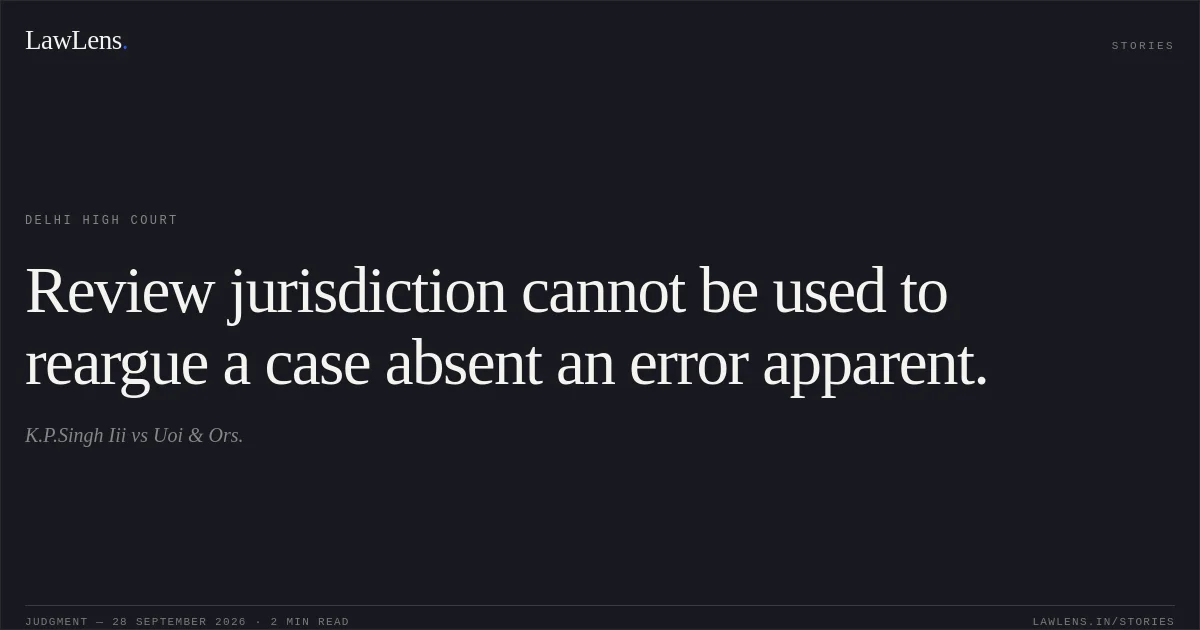
The Court held that the review grounds sought to reopen matters already considered in the writ judgment, rather than identify an apparent error.
Source reference: no citationThe petitioner had earlier confined his challenge to the inquiry officer’s failure to secure a defence witness; the Court had found no automatic duty to compel attendance and no demonstrated prejudice, particularly given the consistent evidence of five witnesses and the failure of the defence witnesses to support his innocence.
Source reference: pp. 3–4Ranjit Singh concerned a materially different situation: a court advanced the hearing of an application and struck out a defence without notice, despite an earlier date having been fixed.
Source reference: pp. 4–5The Court found that precedent inapplicable and concluded that the renewed arguments invited an impermissible merits review.
Source reference: pp. 5–6Holding
The Court found no ground to review its judgment dated 9 April 2026 and dismissed the review petition.
The pending application was also disposed of.
Source reference: p. 6Acts & Sections Cited
2 provisions across 2 statutes referred to in this judgment. Each provision opens on LawLens.
Code of Civil Procedure, 19081
Departmental Inquiries (Enforcement of Attendance of Witnesses and Production of Documents) Act, 19721
Original Court PDF
K.P.Singh IiivsUoi & Ors.
Click to open original judgment
Original judgment, available to read, download and summarize on LawLens.in