Facts
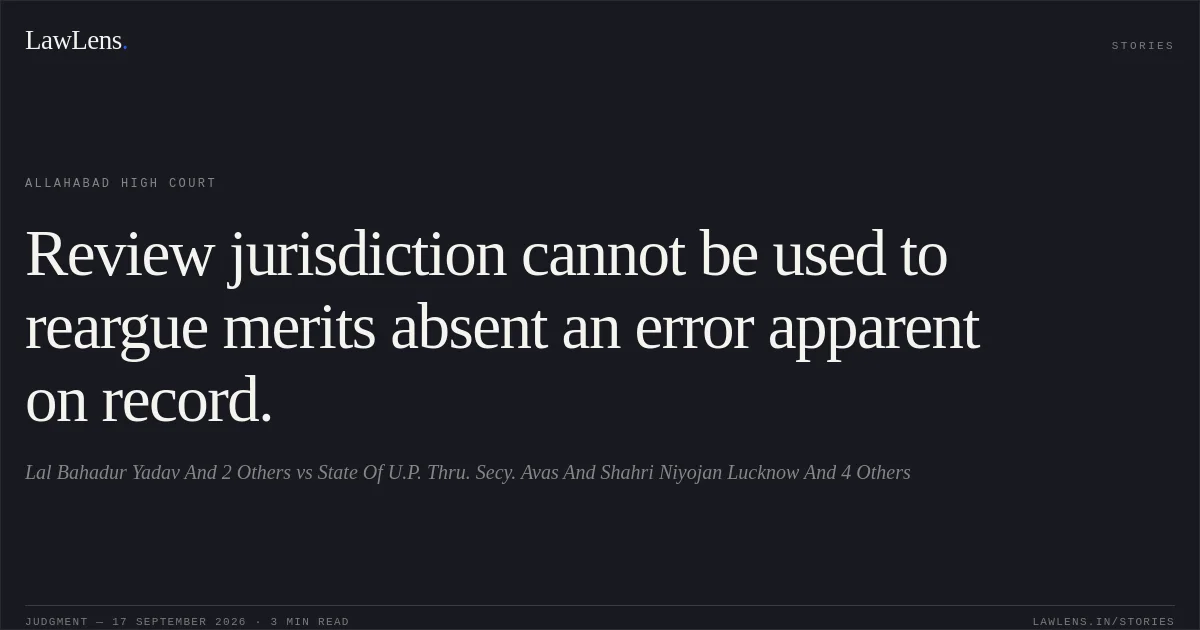
The applicants sought review of the High Court’s order dated 10 November 2025, by which their writ petition was dismissed on the ground of an unexplained delay of approximately 20 years.
Source reference: para. 2The Court had noted that the relevant proceedings were completed in 2006 and that an award had been pronounced against the applicants on 24 September 2009.
Source reference: paras. 2–3In the review application, the applicants contended that the Court had overlooked the law laid down by the Supreme Court, but no specific Supreme Court decision was produced or relied upon during the hearing of the review application.
Source reference: para. 4The applicants’ grounds substantially sought reconsideration of the merits of the original writ petition.
Source reference: para. 5Issues
1. Whether the review application disclosed any discovery of new and important matter, error apparent on the face of the record, or other sufficient reason warranting review under Order XLVII Rule 1 CPC?
Source reference: paras. 5–7, 152. Whether the applicants could use review jurisdiction to re-argue the merits of the dismissed writ petition or substitute an alternative view for the view already taken by the Court?
Source reference: paras. 5–8, 13, 16–17Law Applied
The Court applied the limited scope of review jurisdiction under Section 114 read with Order XLVII Rule 1 CPC, and the principles governing review in writ proceedings. Review is maintainable only upon discovery of new and important matter or evidence despite due diligence, an error apparent on the face of the record, or another sufficient reason analogous to those grounds.
Source reference: paras. 7, 15Relying on Lily Thomas v. Union of India, the Court held that review is intended to correct an apparent mistake and not to substitute one judicial view for another.
Source reference: para. 8Subhash v. State of Maharashtra, State of Haryana v. Mohinder Singh, Union of India v. B. Valluvar, and State of Haryana v. M.P. Mohila were relied upon for the proposition that review cannot become a rehearing, an appeal in disguise, or an indirect method of obtaining relief unavailable in the original proceedings.
Source reference: paras. 9–12The Court also applied the principles in Kamlesh Verma v. Mayawati, under which repetition of old arguments, reappreciation of evidence, or mere disagreement with the original decision does not justify review.
Source reference: para. 13Reasoning
The applicants did not identify any new evidence that could not, despite due diligence, have been produced earlier, nor did they demonstrate a patent and self-evident error in the order under review.
Source reference: paras. 5, 15–16Their assertion that the Court had ignored Supreme Court law was unsupported because no specific precedent was placed before the Court.
Source reference: para. 4The grounds raised had already been considered in the original writ proceedings, and the applicants’ attempt was essentially to reopen and re-argue the merits of the case.
Source reference: paras. 5, 17Applying the settled rule that an error requiring a process of reasoning or reappraisal is not an error apparent on the face of the record, the Court held that the review jurisdiction could not be invoked merely because the applicants desired a different outcome.
Source reference: paras. 6, 13, 15–16Holding
The Court held that the applicants failed to establish any permissible ground for review under Order XLVII Rule 1 CPC.
The review application was found to be an attempt to obtain a rehearing and to challenge the original decision in the guise of review.
Source reference: paras. 16–18Accordingly, Civil Misc. Review Application No. 149 of 2025 was rejected as being without merit.
Source reference: paras. 16–18Acts & Sections Cited
4 provisions across 1 statute referred to in this judgment. Each provision opens on LawLens.
Code of Civil Procedure, 19084
Original Court PDF
Lal Bahadur Yadav And 2 OthersvsState Of U.P. Thru. Secy. Avas And Shahri Niyojan Lucknow And 4 Others
Click to open original judgment
Original judgment, available to read, download and summarize on LawLens.in