Facts
The petitioner, an Indian Air Force serviceman, was removed from service after posting a video in uniform on social media in which he aired grievances about service conditions and alleged disparities between officers and airmen.
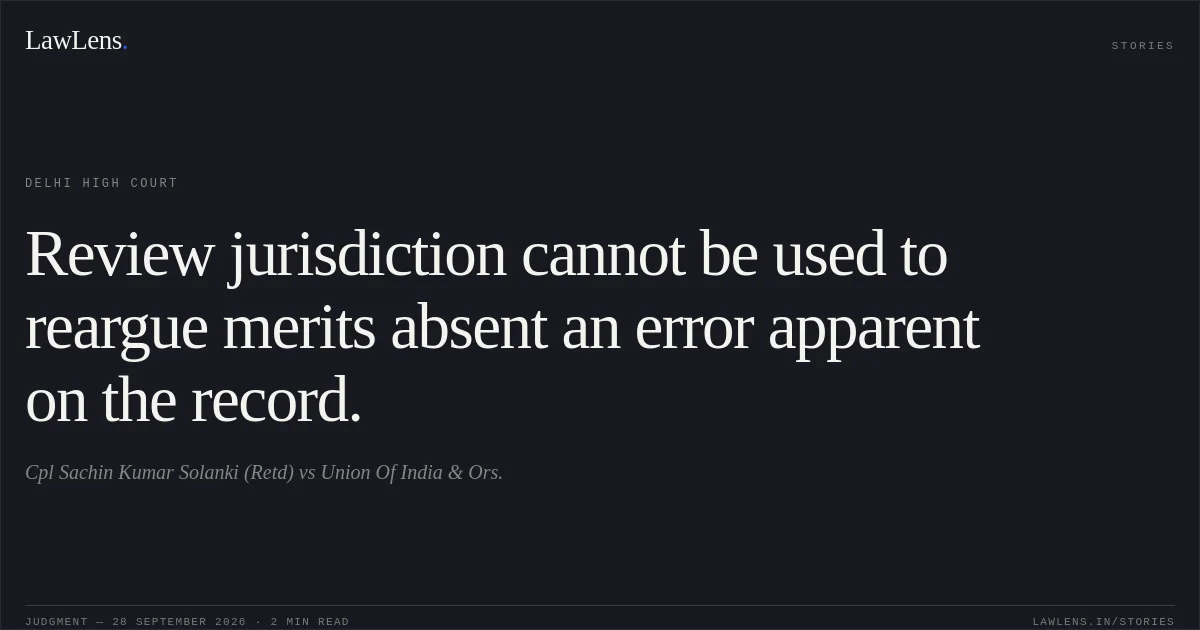
Source reference: paras. 1–4The Armed Forces Tribunal declined to interfere with the removal order, and the Delhi High Court dismissed the petitioner’s writ petition on 9 May 2026.
Source reference: paras. 1–4The petitioner sought review, contending that the judgment had not adequately addressed his arguments concerning the inquiry procedure, questions of law, the video’s content, and the proportionality of removal for a first offence.
Source reference: para. 5Issues
1. Whether the asserted lack of detailed consideration of the petitioner’s grounds disclosed an error apparent on the face of the record warranting review.
Source reference: paras. 5, 8, 152. Whether the review petition could be used to re-argue the merits of the judgment, including the inquiry procedure and proportionality of punishment.
Source reference: paras. 15–18Law Applied
Section 114 read with Order XLVII Rule 1 of the Code of Civil Procedure, 1908 permits review on the prescribed grounds, including an error apparent on the face of the record; review is not an appeal in disguise.
Source reference: para. 7An error apparent must be self-evident and not require a long-drawn process of reasoning, and an issue requiring elaborate examination or permitting reasonably different views ordinarily does not qualify (*Meera Bhanja v. Nirmala Kumari Choudhury*, (1995) 1 SCC 170).
Source reference: para. 7The Court also proceeded on the limited scope of judicial review under Articles 226 and 227 in the underlying writ proceedings.
Source reference: para. 4Reasoning
The Court found that the original judgment had considered the material challenges, including the undisputed recording and dissemination of the video, the petitioner’s opportunity to respond, the preliminary nature of the Court of Inquiry, the service-related social-media restrictions, the petitioner’s explanation, and the proportionality of the punishment.
Source reference: paras. 9–14The petitioner’s complaints about the extent of the discussion and the treatment of particular arguments sought a fresh examination of the merits, rather than correction of a self-evident error. Such reconsideration lay outside review jurisdiction.
Source reference: paras. 15–17Holding
The Court held that no error apparent on the face of the record or other ground under Order XLVII Rule 1 CPC had been established.
It dismissed the review petition and disposed of the pending application.
Source reference: paras. 18–19Acts & Sections Cited
1 provisions across 1 statute referred to in this judgment. Each provision opens on LawLens.
Code of Civil Procedure, 19081
Original Court PDF
Cpl Sachin Kumar Solanki (Retd)vsUnion Of India & Ors.
Click to open original judgment
Original judgment, available to read, download and summarize on LawLens.in