Facts
The petitioner, a successful L-1 bidder under an Expression of Interest dated 20 September 2023, was issued a Work Order dated 27 December 2023 for installation of a Mobile Planetarium in District Surguja. The petitioner claimed that it approached the respondents on 5 January 2024 and 29 January 2024 for delivery, installation and training, but that the respondents refused to accept performance. The District Collector subsequently declined to implement the Work Order by order dated 20 March 2026, and the District Education Officer directed refund of the Earnest Money Deposit by communication dated 23 March 2026.
Source reference: para. 2The petitioner challenged those actions in W.P.(C) No. 2290 of 2026, contending, inter alia, that Clause 4 of the Agreement required commencement of work within one month of the Work Order and that cancellation on the ground of non-completion was unjustified. The writ petition was dismissed on 15 July 2026 on the ground that the dispute concerned enforcement of reciprocal obligations under a non-statutory contract and involved disputed questions of fact unsuitable for adjudication under Article 226.
Source reference: para. 2The review petition was filed through Mr. Faiz Kazi, although the writ petition had been argued by Mr. Shalvik Tiwari; no one appeared for the petitioner at the hearing of the review petition.
Source reference: paras. 3–4Issues
Whether the review petition disclosed an error apparent on the face of the record in the order dated 15 July 2026 dismissing the writ petition?
Source reference: paras. 9–10, 18Whether the alleged inconsistency between Clause 4 of the Agreement and the reason given for cancellation of the Work Order warranted review of the earlier judgment?
Source reference: paras. 9–10Whether filing the review petition through counsel different from the counsel who argued the writ petition justified dismissal or otherwise affected the maintainability of the review petition?
Source reference: paras. 5–8, 18Law Applied
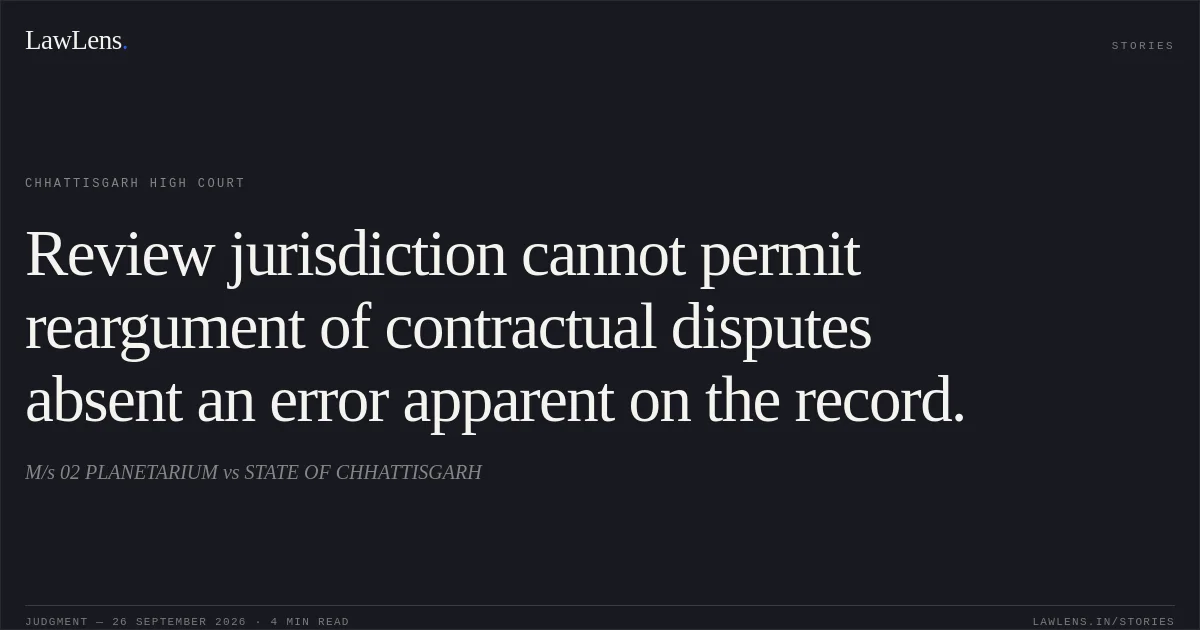
A review petition is governed by the limited scope of review under Order XLVII Rule 1 of the Code of Civil Procedure and cannot be used as an appeal or for rehearing a matter on merits. Under Tungabhadra Industries Ltd. v. Government of Andhra Pradesh, AIR 1964 SC 1372, and Parsion Devi v. Sumitri Devi, (1997) 8 SCC 715, only a patent or self-evident error apparent on the face of the record, and not an error requiring elaborate reasoning, can justify review.
Source reference: paras. 12, 15Sajjan Singh v. State of Rajasthan, AIR 1965 SC 845, M/s Northern India (India) Ltd. v. Lt. Governor of Delhi, (1980) 2 SCC 167, M/s Shanti Conductors (P) Ltd. v. Assam State Electricity Board, (2020) 2 SCC 677, and Kamlesh Verma v. Mayawati, (2013) 8 SCC 320, establish that review cannot be used to reargue issues already considered or to advance an alternative view.
Source reference: paras. 13–17The Court also relied on Tamil Nadu Electricity Board v. N. Raju Reddiar, (1997) 9 SCC 736, and subsequent Allahabad High Court decisions, which deprecated the practice of filing a review through a different counsel who had not argued the original matter, particularly where the review seeks rehearing on merits.
Source reference: paras. 5–8Reasoning
The Court held that the petitioner’s challenge regarding Clause 4, the alleged refusal to accept delivery, the petitioner’s readiness and willingness to perform, and the respondents’ alleged breach had already been considered in the writ proceedings.
Source reference: para. 10Determining whether performance was duly tendered, whether delivery was refused, whether time was the essence of the contract, and which party committed breach would require resolution of disputed facts and interpretation of contractual obligations. These matters did not establish a patent error in the earlier order, but instead sought reconsideration of the contractual dispute and a rehearing on merits.
Source reference: paras. 9–10, 18The change of counsel, by itself, could not create a ground for review; however, the Court noted that the review had been filed through counsel who had not argued the original writ petition and that the grounds substantially repeated issues available at the original hearing.
Source reference: paras. 5–8Applying the settled principles governing review jurisdiction, the Court found no error apparent on the face of the record.
Source reference: no citationHolding
The Court answered the issues against the petitioner. It held that the alleged inconsistency concerning Clause 4 and the cancellation of the Work Order did not constitute an error apparent on the face of the record and that the review petition impermissibly sought reconsideration of contractual issues already addressed in the writ judgment.
The Review Petition was accordingly dismissed, with no order as to costs.
Source reference: para. 19Original Court PDF
M/s 02 PLANETARIUMvsSTATE OF CHHATTISGARH
Click to open original judgment
Original judgment, available to read, download and summarize on LawLens.in