01Facts
The petitioner sought review of the Division Bench’s order dated 21 August 2024 in W.P. No. 26481 of 2023, concerning the Bank’s proceedings under Sections 13 and 14 of the Securitisation and Reconstruction of Financial Assets and Enforcement of Security Interest Act, 2002 (“SARFAESI Act”).
¶ 2 · p. 2A sale certificate had already been issued on 2 December 2022 in favour of intervenor Brijesh Tiwari, the successful auction purchaser, although possession had not been delivered.
¶ 5 · p. 3After the order under review, the Collector passed an order dated 6 December 2024 under Section 14 of the SARFAESI Act directing delivery of possession to the auction purchaser.
¶ 4–5, 12 · p. 3, 602Issues
i.Whether the petitioner established an error apparent on the face of the record warranting review of the order dated 21 August 2024, particularly on the alleged bar against SARFAESI proceedings?
¶ 2, 8, 11 · pp. 2, 4–6ii.Whether the petitioner could, in review jurisdiction, re-agitate the contention that the loan was recoverable as arrears of land revenue and that the Collector’s proceedings under Section 14 of the SARFAESI Act were invalid?
¶ 2, 8, 11–12 · pp. 2, 4–6iii.Whether any subsequent grievance concerning the Collector’s order dated 6 December 2024 and delivery of possession should be pursued through review proceedings or through the statutory remedy under Section 17 of the SARFAESI Act?
¶ 4, 12 · p. 3, 603Law Applied
The Court applied the principles governing review jurisdiction under Order XLVII Rule 1 of the Code of Civil Procedure, 1908, as summarised in Kamlesh Verma v. Mayawati, (2013) 8 SCC 320: review is maintainable upon discovery of new and important matter, an error apparent on the face of the record, or another analogous sufficient reason; it is not an appeal in disguise, cannot be used to reargue concluded issues, and does not lie merely because another view is possible.
¶ 9 · pp. 4–5Relying on State of West Bengal v. Kamal Sengupta, (2008) 8 SCC 612, the Court held that an error apparent must be prima facie visible and must not require detailed examination; an allegedly erroneous legal view is ordinarily not a ground for review.
¶ 10 · p. 5The Court also considered the SARFAESI Act, particularly Sections 13, 14 and 17: proceedings under Section 14 concern assistance in obtaining possession, while an aggrieved person has the statutory remedy of approaching the Debts Recovery Tribunal under Section 17.
¶ 4–5, 12 · p. 3, 6The Court further noted that Clause 11(b)(iv) of the Credit Guarantee Fund Scheme for Micro and Small Enterprises contemplated recovery proceedings under Section 13(4) of the SARFAESI Act.
¶ 6 · p. 3Provisions in the judgment · 3 · Linked ones open on LawLens
Securitisation and Reconstruction of Financial Assets and Enforcement of Security Interest Act, 2002 Section 13Section 14Section 17
04Reasoning
The Court held that the petitioner’s challenge did not disclose any patent or self-evident error.
¶ 8, 11 · pp. 4–6The contention that the loan schemes permitted recovery as arrears of land revenue, thereby excluding the SARFAESI Act, was the same contention already advanced and decided in the writ proceedings; its reassertion could not convert the review into an appellate rehearing.
¶ 8, 11 · pp. 4–6The Court also observed that the petitioner’s reliance on the loan schemes was inconsistent with the Credit Guarantee Fund Scheme, which contemplated recovery under Section 13(4) of the SARFAESI Act.
¶ 6 · p. 3Further, after the original order, the Collector had passed a fresh order dated 6 December 2024 under Section 14 directing delivery of possession. Any challenge to that subsequent order had to be pursued through an appropriate remedy, including the remedy under Section 17 before the DRT, rather than through review of the earlier judgment.
¶ 4, 12 · p. 3, 6Since the auction had concluded and a sale certificate had been issued, the Bank was required to facilitate delivery of possession to the successful auction purchaser.
¶ 5, 12 · p. 3, 605Holding
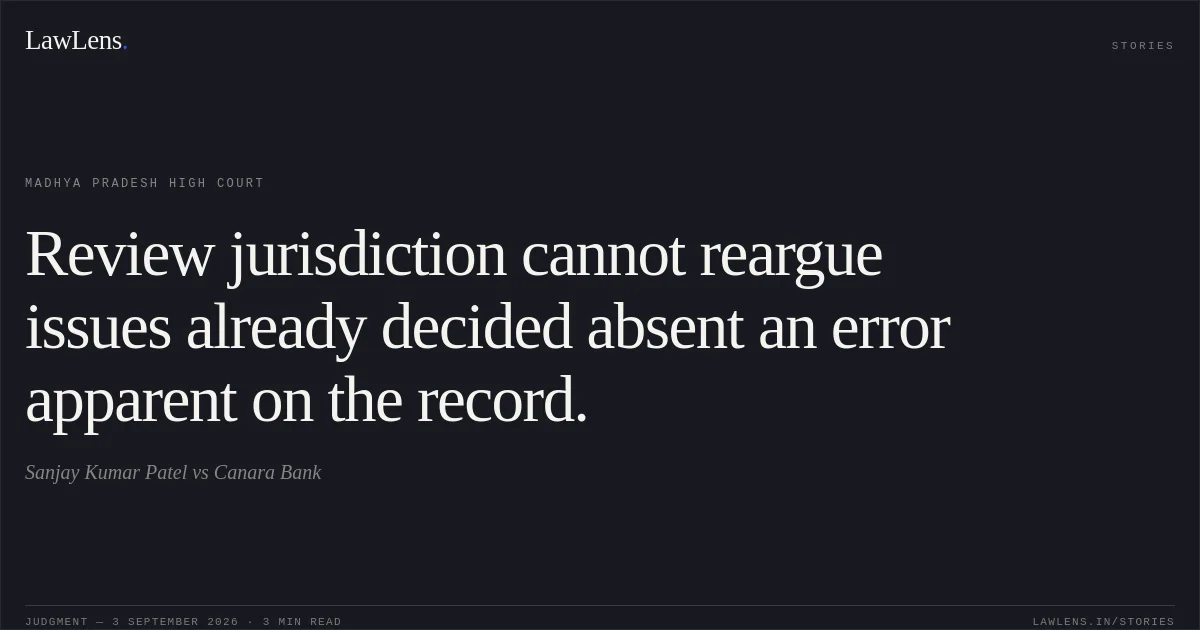
The Court answered the issues against the petitioner. It held that no error apparent on the face of the record, discovery of new evidence, or other sufficient ground for review had been established.
¶ 8, 11–13 · pp. 4–7The petitioner was impermissibly seeking reconsideration of issues already decided in the writ proceedings, while any challenge to the subsequent possession order required an independent statutory remedy rather than review jurisdiction.
¶ 8, 11–13 · pp. 4–7The review petition was accordingly dismissed, although the Court declined to impose costs.
¶ 13–14 · p. 7Original Court PDF
Sanjay Kumar PatelvsCanara Bank
Click to open original judgment
Original judgment, available to read, download and summarize on LawLens.in