Facts
The petitioners were appointed as Lower Division Clerks on compassionate grounds. Their appointment letters applied Finance Circular No. 06/2020 dated 28 July 2020, fixing their initial basic pay at ₹19,900 under Level-2 of the Central Seventh Pay Commission scale.
Source reference: para. 2In the original writ petition, this Court directed the Punjab State Power Corporation Ltd. to fix the petitioners’ pay in accordance with the applicable rules prevailing on the dates of their appointments and to release consequential benefits, including arrears, within three months. The Corporation’s appeal was disposed of as not pressed, with liberty to seek review.
Source reference: paras. 2–3The Corporation thereafter filed the review application, along with an application for condonation of 292 days’ delay, contending that the Punjab State Power Corporation Limited (Revised Pay) Regulations, 2021 had not been considered when the original judgment was delivered.
Source reference: paras. 4–6The delay was condoned.
Source reference: CM-14807-CWP-2026Issues
Whether the Corporation had established a ground under Order XLVII Rule 1 CPC—namely, discovery of new and important matter, error apparent on the face of the record, or any analogous sufficient reason—for reviewing the judgment dated 17 September 2025?
Source reference: paras. 8–11Whether the 2021 Revised Pay Regulations, particularly Regulation 2(2)(b), constituted new material which had not been within the knowledge of, or produced before, the Court despite due diligence?
Source reference: para. 13Whether the expression “applicable Rules as on the date of their appointment” required clarification so as to prevent any reduction in the petitioners’ existing emoluments and to identify the applicable revised pay scale?
Source reference: paras. 14–16Law Applied
The Court applied Article 226 of the Constitution read with Order XLVII Rule 1 and Section 151 CPC, under which review is limited to discovery of new and important matter or evidence that could not, despite due diligence, have been produced earlier; an error apparent on the face of the record; or another sufficient reason analogous to the specified grounds.
Source reference: para. 8A review cannot be used as an appeal or for re-appreciation of evidence, and an error must be self-evident rather than one requiring a process of reasoning.
Source reference: paras. 9–11The Court relied on Kamlesh Verma v. Mayawati, 2013 SCC OnLine SC 714, State of Telangana v. Mohd. Abdul Qasim (Died), 2024 INSC 310, and the principles stated in Aribam Tuleshwar Sharma v. Aribam Pishak Sharma and Parison Devi v. Sumitri Devi.
Source reference: paras. 9–11The Court also applied the principle, reflected in Saurabh Sharma v. State of Punjab, that statutory service rules governing an employee’s appointment cannot be displaced or diluted by executive instructions.
Source reference: paras. 2, 12The applicable pay was to be determined under the Punjab State Electricity Board Technical Services Grade-III Rules, 1996 and the Revised Pay Scales Rules, 2009, as modified by Finance Circulars operative on the respective dates of appointment.
Source reference: para. 16Reasoning
The Court held that the review application failed to identify any specific error apparent in the judgment under review.
Source reference: para. 12The Corporation’s assertion that the original judgment had proceeded solely on Saurabh Sharma and a line of authority beginning with State of U.P. v. Babu Ram Upadhyaya was inconsistent with the judgment’s actual reasoning.
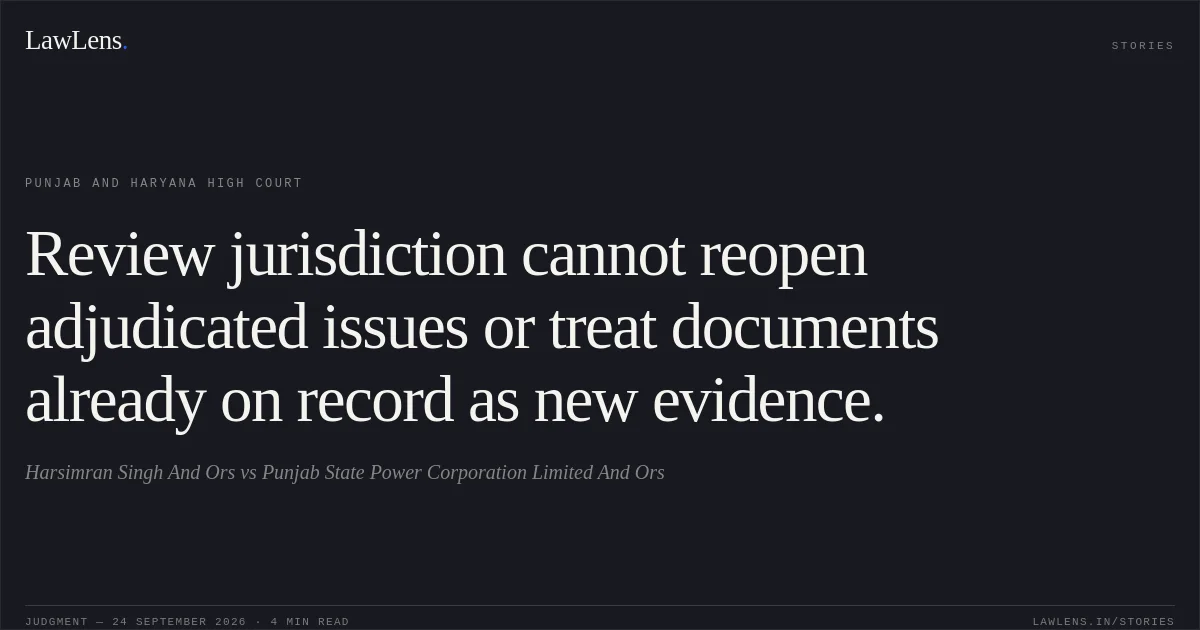
Source reference: para. 12Further, the 2021 Revised Pay Regulations and the challenge to Regulation 2(2)(b) had already been placed on record, pleaded, and expressly reflected in the prayer clause of the writ petition. They therefore could not qualify as newly discovered material under Order XLVII Rule 1 CPC.
Source reference: para. 13The remaining objections sought a fresh consideration of the merits and were consequently grounds of appeal rather than review.
Source reference: para. 14The Court nevertheless clarified the implementation of the original judgment. It rejected the Corporation’s apprehension that applying the rules would reduce the petitioners’ pay, observing that the Corporation had relied only on the original figures in the 1985 Regulations and 1996 Rules while ignoring subsequent revisions through Finance Circulars.
Source reference: para. 15Accordingly, “the applicable Rules as on the date of their appointment” was interpreted to include the 1996 Rules and the Revised Pay Scales Rules, 2009, as revised by Finance Circulars in force on the relevant appointment dates. The applicable scale was held to be ₹10,900–34,800 with Grade Pay of ₹3,400.
Source reference: para. 16Holding
The Court dismissed the review application, holding that no permissible ground for review was made out and that the Corporation’s contentions amounted to an attempt to re-argue the appeal on merits.
It directed the Corporation to comply with the original judgment dated 17 September 2025 within six weeks of receiving the certified copy of the order.
Source reference: para. 16The petitioners’ pay was to be fixed at the scale of ₹10,900–34,800 with Grade Pay of ₹3,400, together with consequential benefits and arrears.
Source reference: para. 16Costs of ₹50,000 were imposed on the Corporation, payable to the petitioners.
Source reference: para. 17In case of non-compliance, the petitioners were granted liberty to initiate appropriate contempt proceedings under Article 215 of the Constitution.
Source reference: para. 18Acts & Sections Cited
2 provisions across 2 statutes referred to in this judgment. Each provision opens on LawLens.
Limitation Act, 19631
Code of Civil Procedure, 19081
Original Court PDF
Harsimran Singh And OrsvsPunjab State Power Corporation Limited And Ors
Click to open original judgment
Original judgment, available to read, download and summarize on LawLens.in