Facts
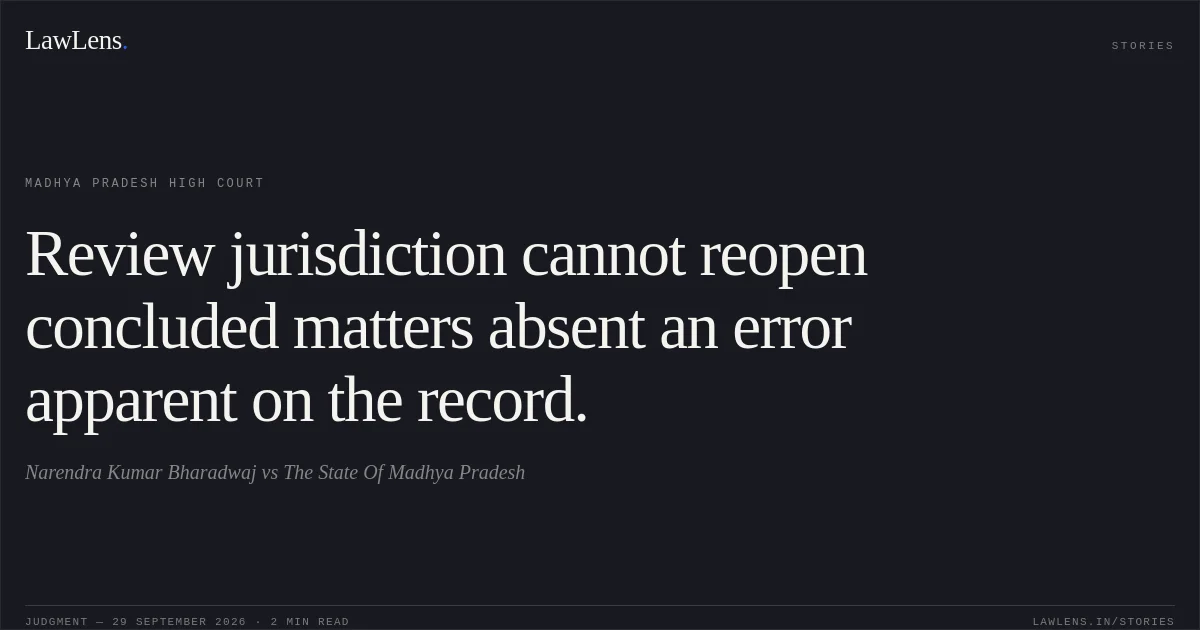
The petitioner, a contractual Sub-Engineer under MNREGA, sought review of the order dated 16 September 2026 dismissing his writ petition against the non-renewal of his contract and the consequential appellate order.
Source reference: pp. 1–2, 12He contended that the non-renewal followed allegations of misconduct and an inquiry conducted behind his back, making the action stigmatic and requiring an inquiry consistent with natural justice.
Source reference: pp. 1–2, 12He also relied on appellate orders granting relief to three other Sub-Engineers whose services had been discontinued by the same order.
Source reference: pp. 1–2, 12The State opposed review, arguing that the petition sought a rehearing and that it intended to seek review of the orders in the other employees’ cases.
Source reference: pp. 1–2, 12Issues
Whether the petitioner established an error apparent on the face of the record, or another ground under Order XLVII Rule 1 CPC, warranting review of the dismissal of his writ petition.
Source reference: paras. 8–14, 17–19Whether the decisions granting relief to other Sub-Engineers established a ground for review or a right to similar relief for the petitioner.
Source reference: para. 18Law Applied
Section 114 and Order XLVII Rule 1 CPC permit review on discovery of new and important evidence unavailable despite due diligence, an error apparent on the face of the record, or another sufficient reason.
Source reference: paras. 10–12Under Kamlesh Verma v. Mayawati, (2013) 8 SCC 320, and State of West Bengal v. Kamal Sengupta, (2008) 8 SCC 612, review is not an appeal in disguise; an apparent error must be self-evident and not require detailed reasoning or reappraisal of evidence.
Source reference: paras. 8–9Parsion Devi v. Sumitri Devi, (1997) 8 SCC 715, likewise distinguishes a patent error from an erroneous decision requiring reasoning to detect.
Source reference: para. 14K. Raghupathi v. State of U.P., (2022) 6 SCC 346, turns on the facts of that case and does not apply mechanically.
Source reference: paras. 15–16Article 14 does not permit “negative parity” or perpetuation of an irregular benefit granted in another case, as stated in Basawaraj v. Special Land Acquisition Officer, (2013) 14 SCC 81, and State of Odisha v. Anup Kumar Senapati, (2019) 19 SCC 626.
Source reference: para. 18Reasoning
The Court found that the petitioner’s reliance on the allegations, the alleged lack of inquiry, and K. Raghupathi did not reveal a patent error in the order under review; the cited precedent arose from different facts and could not be applied mechanically.
Source reference: paras. 15–17The petitioner’s arguments therefore did not satisfy the narrow grounds for review and instead sought reconsideration of the merits.
Source reference: paras. 15–17Nor did the other Sub-Engineers’ appellate orders establish entitlement to relief: those orders were based on individual facts, and any benefit granted in another case could not, without more, create a right through negative parity.
Source reference: para. 18Holding
The Court held that no error apparent on the face of the record or other ground for review had been established.
It dismissed the review petition as devoid of merit.
Source reference: paras. 19–20Acts & Sections Cited
1 provisions across 1 statute referred to in this judgment. Each provision opens on LawLens.
Code of Civil Procedure, 19081
Original Court PDF
Narendra Kumar BharadwajvsThe State Of Madhya Pradesh
Click to open original judgment
Original judgment, available to read, download and summarize on LawLens.in