Facts
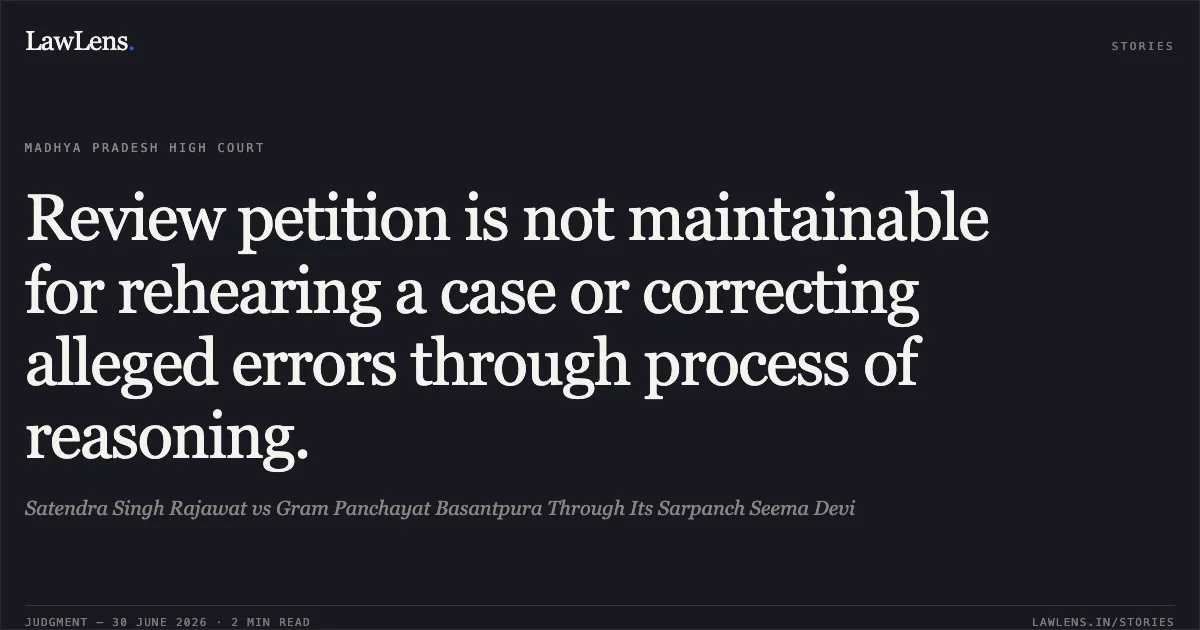
The petitioner filed a review petition under Order 47 Rule 1 of the CPC against an order dated April 27, 2026, passed in W.P. No. 3059/2017
Source reference: para. 1In the original writ petition, the High Court had directed the Collector of District Bhind to conduct an inquiry against the petitioner (respondent No. 6 in the writ) based on a complaint and a report from the Rural Engineering Services
Source reference: para. 3The petitioner sought a recall of that order, arguing that there were no specific allegations against him
Source reference: para. 2Issues
1. Whether the petitioner made out a case for the exercise of review jurisdiction based on an error apparent on the face of the record or the discovery of new evidence
Source reference: para. 4 / para. 92. Whether the court’s previous direction to conduct an inquiry, while providing the petitioner with an opportunity to be heard, constituted a miscarriage of justice or a patent error
Source reference: para. 12Law Applied
The court primarily applied Order 47 Rule 1 and Section 114 of the Code of Civil Procedure (CPC), which limit review to cases involving the discovery of new evidence, mistakes or errors apparent on the face of the record, or other analogous "sufficient reasons"
Source reference: para. 7 / para. 8The court relied on Kamlesh Verma v. Mayawati, emphasizing that a review is not a "rehearing" or an "appeal in disguise" and cannot be granted for minor mistakes or the possibility of a different view
Source reference: para. 5It cited State of West Bengal v. Kamal Sengupta to clarify that an "error apparent" must be prima facie visible without detailed examination
Source reference: para. 6Col. Avatar Singh Sekhon v. Union of India, which establishes that a review is a serious step only taken to correct glaring omissions or patent mistakes
Source reference: para. 10Reasoning
The court reasoned that the petitioner failed to demonstrate any manifest error or discovery of new material that would undermine the original order's soundness
Source reference: para. 12The court noted that the previous order already protected the petitioner's rights by mandating a personal opportunity of being heard during the Collector's inquiry
Source reference: para. 4The court observed that the petitioner’s arguments—specifically that there were no allegations against him—could be raised directly before the Collector during the inquiry process rather than through a review
Source reference: para. 4Following the principles in Parsion Devi v. Sumitri Devi, the court determined that since the alleged error was not self-evident and would require a process of reasoning to detect, it did not satisfy the strict criteria for review jurisdiction
Source reference: para. 11Holding
The court held that no apparent error existed on the face of the record to warrant judicial interference
Consequently, the review petition was dismissed
Source reference: para. 13The court maintained its previous direction for the Collector to conclude the inquiry within four months, ensuring all parties, including the petitioner, are heard in accordance with the law
Source reference: para. 3 / para. 4Acts & Sections Cited
1 provisions across 1 statute referred to in this judgment. Each provision opens on LawLens.
Code of Civil Procedure, 19081
Original Court PDF
Satendra Singh RajawatvsGram Panchayat Basantpura Through Its Sarpanch Seema Devi
Click to open original judgment
Original judgment, available to read, download and summarize on LawLens.in