Facts
The petitioner challenged the punishment order dated 28 November 2022, the subsequent order dated 9 January 2023, and the consequential charge-sheet issued by the departmental authorities.
Source reference: para. 1A common/joint charge-sheet was issued against the petitioner and Manish Kumar Sharma, pursuant to which a joint departmental inquiry was conducted and a common punishment order was passed against both employees.
Source reference: paras. 2, 5The appeal against the punishment order was rejected on 9 January 2023 by D. Srinivas Verma, who was also the authority involved in the earlier disciplinary action.
Source reference: para. 5Manish Kumar Sharma had earlier challenged substantially identical orders in W.P. No. 27374 of 2023, which was allowed by the High Court on the ground that the order dated 9 January 2023 was contrary to Regulation 270 of the M.P. Police Regulations, 1959, particularly because it was passed by the same authority and without adherence to the prescribed procedure.
Source reference: paras. 2, 5, 9The State opposed the petition, principally contending that it was delayed, but was unable to distinguish the petitioner’s case from that of Manish Kumar Sharma.
Source reference: para. 3The petitioner stated that he approached the Court promptly after learning of the relief granted to the similarly situated co-delinquent.
Source reference: para. 6Issues
1. Whether the disciplinary and appellate/revisional orders passed in the petitioner’s case were without jurisdiction because the same authority purported to revise or alter the earlier disciplinary decision, contrary to Regulation 270 of the M.P. Police Regulations, 1959?
Source reference: paras. 5, 7, 112. Whether the impugned orders and consequential charge-sheet were vitiated for failure to provide notice and an opportunity of hearing, as required by the proviso to Regulation 270 and the principles of natural justice?
Source reference: paras. 6–93. Whether the petitioner, being identically situated with Manish Kumar Sharma and having participated in common disciplinary proceedings, was entitled to the same relief notwithstanding the alleged delay in filing the writ petition?
Source reference: paras. 5–8, 10–12Law Applied
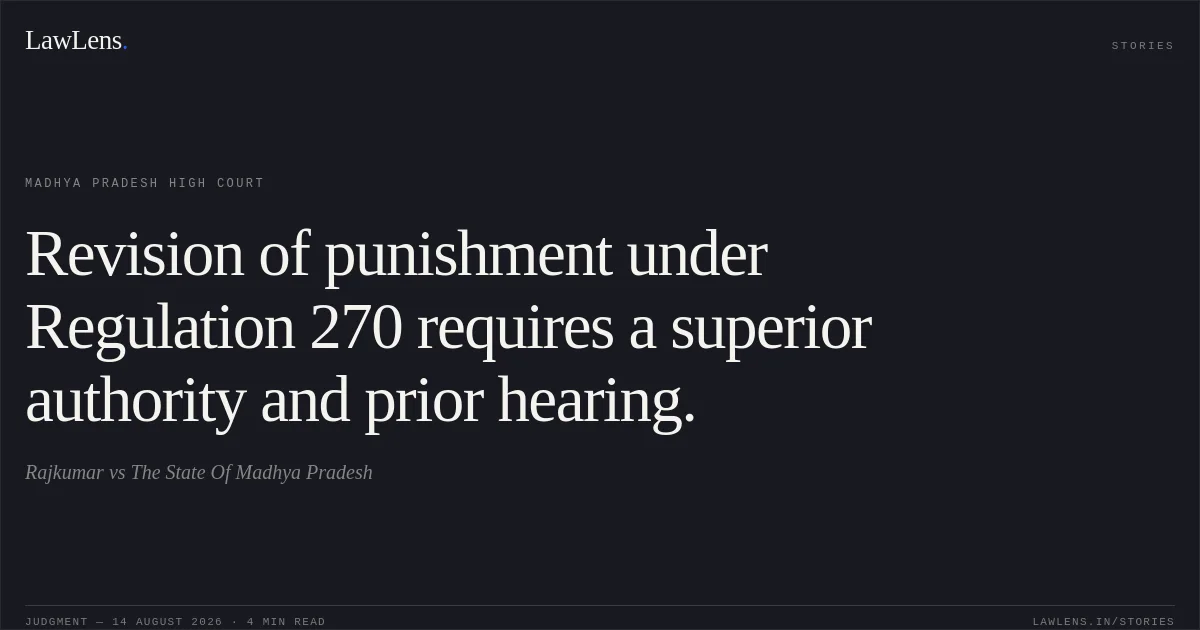
Regulation 270 of the M.P. Police Regulations, 1959 permits suo motu revision of an order of punishment or exoneration by an authority superior to the authority that made the order; it also requires compliance, as far as applicable, with Regulations 266, 267, 268 and 271, and prohibits variation or reversal of an order unless notice is served on the interested parties and an opportunity of hearing is provided.
Source reference: para. 6The Court relied on Sant Lal v. State of M.P., W.A. No. 404/2017, which held that an opportunity of hearing is mandatory before action is taken under the proviso to Regulation 270.
Source reference: para. 6The Court also relied on Rajendra Kumar Chaturvedi v. State of M.P., 2010 (1) MPLJ 417, concerning the requirement of natural justice before altering a disciplinary order.
Source reference: para. 9The Court also followed its earlier decision in Manish Kumar Sharma, where materially identical orders were quashed because the same authority had revised its earlier decision without jurisdiction and without hearing the delinquent employee.
Source reference: para. 9On delay and equal treatment, the Court referred to BSNL v. Ghanshyam Dass, (2011) 4 SCC 374, and State of Uttar Pradesh v. Arvind Kumar Shrivastava, (2015) 1 SCC 347, recognising that similarly situated employees should not be discriminated against and may receive the same relief where the factual and legal circumstances are identical.
Source reference: paras. 7–8Reasoning
The Court found that the petitioner and Manish Kumar Sharma had been proceeded against through a common charge-sheet and joint departmental inquiry, punished by a common order, and subjected to rejection of their appeals by a common order.
Source reference: para. 5Since the same authority, D. Srinivas Verma, had acted in relation to the earlier disciplinary decision and thereafter passed the impugned order, the exercise was inconsistent with Regulation 270, which contemplates revision by an authority superior to the authority that made the original order.
Source reference: paras. 5–7Further, the impugned action was taken without the required notice or opportunity of hearing, violating both the express proviso to Regulation 270 and the principles of natural justice.
Source reference: paras. 6–9The State could not distinguish the petitioner’s case from the earlier decision in Manish Kumar Sharma.
Source reference: no citationThe Court therefore held that the petitioner was identically situated and entitled to the same relief.
Source reference: no citationThe objection of delay was rejected in substance because the petitioner approached the Court soon after learning of the relief granted to the similarly situated co-delinquent, and denial of equivalent relief would result in impermissible discrimination.
Source reference: paras. 6, 8, 10–11Holding
The Court held that the impugned punishment order dated 28 November 2022, order dated 9 January 2023, and consequential charge-sheet dated 2 January 2023, as referred to in the operative reasoning, were unsustainable for want of jurisdiction and violation of Regulation 270 and natural justice.
Applying the principle of equal treatment to the petitioner, who was identically situated with Manish Kumar Sharma, the Court quashed and set aside all three impugned orders and consequential actions.
Source reference: paras. 10–12The writ petition was accordingly disposed of in favour of the petitioner.
Source reference: para. 12Original Court PDF
RajkumarvsThe State Of Madhya Pradesh
Click to open original judgment
Original judgment, available to read, download and summarize on LawLens.in