Facts
The petitioner was convicted under Section 138 of the Negotiable Instruments Act, 1881, for dishonour of a cheque for ₹5,00,000, and sentenced to six months’ rigorous imprisonment and compensation of ₹6,13,000, with a further three months’ rigorous imprisonment in default.
Source reference: para. 1The Sessions Court affirmed the conviction and sentence.
Source reference: para. 1In revision, both parties sought compounding of the offence, stating that they had voluntarily settled the dispute and that the petitioner had paid the settled amount.
Source reference: paras. 1–4The Principal Registrar verified the compromise as voluntary and confirmed payment.
Source reference: paras. 1–4The petitioner sought setting aside of the judgments below and acquittal on the basis of the compromise.
Source reference: para. 5Issues
Whether the parties’ verified compromise and payment of the settled amount justified compounding the Section 138 offence and setting aside the conviction and sentence
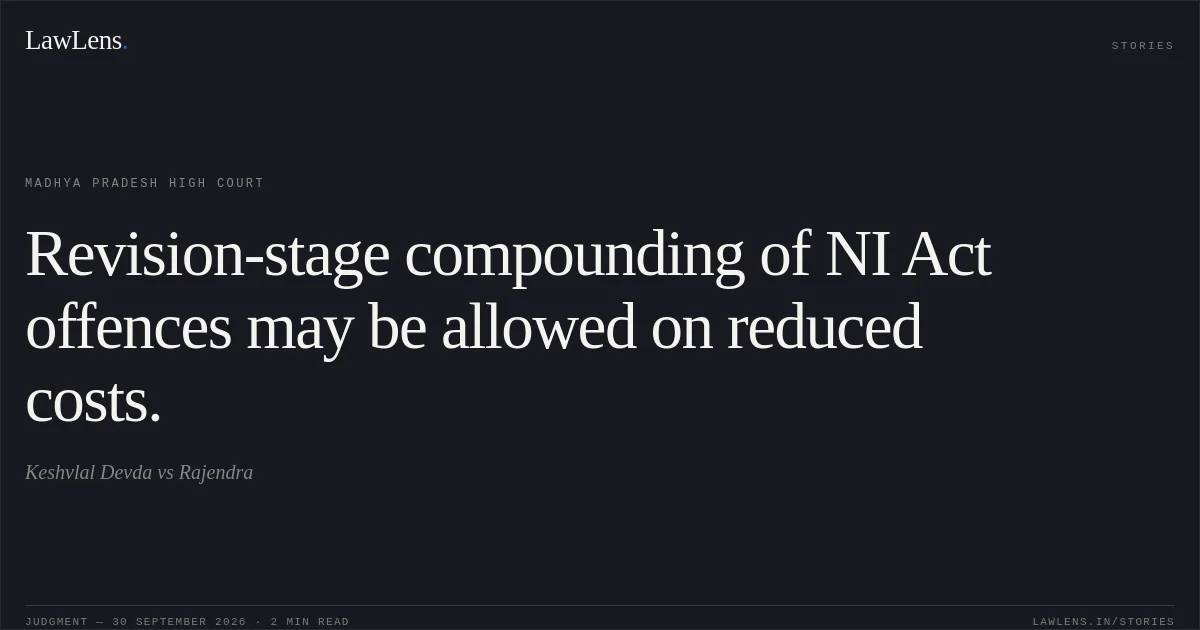
Source reference: paras. 3–5, 8–9Whether, given that compounding was sought at the revision stage, the petitioner should be directed to pay costs under the principles in Damodar S. Prabhu v. Sayed Babalal H., and, if so, in what amount
Source reference: paras. 6–7, 10Law Applied
Section 138 of the Negotiable Instruments Act, 1881, creates the offence of cheque dishonour, while Section 147 permits compounding of offences under the Act.
Source reference: para. 3Section 359 of the Bharatiya Nagarik Suraksha Sanhita, 2023, was also invoked in the parties’ applications.
Source reference: para. 3In Damodar S. Prabhu v. Sayed Babalal H., (2010) 5 SCC 663, the Supreme Court set out a graded costs scheme to encourage early compounding: ordinarily, compounding sought before a Sessions Court or High Court in appeal or revision attracts costs of 15% of the cheque amount; it also recognised that the competent court may reduce costs in the circumstances of a case, recording reasons in writing.
Source reference: paras. 6–7Reasoning
The High Court found that the compromise had been independently verified, was voluntary, and had been performed through payment of the settled amount.
Source reference: paras. 4, 8–9Considering the private nature of the dispute and the parties’ expressed wish to end the litigation, it accepted the compromise and set aside the lower courts’ judgments.
Source reference: paras. 4, 8–9Because the settlement occurred at the revision stage, the Court applied the principles in Damodar S. Prabhu and directed payment of costs.
Source reference: para. 10It fixed the costs at 1% of the cheque amount—₹5,000—rather than the guideline figure stated for revision proceedings.
Source reference: para. 10Holding
The revision was allowed; the compromise was accepted, the judgments of the courts below were set aside, and the petitioner was acquitted of the Section 138 offence, subject to depositing ₹5,000 with the Secretary, High Court Legal Services Authority, Indore, within ten days.
The petitioner’s bail bonds were to stand discharged upon compliance.
Source reference: paras. 11–12If he failed to deposit the amount within the stipulated period, the acquittal would not enure to his benefit and he would remain liable to undergo the trial court’s sentence.
Source reference: paras. 11–12Acts & Sections Cited
6 provisions across 3 statutes referred to in this judgment. Each provision opens on LawLens.
Bharatiya Nagarik Suraksha Sanhita, 20233
Negotiable Instruments Act, 18812
Code of Criminal Procedure, 19731
Original Court PDF
Keshvlal DevdavsRajendra
Click to open original judgment
Original judgment, available to read, download and summarize on LawLens.in