Facts
Respondent No. 2 lodged FIR I-C.R. No. 77 of 2008 at Paddhari Police Station against Applicant No. 1 for offences under Sections 406, 409 and 420 IPC. During investigation, certain registered sale deeds standing in the names of the applicants were seized as muddamal documents.
Source reference: paras. 4.1–4.2; pp. 2–4The applicants obtained release of the documents from the Sessions Court on the condition that they preserve them and produce the originals or certified copies when directed by the Trial Court.
Source reference: paras. 4.1–4.2; pp. 2–4Respondent No. 2 subsequently sought production of the sale deeds before the Trial Court under Exh. 207. By order dated 22 November 2024, the Judicial Magistrate First Class, Paddhari allowed the application and directed production of the original documents or certified copies.
Source reference: para. 4.3; p. 4Respondent No. 2 challenged that order in Criminal Revision Application No. 237 of 2024. The Sessions Court allowed the revision, set aside the Magistrate’s order and directed production of the original documents for inspection.
Source reference: para. 4.4; p. 4The applicants challenged the Sessions Court’s order before the High Court under Sections 438 read with 442 of the BNSS.
Source reference: no citationIssues
Whether the Magistrate’s order dated 22 November 2024 directing production of the original sale deeds or certified copies was an interlocutory order under Section 438(2) of the BNSS?
Source reference: para. 9(i); p. 10Whether the revision preferred by Respondent No. 2 before the Sessions Court was maintainable?
Source reference: para. 9(ii); p. 10Whether the Sessions Court was justified in substituting the Magistrate’s direction permitting production of originals or certified copies with a mandatory direction to produce the originals?
Source reference: para. 9(iii); p. 10Whether the High Court’s revisional jurisdiction should be exercised to interfere with the Sessions Court’s order?
Source reference: para. 9(iv); p. 10Law Applied
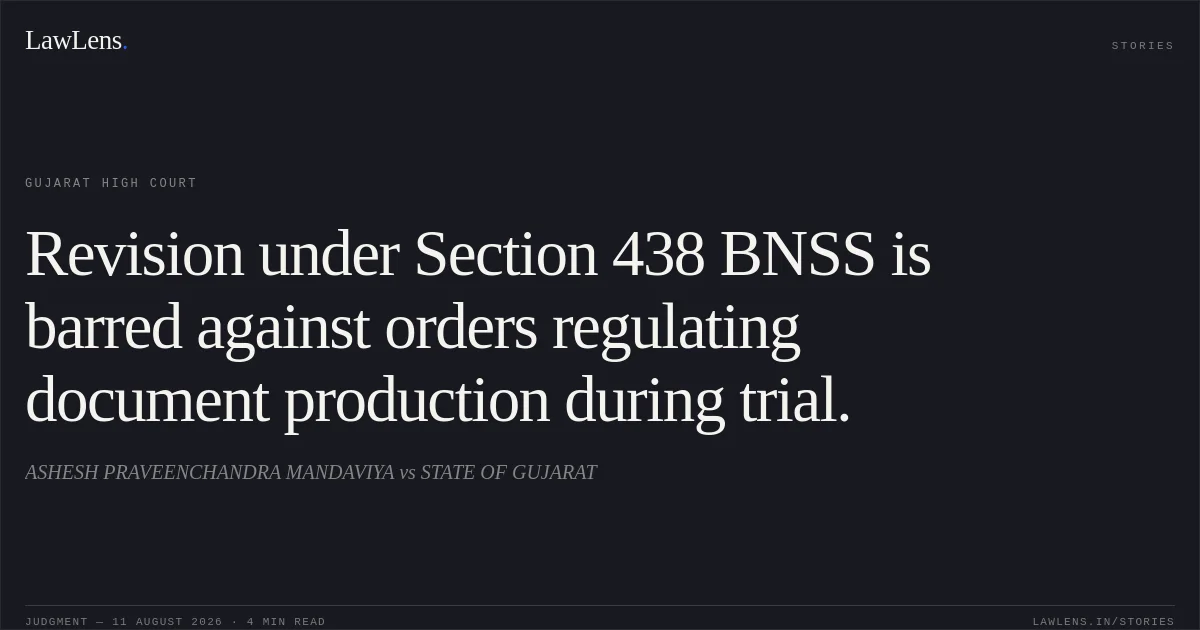
Section 438(1) of the BNSS empowers the High Court or Sessions Court to examine the correctness, legality or propriety of orders passed by inferior criminal courts, while Section 438(2) expressly bars revision against interlocutory orders passed in an appeal, inquiry, trial or other proceeding.
Source reference: paras. 10–10.1; pp. 11–12Applying the principles under the substantially identical Section 397(2) CrPC, Amar Nath v. State of Haryana holds that purely interim orders which do not determine important rights or liabilities are interlocutory, whereas orders substantially affecting such rights are revisable.
Source reference: para. 11.1; pp. 13–14Bhaskar Industries Ltd. v. Bhivani Denim & Apparels Ltd. and Girish Kumar Suneja v. CBI recognise the distinction between final, intermediate and interlocutory orders and apply the test of whether setting aside the order would terminate or materially conclude the proceedings.
Source reference: paras. 11.2–11.3; pp. 14–19Section 438(3) bars a further revision by the same person who has already invoked revisional jurisdiction before either the High Court or Sessions Court.
Source reference: para. 16; pp. 26–27Questions of admissibility, mode of proof and evidentiary value of documents are to be determined by the Trial Court under the applicable law of evidence.
Source reference: para. 14.1; pp. 23–24Reasoning
The High Court held that the Magistrate’s order merely regulated the manner in which the sale deeds were to be produced during the pending trial.
Source reference: paras. 13–13.1; pp. 20–22Respondent No. 2 had substantially obtained the relief sought because production of the documents was directed; the only dispute concerned whether production of certified copies would suffice in addition to originals.
Source reference: paras. 13–13.1; pp. 20–22The order did not determine guilt, admissibility, evidentiary value, execution, contents or any substantive right, nor would its reversal terminate or materially alter the criminal proceedings. It was therefore interlocutory, attracting the jurisdictional bar under Section 438(2) BNSS.
Source reference: paras. 13–13.2; pp. 20–22The Sessions Court consequently lacked jurisdiction to entertain Respondent No. 2’s revision and also exceeded the limited scope of revisional jurisdiction by substituting its procedural preference for that of the Magistrate without identifying perversity, patent illegality, jurisdictional error or material irregularity.
Source reference: para. 13.3; pp. 22–23The present revision was held maintainable under Section 438(3) BNSS because it was filed by the applicants, who had not themselves earlier invoked revisional jurisdiction; they were merely respondents in the Sessions Court revision.
Source reference: para. 16; pp. 26–27The High Court declined to decide whether certified copies were admissible or whether originals were mandatory, leaving those matters to the Trial Court.
Source reference: paras. 14.1 and 19; pp. 23–24, 30–31Holding
The High Court allowed the criminal revision application and quashed and set aside the Sessions Court’s judgment dated 1 March 2025.
It restored the Magistrate’s order dated 22 November 2024 permitting production of the original sale deeds or certified copies.
Source reference: para. 18; pp. 30–31The Court held that Respondent No. 2’s revision before the Sessions Court was barred under Section 438(2) BNSS because it challenged an interlocutory procedural order.
Source reference: paras. 15, 17–20; pp. 24–31It clarified that the Trial Court may, at a later stage and for recorded reasons, require production or inspection of the original documents if necessary for a just decision, and that the applicants remain bound by subsisting directions to preserve and produce the originals.
Source reference: paras. 15, 17–20; pp. 24–31Acts & Sections Cited
9 provisions across 3 statutes referred to in this judgment. Each provision opens on LawLens.
Bharatiya Nagarik Suraksha Sanhita, 20233
Indian Penal Code, 18603
Code of Criminal Procedure, 19733
Original Court PDF
ASHESH PRAVEENCHANDRA MANDAVIYAvsSTATE OF GUJARAT
Click to open original judgment
Original judgment, available to read, download and summarize on LawLens.in