Facts
The petitioner and respondent Naresh Singh were real brothers and sons of late Jagroop Singh. The petitioner claimed that their father had executed a Will in his favour concerning land bearing Survey No. 1630 at Ambah.
Source reference: para. 2; pp. 1–2On the basis of the Will, the Tehsildar, Ambah, ordered mutation of the land in the petitioner’s favour on 30 July 1994 under Section 110 of the Madhya Pradesh Land Revenue Code. Naresh Singh challenged the mutation order before the Sub-Divisional Officer, Ambah, in Appeal No. 139/1993-94.
Source reference: para. 2; pp. 1–2During the appeal, an application for interim relief under Section 52 of the Code was filed, upon which the Sub-Divisional Officer passed an order dated 2 August 1994. The petitioner challenged that interlocutory order before the Additional Collector and thereafter the Commissioner. The matter ultimately reached the Board of Revenue.
Source reference: para. 2; pp. 1–2Issues
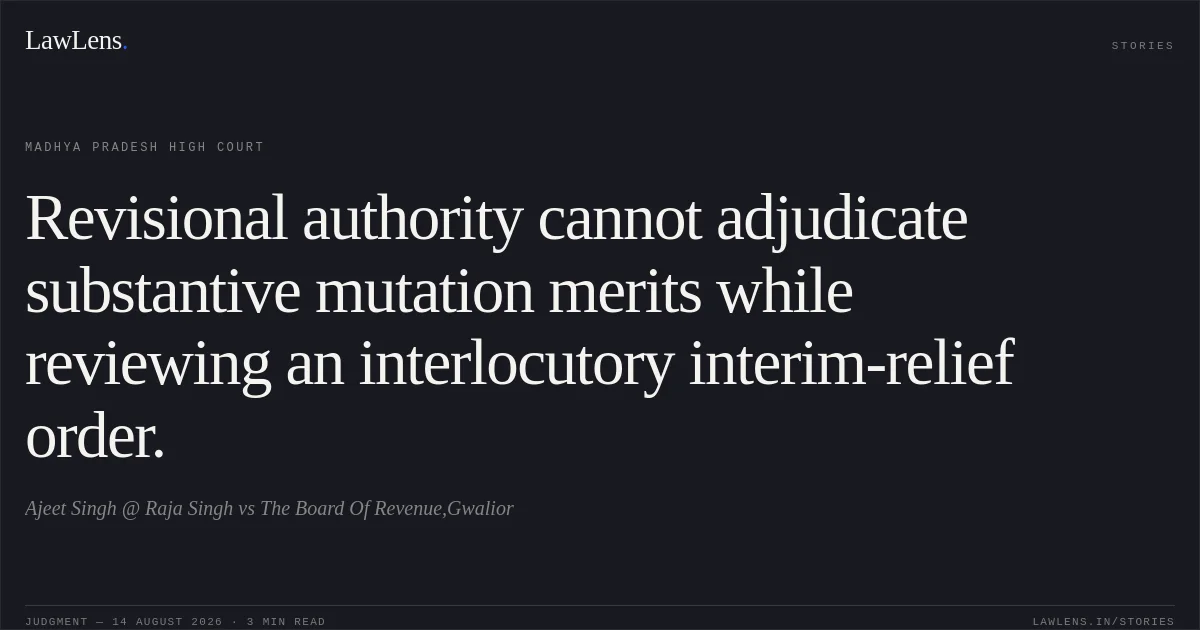
Whether the Board of Revenue, while exercising revisional jurisdiction over an interlocutory order concerning interim relief under Section 52 of the Madhya Pradesh Land Revenue Code, could examine and set aside the substantive mutation order passed by the Tehsildar.
Source reference: paras. 7–8; pp. 4–5Whether the Board of Revenue could make observations concerning the nature and validity of the Will when the appeal against the mutation order was pending before the Sub-Divisional Officer.
Source reference: paras. 8–9; pp. 4–5Whether the matter ought to be remanded to the Sub-Divisional Officer for fresh adjudication of the pending appeal.
Source reference: paras. 9–10; pp. 5–6Law Applied
The Court applied Article 226 of the Constitution of India in reviewing the legality and jurisdictional limits of the revenue authorities’ orders.
Source reference: para. 1Section 110 of the Madhya Pradesh Land Revenue Code governed the mutation proceedings, while Section 52 governed the application for interim relief.
Source reference: para. 2The Court applied the principle that a revisional authority must confine its consideration to the order and proceedings properly brought before it and cannot enlarge the scope of revision to adjudicate an independent substantive dispute, particularly where that dispute is pending before the competent appellate authority.
Source reference: paras. 7–8The Court further applied the principles of natural justice and fair adjudication by requiring that the pending appeal be decided after adequate opportunity of hearing to all concerned parties.
Source reference: paras. 9, 11–13Reasoning
The Court found that the proceedings before the higher revenue authorities arose from an interlocutory order relating to interim relief under Section 52, whereas the original mutation order was independently under challenge before the Sub-Divisional Officer.
Source reference: para. 7Accordingly, the Board of Revenue was required to confine its revisional examination to the legality of the interim-relief order. By entering into the merits of the mutation proceedings, making observations regarding the Will, and directing reconsideration of the mutation proceedings, the Board enlarged the scope of revision and substantially prejudged issues falling within the jurisdiction of the Sub-Divisional Officer.
Source reference: para. 8Since the substantive appeal remained pending, the High Court declined to express any opinion on the validity or legal effect of the Will and considered remand to the competent appellate authority to be the appropriate course.
Source reference: paras. 9–10Holding
The Court held that the Board of Revenue had exceeded the permissible scope of its revisional jurisdiction by adjudicating the merits of the mutation proceedings and commenting upon the Will while dealing with an interlocutory interim-relief matter.
The order dated 30 April 2008 passed by the Board of Revenue in Revision No. 195/1996 was set aside. The matter was remanded to the Sub-Divisional Officer, Ambah, to decide afresh the pending appeal arising from the Tehsildar’s order dated 30 July 1994, after granting adequate opportunity of hearing to the petitioner and other concerned parties.
Source reference: para. 11The Sub-Divisional Officer was directed to decide the appeal independently, uninfluenced by observations of the Board of Revenue or the High Court, preferably within three months from receipt of the certified copy of the order.
Source reference: paras. 12–14Acts & Sections Cited
2 provisions across 1 statute referred to in this judgment. Each provision opens on LawLens.
MP Land Revenue Code 19592
Original Court PDF
Ajeet Singh @ Raja SinghvsThe Board Of Revenue,Gwalior
Click to open original judgment
Original judgment, available to read, download and summarize on LawLens.in