Facts
The petitioners were successful bidders in a government auction of lands (Survey Nos. 1009 and 1010) in Village Pandad, for which sanads were issued on 30.04.1977.
Source reference: p. 2To benefit the community, 38 purchasers transferred the lands to a cooperative society (Pandad Anusuchit Jati Samuhik Co-operative Kheti Society Ltd.) with the Collector's permission, subject to a condition that if the society went into liquidation, the lands would revert to the original auction purchasers.
Source reference: p. 3, 16The society was ordered into liquidation on 06.03.1999, a decision confirmed by the SSRD in 2013 and never challenged further.
Source reference: p. 8, 17Following various rounds of litigation and multiple remands, the Collector, Anand, passed an order on 05.04.2018 restoring the lands to the petitioners.
Source reference: p. 10, 18The private respondents (society members) challenged this before the SSRD, which, through the impugned order dated 11.09.2018, set aside the Collector's order and remanded the matter for a fourth time based on issues not previously raised.
Source reference: p. 11, 19Issues
1. Whether the private respondents (members of a dissolved society) possessed the locus standi to contest the restoration of land to the original purchasers after the society went into liquidation.
Source reference: p. 8, 212. Whether the revisional authority (SSRD) exceeded its jurisdiction by remanding the matter based on issues not raised by the parties and travelling beyond the scope of the proceedings.
Source reference: p. 10, 22Law Applied
Provisions of the Bombay Land Revenue Code regarding restricted tenure and the restoration of revenue entries.
Source reference: p. 2The principle of Finality of Administrative Orders, specifically concerning the liquidation order under the Gujarat Co-operative Societies Act.
Source reference: p. 8, 17The principle of Scope of Revisional Jurisdiction, which dictates that a revisional authority must adjudicate based on the grounds raised by the parties and cannot independently formulate entirely new issues extraneous to the core dispute.
Source reference: p. 10, 22Reasoning
The court reasoned that the society ceased to exist legally upon the finality of the liquidation order and the dismissal of the revision by the Additional Secretary.
Source reference: p. 8, 19The private respondents, who were merely members and not owners or auction purchasers, had no legal right, title, or interest in the property to maintain a challenge against the Collector's order.
Source reference: p. 12, 21The Collector had already complied with previous remand directions by scrutinizing documentary evidence and confirming that no breach of statutory provisions occurred, especially since the original grant conditions explicitly mandated reversion to the purchasers upon the society's dissolution.
Source reference: p. 10, 21The court found the SSRD’s third remand order to be perverse because it formulated four new issues—such as current land use and alternative employment—which were neither argued by the respondents nor relevant to the legal determination of ownership and restoration under the sanad conditions.
Source reference: p. 10, 22-23Holding
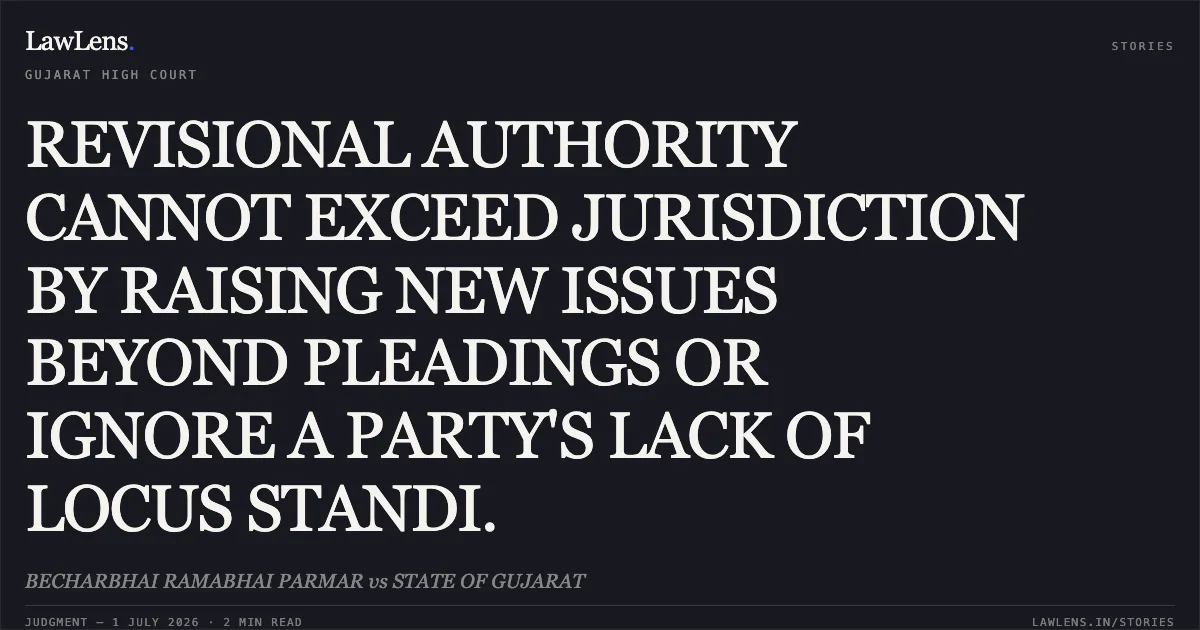
The Court held that the private respondents lacked locus standi as the society was defunct and that the SSRD had exceeded its jurisdiction by travelling beyond the scope of the pleadings.
The Court allowed the petition, quashed the impugned SSRD order dated 11.09.2018, and confirmed the Collector’s order dated 05.04.2018, directing revenue authorities to restore the property and revenue entries to the petitioners.
Source reference: p. 23, 24Acts & Sections Cited
2 provisions across 2 statutes referred to in this judgment. Linked provisions open on LawLens.
Bombay Land Revenue Code1
Gujarat Co-Operative Societies Act, 19611
Original Court PDF
BECHARBHAI RAMABHAI PARMARvsSTATE OF GUJARAT
Click to open original judgment
Original judgment, available to read, download and summarize on LawLens.in


