Facts
The applicant-wife and respondent-husband solemnised their Nikah on 14 March 2016.
Source reference: paras. 4–5; pp. 2–4The wife alleged that the husband had concealed his earlier marriage, subjected her to physical and mental cruelty, and deserted her without sufficient cause.
Source reference: paras. 4–5; pp. 2–4She further alleged that he had substantial means through construction, money-lending, cricket betting and ownership or use of high-value vehicles, and therefore claimed maintenance of ₹80,000 per month under Section 125 of the Code of Criminal Procedure, 1973 (“CrPC”).
Source reference: paras. 4–5; pp. 2–4The Family Court, Anand, held that the husband had deserted the wife without reasonable cause and that she was entitled to maintenance.
Source reference: para. 6; p. 4However, considering the evidence regarding the husband’s actual income, it awarded ₹10,000 per month from 4 November 2019, the date of filing of the application, and directed payment of arrears.
Source reference: para. 6; p. 4The wife challenged the quantum in revision under Sections 397 and 401 CrPC, seeking enhancement to ₹80,000 per month.
Source reference: paras. 2, 7; pp. 1–2, 5The Family Court had noted that the husband had not filed income-tax returns for several years, that his bank statements showed deposits exceeding his disclosed income, and that he used a Fortuner, Swift and Harley Davidson motorcycle.
Source reference: para. 13; pp. 11–12However, the wife had not produced direct and reliable evidence conclusively establishing his precise monthly income at ₹80,000 or more.
Source reference: para. 13; pp. 11–12Issues
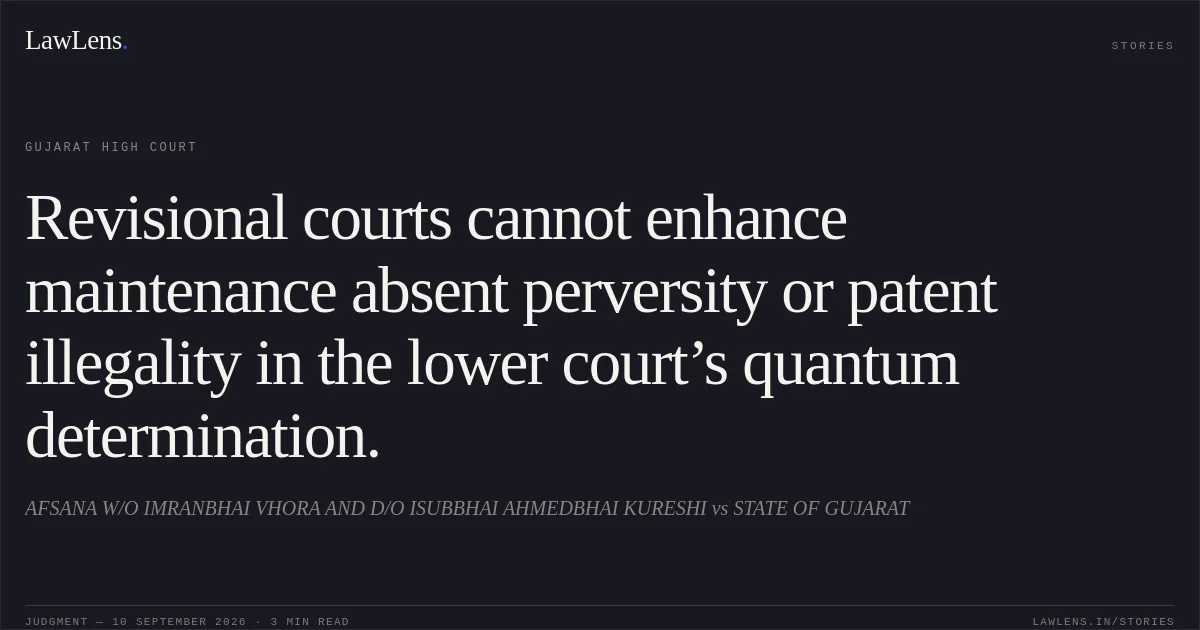
Whether the maintenance of ₹10,000 per month awarded under Section 125 CrPC was so inadequate, perverse or unreasonable as to warrant interference in revisional jurisdiction under Sections 397 and 401 CrPC?
Source reference: paras. 7, 11–11.3; pp. 5, 7–9Whether the High Court could reappreciate the evidence and substitute its own assessment of the husband’s income and maintenance liability in revision?
Source reference: paras. 11–11.3, 13.1, 15; pp. 7–8, 12–14Law Applied
The Court applied Section 125 CrPC, which provides a social-justice remedy to prevent destitution and vagrancy and requires maintenance to be assessed by considering the claimant’s reasonable needs, the respondent’s income and earning capacity, his dependants, and the parties’ standard of living.
Source reference: para. 12; p. 9It exercised revisional jurisdiction under Sections 397 and 401 CrPC, under which interference is supervisory and is justified only for patent illegality, jurisdictional error, material irregularity, perversity, arbitrary exercise of discretion or findings based on no evidence.
Source reference: paras. 11–11.3; pp. 7–9Relying on State of Kerala v. Puttumana Illath Jathavedan Namboodiri, (1999) 2 SCC 452, the Court held that revision is not equivalent to an appeal and ordinarily does not permit reappreciation of evidence.
Source reference: para. 11.1; p. 8Relying on Amit Kapoor v. Ramesh Chander, (2012) 9 SCC 460, it reiterated that revisional interference is warranted where the order contains a palpable error, non-compliance with law, complete erroneousness or arbitrary exercise of discretion.
Source reference: para. 11.2; p. 8The Court also applied the principles in Rajnesh v. Neha, (2021) 2 SCC 324, concerning the status and needs of the claimant, the financial capacity of the person liable to pay, his reasonable expenses and the parties’ standard of living.
Source reference: para. 12.2; p. 10Although suppression or non-disclosure of income may justify an adverse inference, the resulting maintenance must remain just and reasonable rather than speculative or extravagant.
Source reference: para. 12.1; p. 9Reasoning
The High Court accepted that the husband had not fully disclosed his financial position and that the evidence of unexplained bank deposits and use of expensive vehicles permitted an adverse inference regarding undisclosed income.
Source reference: para. 13; pp. 11–12However, the wife had not produced sufficiently cogent evidence—such as reliable business records, sale deeds, bank statements showing quantified business receipts, or admissions—to establish that the husband earned ₹80,000 or more per month.
Source reference: paras. 9, 13; pp. 5–6, 11–12The Family Court had considered both the suspicious financial circumstances and the absence of precise proof, and had fixed ₹10,000 per month as a reasonable figure.
Source reference: paras. 13.1–15; pp. 12–14Since that conclusion was a possible view based on the evidence and was neither perverse nor arbitrary, reassessing the evidence and substituting a higher amount would exceed the limited scope of revisional jurisdiction.
Source reference: paras. 13.1–15; pp. 12–14Holding
The Court answered the issues against the applicant.
It held that the award of ₹10,000 per month was not shown to be perverse, manifestly unreasonable, illegally arrived at, or unsupported by evidence, and therefore did not warrant interference under Sections 397 and 401 CrPC.
Source reference: paras. 17–18; p. 15The Criminal Revision Application was rejected, the Family Court’s order dated 5 November 2022 was confirmed, the Rule was discharged, and any interim relief was vacated.
Source reference: paras. 18–19; p. 15The Court clarified that the wife could seek enhancement before the appropriate forum if there were a subsequent change in the husband’s financial circumstances.
Source reference: para. 16; p. 14Acts & Sections Cited
3 provisions across 1 statute referred to in this judgment. Each provision opens on LawLens.
Code of Criminal Procedure, 19733
Original Court PDF
AFSANA W/O IMRANBHAI VHORA AND D/O ISUBBHAI AHMEDBHAI KURESHIvsSTATE OF GUJARAT
Click to open original judgment
Original judgment, available to read, download and summarize on LawLens.in