Facts
Renuka married respondent Yashwant on 27 February 2015 according to Hindu customs.
Source reference: p. 2–3She alleged that, after the marriage and particularly following the birth of her daughter in February 2018, Yashwant and certain in-laws subjected her to physical and mental cruelty and demanded an Alto car and ₹5,00,000 as dowry.
Source reference: p. 2–3On 17 July 2021, the respondents allegedly left Renuka and her daughter at her parental home and demanded fulfilment of the dowry demands as a condition for taking her back.
Source reference: p. 3Renuka subsequently lodged an FIR at Police Station Kishanganj, registered as Crime No. 623/2021.
Source reference: p. 1–3The Judicial Magistrate First Class acquitted all four accused of offences under Section 498A IPC and Sections 3/4 of the Dowry Prohibition Act, 1961, on 23 April 2025.
Source reference: p. 1–3The State’s appeal was dismissed by the First Additional Sessions Judge on 15 June 2026, resulting in the present revision petition under Section 442 BNSS, 2023.
Source reference: p. 1–3Issues
1. Whether the trial court and appellate court committed any patent illegality, jurisdictional error, material irregularity, or perversity in acquitting the respondents of offences under Section 498A IPC and Sections 3/4 of the Dowry Prohibition Act, 1961.
Source reference: para. 9, 14–152. Whether the High Court, in exercise of its limited revisional jurisdiction under Section 442 BNSS, could reappreciate the evidence and interfere with concurrent findings of acquittal.
Source reference: para. 93. Whether the delay in lodging the complaint, the circumstances surrounding the divorce notice, and inconsistencies in the complainant’s evidence created reasonable doubt regarding the prosecution case.
Source reference: para. 10–13Law Applied
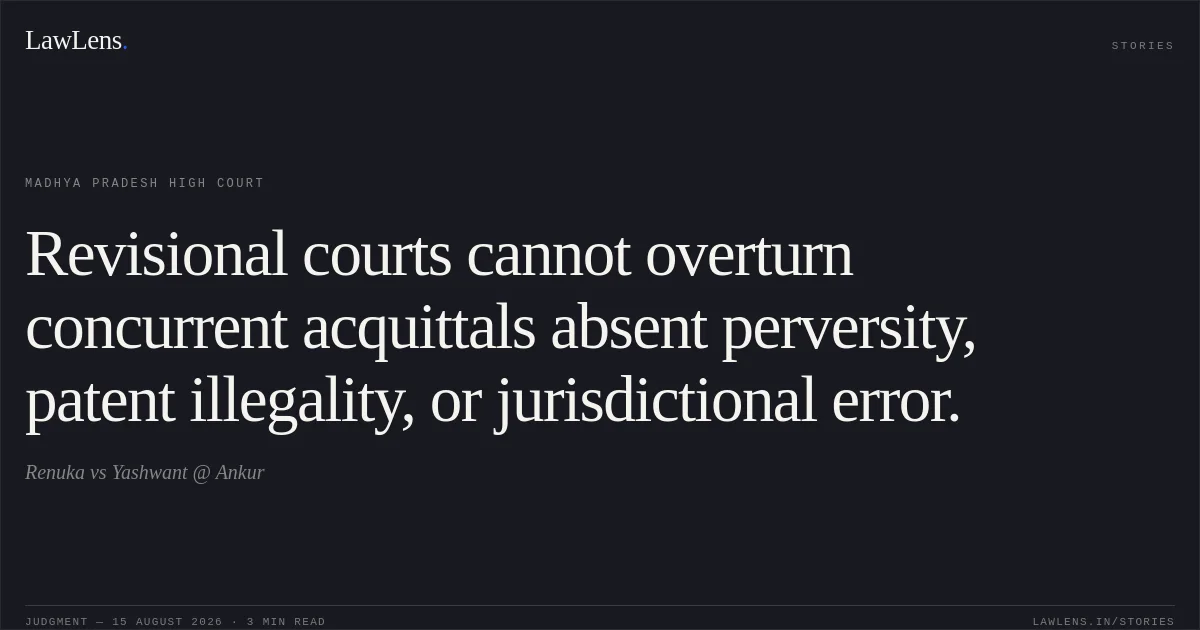
The Court applied Section 442 of the Bharatiya Nagarik Suraksha Sanhita, 2023, governing the High Court’s revisional jurisdiction, and reiterated that revisional jurisdiction is supervisory and narrower than appellate jurisdiction.
Source reference: para. 9Interference with concurrent findings is justified only where there is perversity, patent illegality, material irregularity, jurisdictional error, or gross miscarriage of justice.
Source reference: para. 9The substantive allegations were examined with reference to Section 498A IPC, concerning cruelty by the husband or his relatives, and Sections 3/4 of the Dowry Prohibition Act, 1961, concerning giving, taking, and demanding dowry.
Source reference: p. 1–2The Court also considered the authorities cited before the trial court, including Charul Shukla v. State of Uttar Pradesh and Geeta Mahrotra v. State of Uttar Pradesh , in the context of assessing the complainant’s credibility and allegations against matrimonial relatives.
Source reference: para. 11Reasoning
The High Court found that the trial court had properly considered the unexplained delay between the alleged incident of 17 July 2021 and the filing of the report in September 2021.
Source reference: para. 10–11Renuka’s mother admitted that the complaint was lodged only after Yashwant issued a divorce notice, supporting the trial court’s inference that the prosecution was prompted by displeasure over the notice.
Source reference: para. 10–11The Court further noted the absence of any contemporaneous complaint concerning the alleged dowry-related harassment said to have commenced in 2018.
Source reference: para. 12In addition, inconsistencies emerged regarding the alleged incident of 17 July 2021: although Renuka claimed that she had been assaulted and abandoned, her cross-examination indicated that family members were present inside the house and several persons were outside when she was left there.
Source reference: para. 13These circumstances were sufficient to create reasonable doubt.
Source reference: para. 13Since the subordinate courts had evaluated the evidence and recorded findings that were neither perverse nor legally defective, the High Court held that revisional interference was impermissible.
Source reference: para. 14–15Holding
The High Court answered the issues against the revisionist.
It held that the concurrent acquittal of the respondents did not suffer from jurisdictional error, patent illegality, material irregularity, or perversity, and that the High Court could not reappreciate the evidence merely because another view was possible.
Source reference: para. 14–15The Criminal Revision Petition was dismissed, and the appellate judgment dated 15 June 2026 and the trial court’s judgment of acquittal dated 23 April 2025 were affirmed.
Source reference: para. 16Acts & Sections Cited
3 provisions across 2 statutes referred to in this judgment. Each provision opens on LawLens.
Bharatiya Nagarik Suraksha Sanhita, 20231
Original Court PDF
RenukavsYashwant @ Ankur
Click to open original judgment
Original judgment, available to read, download and summarize on LawLens.in