Facts
The petitioners and Respondent No. 1 are brothers involved in a dispute over their late father’s property.
Source reference: para. 3.3–3.5Respondent No. 1 alleged that the petitioners forged a Power of Attorney, Affidavit and Release Deed dated 20 December 2005, and relied on them in a civil suit to deprive him of his share.
Source reference: para. 3.3–3.5On his complaint under Section 156(3) of the CrPC, an FIR was registered; after investigation, police filed a C-Summary Report.
Source reference: para. 3.3–3.5The Magistrate accepted the report and dismissed the protest petition, finding that the alleged offences were not made out.
Source reference: para. 7, 9–10The Sessions Court, in revision, set that order aside and directed the Magistrate to reconsider the matter, also imposing costs of Rs. 10,000 on the petitioners.
Source reference: para. 13–15The petitioners challenged the Sessions Court’s order under Article 227 of the Constitution and Sections 397 and 401 of the CrPC.
Source reference: para. 1Issues
1. Whether the Sessions Court exceeded the limits of its revisional jurisdiction by setting aside the Magistrate’s order and directing fresh consideration of the protest petition
Source reference: para. 13–172. Whether the Sessions Court’s finding that the handwriting expert’s opinion was inconclusive, and its imposition of costs on the petitioners, disclosed error warranting interference
Source reference: para. 11–12, 15–17Law Applied
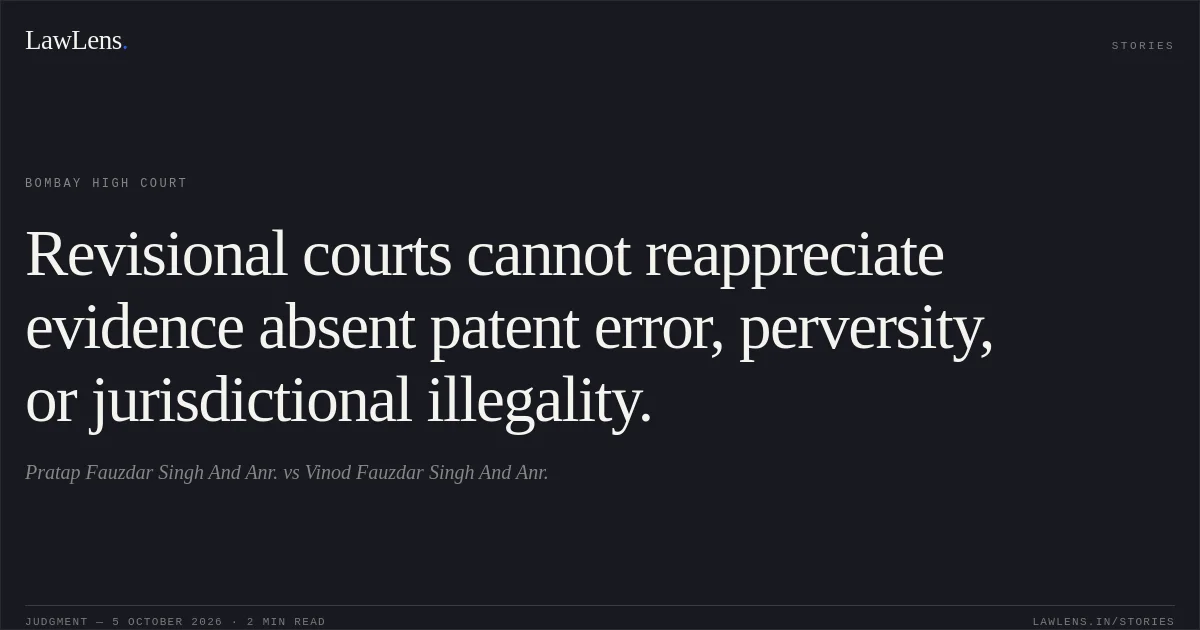
Sections 397 and 401 of the CrPC empower a revisional court to examine the correctness, legality or propriety of an inferior court’s order and to correct patent defects, jurisdictional or legal errors, material non-compliance, or perverse findings; the jurisdiction is limited and is not a vehicle for routine reappraisal of evidence or substitution of another possible view.
Source reference: para. 18.1–18.3The Court relied on Amit Kapoor v. Ramesh Chander, (2012) 9 SCC 460, Manendra Prasad Tiwari v. Amit Kumar Tiwari, (2022) 20 SCC 757, and New India Assurance Co. Ltd. v. Krishna Kumar Pandey, (2021) 14 SCC 683, for these principles.
Source reference: para. 18.1–18.3The petition also invoked Article 227 of the Constitution, under which the High Court considered the challenged revisional order.
Source reference: para. 1Reasoning
The High Court held that the Magistrate had considered the complaint, investigation papers, C-Summary Report, protest petition, supporting material and handwriting expert’s report before concluding that the essential ingredients of the alleged offences were not made out.
Source reference: para. 9–10, 20The expert’s opinion stated that the questioned signatures and comparison signatures were written by the same hand; accordingly, the Sessions Court’s characterisation of the opinion as inconclusive was prima facie incorrect.
Source reference: para. 11–12In reweighing the circumstances surrounding the documents and preferring a different view, the Sessions Court exceeded the limited scope of revision; the unexplained costs order against the petitioners, who were respondents in the revision, further indicated non-application of mind.
Source reference: para. 14–17The family-property context and pending civil proceedings formed part of the factual background, but the decision turned on the Sessions Court’s improper exercise of revisional jurisdiction.
Source reference: para. 16–19Holding
The High Court answered the first issue in the affirmative and found the Sessions Court’s treatment of the handwriting opinion and costs order to be erroneous.
It allowed the petition and quashed and set aside the Sessions Court’s order dated 17 January 2019 in Criminal Revision Application No. 649 of 2017.
Source reference: para. 21–22Acts & Sections Cited
13 provisions across 3 statutes referred to in this judgment. Each provision opens on LawLens.
Code of Criminal Procedure, 19734
Indian Penal Code, 18608
Negotiable Instruments Act, 18811
Original Court PDF
Pratap Fauzdar Singh And Anr.vsVinod Fauzdar Singh And Anr.
Click to open original judgment
Original judgment, available to read, download and summarize on LawLens.in