Facts
The husband and wife, both entering their second marriage, married on 15 July 2012. The wife alleged that the husband was addicted to alcohol, maintained an extra-marital relationship, and subjected her to physical, mental, and verbal cruelty. Following an alleged assault on 7 April 2015, she left the matrimonial home on 9 April 2015 and began residing with her father. She filed an application under Section 125 of the Code of Criminal Procedure, 1973 (“CrPC”) on 28 August 2018, claiming maintenance of ₹35,000 per month.
Source reference: paras. 4–5; pp. 3–4The husband denied liability, alleging that the wife had voluntarily deserted him and was capable of maintaining herself because she was an M.Sc., B.Ed. and lecturer earning approximately ₹45,000 per month. He also claimed that he had suffered a heart attack, resigned from employment, had no regular income, and was responsible for maintaining his daughter from his first marriage.
Source reference: para. 5; p. 4The Family Court, Bhavnagar, held that the husband had failed to prove that the wife had left the matrimonial home without sufficient cause. Considering his income-tax returns, interest from fixed deposits, and movable and immovable assets, it assessed his income at approximately ₹35,000–₹40,000 per month. Since the wife was also earning approximately ₹35,000 per month as a lecturer, the Court awarded her maintenance of ₹9,000 per month from the date of the application.
Source reference: para. 6; p. 4The husband challenged the grant of maintenance in CRRA No. 978 of 2022, while the wife sought enhancement to ₹35,000 per month in CRRA No. 1221 of 2022.
Source reference: paras. 2–3; pp. 2–3Issues
Whether the wife was disentitled to maintenance under Section 125 CrPC on the ground that she had voluntarily deserted the matrimonial home without sufficient reason?
Source reference: paras. 8–9, 14; pp. 6, 13–14Whether the Family Court erred in awarding maintenance of ₹9,000 per month, either because no maintenance should have been granted or because the amount should have been enhanced to ₹35,000 per month?
Source reference: paras. 8–10, 15–16; pp. 6–8, 14–16Whether the High Court, in exercise of its limited revisional jurisdiction under Sections 397 and 401 CrPC, could reappreciate the evidence and substitute its own assessment of the parties’ income and maintenance entitlement?
Source reference: paras. 12–12.3, 16; pp. 9–10, 15–16Law Applied
Section 125 CrPC is a social-justice measure intended to prevent destitution and vagrancy by providing a speedy remedy to a person unable to maintain herself.
Source reference: para. 13; p. 11The determination of maintenance requires consideration of the claimant’s reasonable needs, the respondent’s income and earning capacity, his dependants and expenses, and the standard of living of the parties.
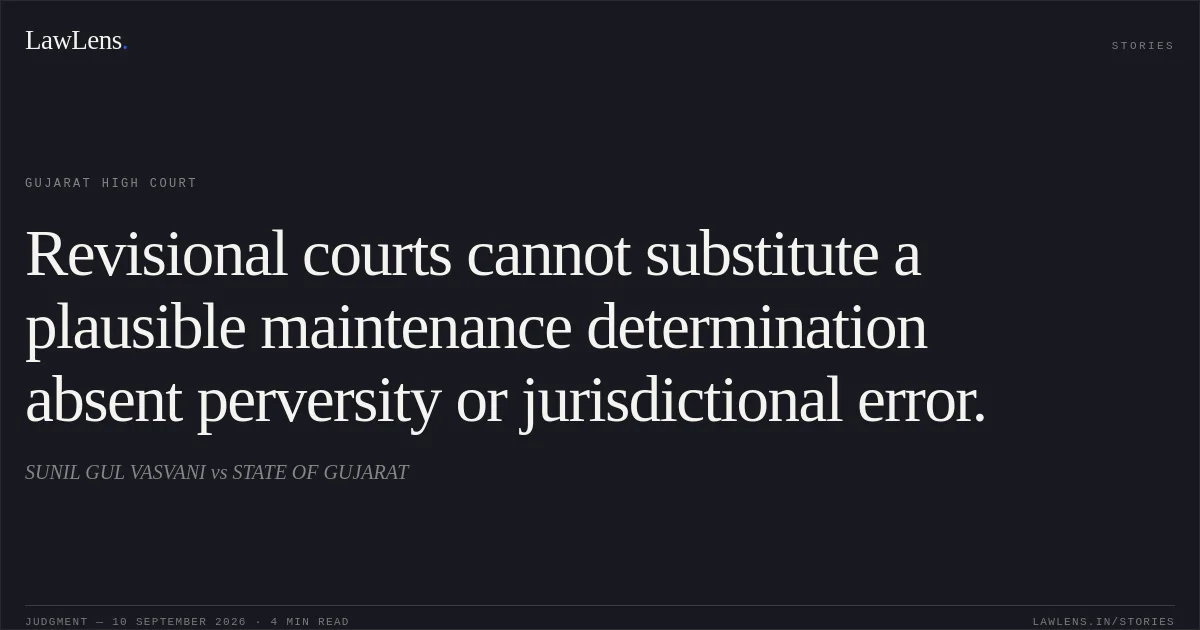
Source reference: no citationUnder Sections 397 and 401 CrPC, revisional jurisdiction is supervisory and cannot be equated with appellate jurisdiction; interference is justified only for patent illegality, perversity, jurisdictional error, material irregularity, or a finding based on no evidence.
Source reference: para. 12.1; p. 9The Court relied on State of Kerala v. Puttumana Illath Jathavedan Namboodiri, (1999) 2 SCC 452, which restricts reappreciation of evidence in revision absent gross miscarriage of justice.
Source reference: para. 12.1; p. 9The Court relied on Amit Kapoor v. Ramesh Chander, (2012) 9 SCC 460, which permits interference for palpable error, non-compliance with law, complete erroneousness, or arbitrary exercise of discretion.
Source reference: para. 12.2; pp. 10–11The Court also applied the principles in Rajnesh v. Neha, (2021) 2 SCC 324, concerning the parties’ status, reasonable needs, financial capacity, dependants, and standard of living.
Source reference: para. 13.2; p. 12Although the claimant bears the initial burden of establishing the husband’s income, suppression of material financial information may justify a reasonable adverse inference; such inference, however, must remain just and non-speculative.
Source reference: para. 13.1; pp. 11–12Reasoning
The Court upheld the Family Court’s finding that the wife had not voluntarily deserted the matrimonial home without sufficient cause. That finding was based on the evidence, including the husband’s admissions, and the husband failed to demonstrate perversity or any other ground warranting revisional interference.
Source reference: para. 14; p. 13On quantum, the Family Court had considered the husband’s income-tax returns, fixed-deposit interest, assets, and the wife’s independent income of approximately ₹35,000 per month.
Source reference: paras. 15–16; pp. 14–16Although the wife relied on the husband’s valuable properties, provident-fund contributions, fixed deposits, and former employment to contend that his income was substantially higher, those circumstances did not establish a sufficiently certain income of ₹75,000–₹1,25,000 per month.
Source reference: paras. 15–16; pp. 14–16The High Court therefore held that the award of ₹9,000 per month was a plausible and reasonable view of the evidence, and that substituting either a lower or higher amount would amount to impermissible reappreciation of evidence in revision.
Source reference: paras. 15–16; pp. 14–16Holding
The High Court answered the entitlement issue against the husband and held that the wife was entitled to maintenance under Section 125 CrPC.
It further held that neither the husband nor the wife established patent illegality, perversity, jurisdictional error, or material irregularity in the Family Court’s order.
Source reference: paras. 18–19; p. 16Accordingly, both CRRA Nos. 978 and 1221 of 2022 were rejected, and the Family Court’s order dated 19 July 2022 awarding ₹9,000 per month to the wife from the date of her application was confirmed. The rule was discharged, and any interim relief stood vacated.
Source reference: paras. 19–20; p. 16The Court clarified that either party could seek variation of maintenance before the appropriate forum upon a subsequent change in circumstances, if permitted by law.
Source reference: para. 17; p. 16Acts & Sections Cited
3 provisions across 1 statute referred to in this judgment. Each provision opens on LawLens.
Code of Criminal Procedure, 19733
Original Court PDF
SUNIL GUL VASVANIvsSTATE OF GUJARAT
Click to open original judgment
Original judgment, available to read, download and summarize on LawLens.in