Facts
Originally owned by Raghunathbhai Lalabhai, the land was mutated in the names of his widow, Bai Suri, and his two sons (the petitioners) via Entry No. 1208 in 1975.
Source reference: para 2.1Before her death in 1989, Bai Suri executed a registered Will in 1988 bequeathing the property to Respondent Nos. 1 and 2.
Source reference: para 5, 6Based on this Will, Entry No. 1641 was mutated in 1993 with the "consent" statements of the petitioners and subsequently certified.
Source reference: para 5, 6In 2012, after a lapse of 19 years, the Collector of Vadodara initiated suo motu revision proceedings under Rule 108(6) of the Gujarat Land Revenue Rules, 1972.
Source reference: para 2.1The Collector cancelled the 1993 entry, holding that the property was ancestral, the Will was executed without absolute ownership, and the land was of restricted tenure.
Source reference: para 6.1The Special Secretary Revenue Department (SSRD) reversed the Collector’s order in 2014, citing inordinate delay and jurisdictional errors.
Source reference: para 2.2, 4.2The petitioners challenged the SSRD's order before the High Court.
Source reference: no citationIssues
1. Whether the Collector’s exercise of suo motu revisional power after an inordinate delay of 19 years was legally valid.
Source reference: para 4.2, 5.12. Whether a revenue authority, while adjudicating mutation entries (RTS proceedings), has the jurisdiction to determine the validity of a registered Will or adjudicate civil rights.
Source reference: para 5.2, 6.53. Whether the revenue authority can cancel an entry by cross-utilizing powers under different statutes (e.g., alleging breach of tenure while deciding a mutation dispute).
Source reference: para 4.3, 5.3, 6.6Law Applied
The court primarily applied Rule 108(6) of the Gujarat Land Revenue Rules, 1972, regarding the revision of mutation entries.
Source reference: para 2.1State of Gujarat v. Patel Raghav Natha & Ors. (1969), which established that suo motu revisional powers must be exercised within a "reasonable time," typically not exceeding three years.
Source reference: para 5.1, 7Evergreen Apartment Co-op. Housing Society v. Special Secretary, Revenue Department (1991), holding that revenue authorities in RTS proceedings cannot adjudicate title or transactions' validity under other special enactments; they must follow registered title documents unless set aside by a competent Civil Court.
Source reference: para 5.3, 7.1Reasoning
The Court found that the Collector's intervention after 19 years was an unsustainable exercise of power due to the lack of a reasonable timeframe, as mandated by the Patel Raghav Natha doctrine.
Source reference: para 6.6, 8The Court reasoned that mutation entries are for fiscal purposes only and do not determine title. Since the petitioners had withdrawn their civil suit challenging the Will, the registered document remained valid and the revenue authorities lacked the jurisdiction to declare it void or decide if the property was "ancestral" versus "self-acquired".
Source reference: para 6.4, 6.5Furthermore, the Court criticized the Collector for "cross-utilizing" powers by canceling the entry based on alleged breaches of land tenure (new/impartible tenure).
Source reference: para 6.6, 7.1Following the Evergreen Apartment rule, the Court held that if a statutory breach is suspected, independent proceedings under that specific law must be initiated rather than summarily canceling a revenue entry under Rule 108.
Source reference: para 6.6, 7.1Finally, the Court noted that the petitioners had originally consented to the entry in 1993, making their subsequent challenge inequitable.
Source reference: para 5, 6.6Holding
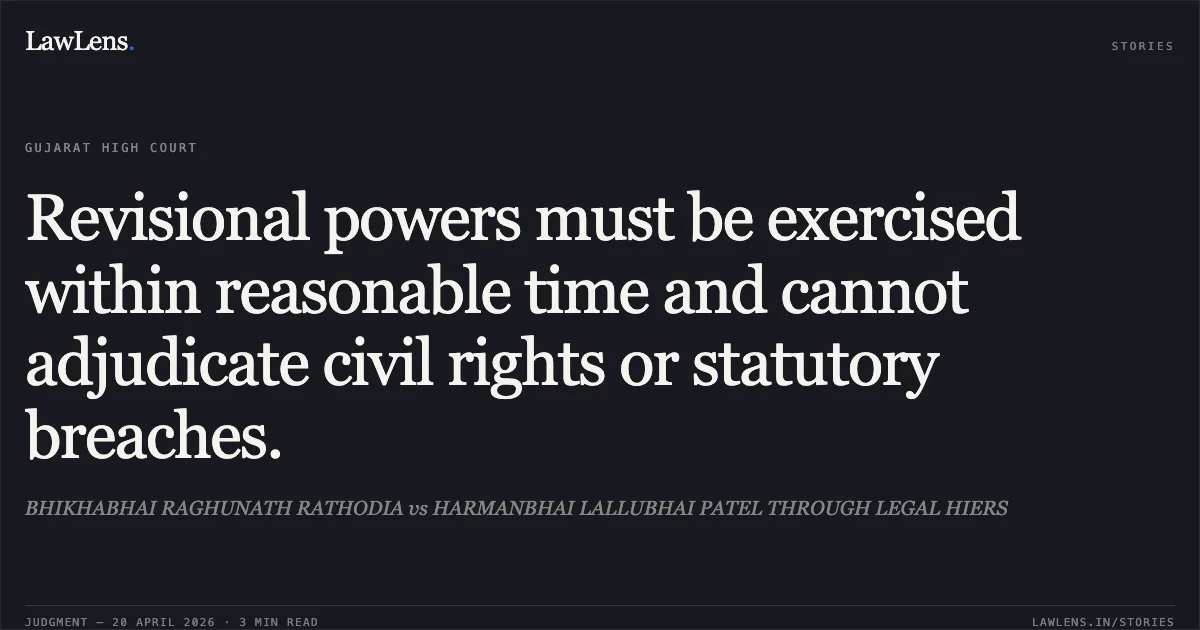
The Court held that the SSRD correctly set aside the Collector's order due to the gross delay of 19 years and the improper adjudication of civil title in summary revenue proceedings.
The High Court dismissed the petition, confirming the SSRD’s order dated 23.05.2014, and discharged the rule. All interim reliefs were vacated.
Source reference: para 8Acts & Sections Cited
2 provisions across 1 statute referred to in this judgment. Linked provisions open on LawLens.
Bombay Land Revenue Code, 18792
Original Court PDF
BHIKHABHAI RAGHUNATH RATHODIAvsHARMANBHAI LALLUBHAI PATEL THROUGH LEGAL HIERS
Click to open original judgment
Original judgment, available to read, download and summarize on LawLens.in


![Subsequent exoneration does not retrospectively invalidate a finalized promotion select list.. UNNIKRISHNAN M vs M/o Environment And Forests. CAT - ['Ernakulam']. LawLens](/stories/thumbnails/subsequent-exoneration-does-not-retrospectively-invalidate-a-finalized-promotion-select-li-ce80a0e84f2f4887857271e8b4341c42.webp)