01Facts
The claimant sustained injuries in an accident involving motorcycle No. KA-56-J-1132 and car No. KA-56-M-0335 on 22 September 2018.
p. 4 · ¶ 5He was initially admitted to Shendiya Hospital and Research Center, Omerga, where the medico-legal case was reported to the police.
p. 4 · ¶ 5The claimant’s statement and medical records were subsequently transferred to Basavakalyan Police, which registered the FIR involving the insured car.
p. 4 · ¶ 5The insurer alleged that the car had been falsely implicated in collusion with the claimant, vehicle owner, police, and hospital, and contended that the claimant had himself caused the accident while riding under the influence of alcohol.
pp. 2-4 · ¶ 2-4.2The Tribunal held that the insured vehicle was involved in the accident and directed the insurer to pay compensation.
p. 2 · ¶ 3.1The insurer challenged that award under Section 173(1) of the Motor Vehicles Act, 1988.
p. 2 · ¶ 3.102Issues
i.1. Whether the insured car was falsely implicated and whether the evidence established its involvement in the accident dated 22 September 2018.
pp. 5-6 · ¶ 5-7ii.2. Whether the claimant’s medical records established that he was riding the motorcycle under the influence of alcohol at the time of the accident.
pp. 7-8 · ¶ 9iii.3. Whether the claimant’s intoxication amounted to contributory negligence warranting reduction of the compensation payable by the insurer.
pp. 8-9 · ¶ 10-1103Law Applied
The Court applied Section 173(1) of the Motor Vehicles Act, 1988, governing an appeal against an award of the Motor Accident Claims Tribunal.
p. 2It applied the principle that involvement of the offending vehicle and the date of the accident may be established on the basis of the overall documentary and oral evidence, including medical records, medico-legal reports, police correspondence, the claimant’s statement, and the FIR.
pp. 5-6 · ¶ 7The Court further applied the principle of contributory negligence, holding that a claimant who rides a motorcycle under the influence of alcohol and thereby violates the law may have compensation reduced to reflect his contribution to the accident; the beneficial interpretation of motor accident compensation law cannot be extended so as to reward or disregard such unlawful conduct.
pp. 8-9 · ¶ 10-11Provisions in the judgment · 1 · Linked ones open on LawLens
Motor Vehicles Act, 1988 Section 173
04Reasoning
The Court rejected the insurer’s false-implication argument because the contemporaneous medical and police records—particularly the MLC, hospital records, police transfer letter, claimant’s statement, and FIR—consistently established the accident date as 22 September 2018 and supported the involvement of the insured car.
pp. 5-6 · ¶ 7The purchase of stamp paper before the vehicle’s formal surrender did not prove collusion, since it could have been obtained in anticipation of the vehicle’s surrender and inspection.
pp. 6-7 · ¶ 8The reference in the medical history to a “fall from the motorcycle” was not treated as proof of a self-fall, as the doctor’s brief history was recorded for treatment purposes and did not necessarily contain the complete accident narrative.
pp. 6-7 · ¶ 8However, the clinical notes and the treating doctor’s admission established that the claimant was under the influence of alcohol when brought to the hospital.
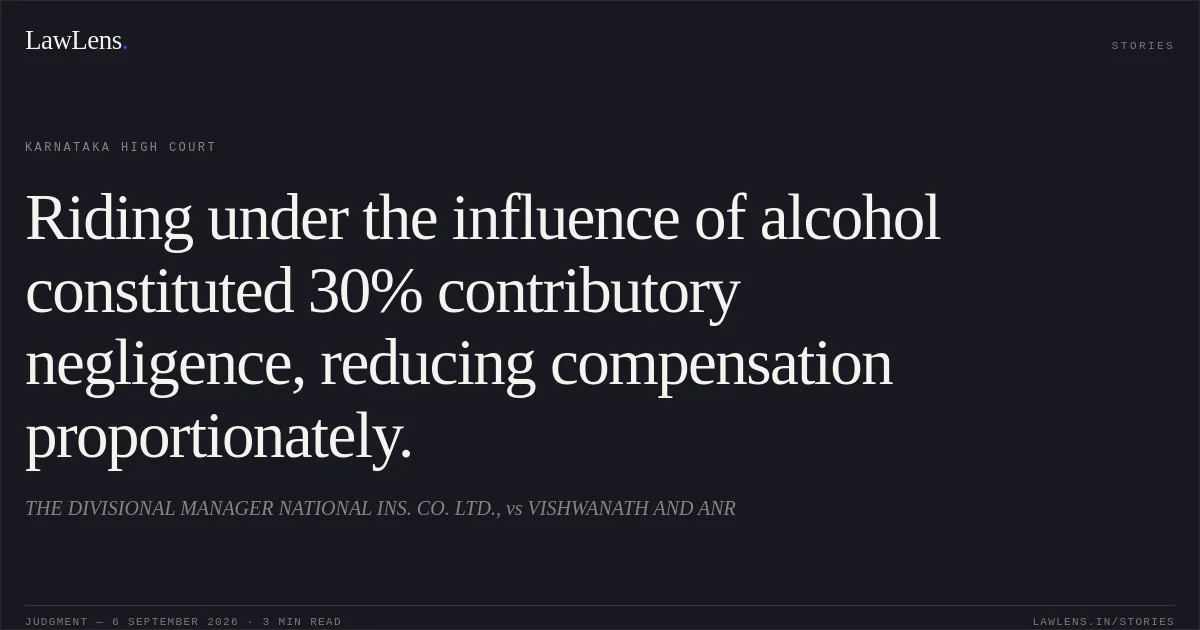
pp. 7-8 · ¶ 9On that basis, the Court attributed 30% contributory negligence to the claimant, while maintaining the finding that the insured car was involved and that the insurer remained liable for the balance.
pp. 8-9 · ¶ 10-1105Holding
The appeal was allowed in part.
pp. 9-10 · ¶ 12The Tribunal’s finding regarding the involvement of the insured vehicle was upheld, but the claimant was held 30% contributorily negligent for riding under the influence of alcohol.
pp. 9-10 · ¶ 12Accordingly, the insurer was directed to deposit 70% of the compensation awarded by the Tribunal, together with applicable interest, within eight weeks; the deposited amount was to be transferred to the Tribunal, and the remaining terms of the Tribunal’s award were maintained.
pp. 9-10 · ¶ 12Original Court PDF
THE DIVISIONAL MANAGER NATIONAL INS. CO. LTD.,vsVISHWANATH AND ANR
Click to open original judgment
Original judgment, available to read, download and summarize on LawLens.in