Facts
The appellant, a former Vice Chancellor of LNIPE, was the subject of a 2019 sexual harassment complaint filed by a Yoga Instructor (Respondent No. 1) under the POSH Act, 2013
Source reference: para. 2An Internal Complaint Committee (ICC) conducted an inquiry and submitted a report in September 2020 which indicated misconduct but did not suggest specific penal actions
Source reference: para. 4The appellant claimed to have filed an administrative appeal against this report, which he asserted was still pending
Source reference: para. 4, 6Concurrently, the Writ Court entertained a petition by Respondent No. 1 and issued an order on July 15, 2025, awarding substantial monetary compensation against the appellant, the State, and the Institute
Source reference: para. 1, 5The appellant challenged this order, arguing that judicial findings of guilt during the pendency of a departmental appeal were premature and prejudicial
Source reference: para. 6Issues
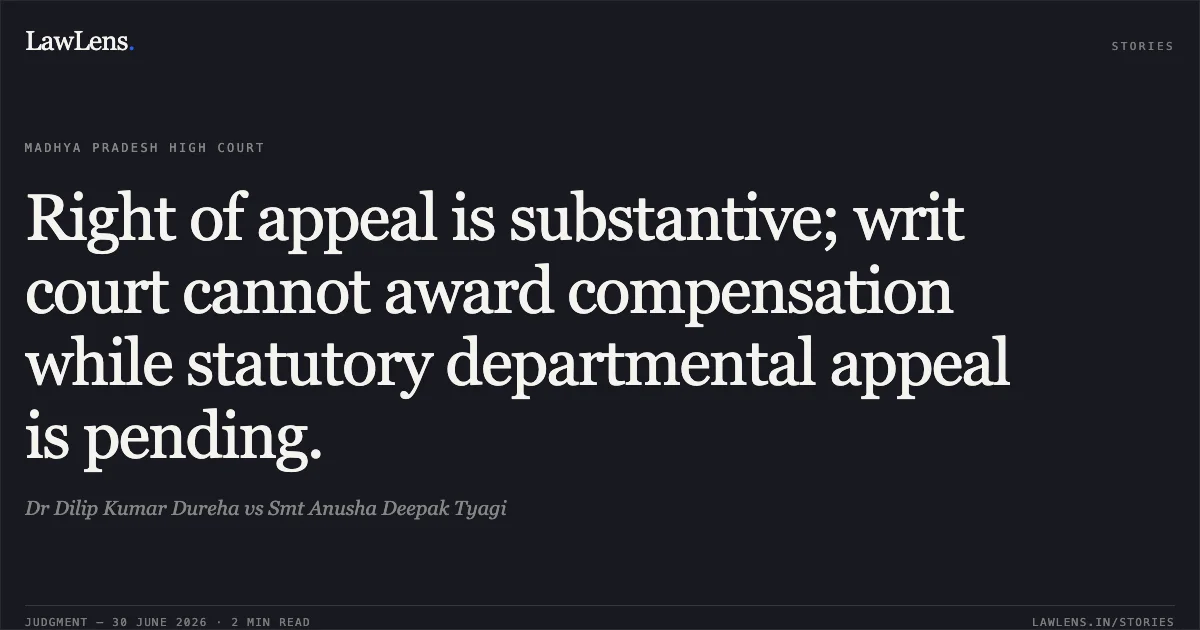
1. Whether the Writ Court erred in awarding compensation and effectively affirming findings of misconduct while a statutory departmental appeal against the ICC report was allegedly pending.
Source reference: para. 6, 102. Whether the matter should be remanded to the departmental appellate authority to ensure the exhaustion of substantive administrative remedies.
Source reference: para. 10, 11Law Applied
Sexual Harassment of Women at Workplace (Prevention, Prohibition and Redressal) Act, 2013, specifically Section 18 regarding the right to appeal
Source reference: para. 4Central Civil Services (Classification Control and Appeal) Rules, 1965, as the ICC acts as an inquiring authority thereunder
Source reference: para. 3UGC Regulations, 2015
Source reference: para. 4The core legal principle applied is that the right to appeal is a "substantive right," and departmental authorities should generally resolve factual disputes and apply their minds before final judicial intervention
Source reference: para. 10Reasoning
The High Court observed that while the respondent contested the existence of a departmental appeal, the appellant provided electronic evidence suggesting it had been initiated in 2020
Source reference: para. 9, 10The Court reasoned that judicial observations regarding the "guilt" of the appellant or the imposition of heavy compensation packages by the Writ Court created a risk of prejudice while the administrative process was incomplete
Source reference: para. 6It determined that the "tenure and texture" of the dispute necessitated a "threadbare" examination by the appropriate departmental authority (the Secretary, Ministry of Sports and Youth Affairs) to ensure clarity on the factual matrix
Source reference: para. 10, 11By failing to wait for the appellate authority’s decision, the original writ order had bypassed the primary fact-finding and administrative review process
Source reference: para. 10Holding
The High Court set aside the Writ Court’s order dated July 15, 2025
It remanded the matter to the Secretary, Ministry of Sports and Youth Affairs, Government of India, directing all parties to appear before said authority on July 14, 2026. The appellate authority was ordered to provide a reasonable hearing and pass a final order within two months of the parties' first appearance. The writ appeal was disposed of accordingly.
Source reference: para. 11, 12, 13, 14Acts & Sections Cited
1 provisions across 1 statute referred to in this judgment. Each provision opens on LawLens.
Sexual Harassment of Women at Workplace (Prevention, Prohibition and Redressal) Act, 20131
Original Court PDF
Dr Dilip Kumar DurehavsSmt Anusha Deepak Tyagi
Click to open original judgment
Original judgment, available to read, download and summarize on LawLens.in


