Facts
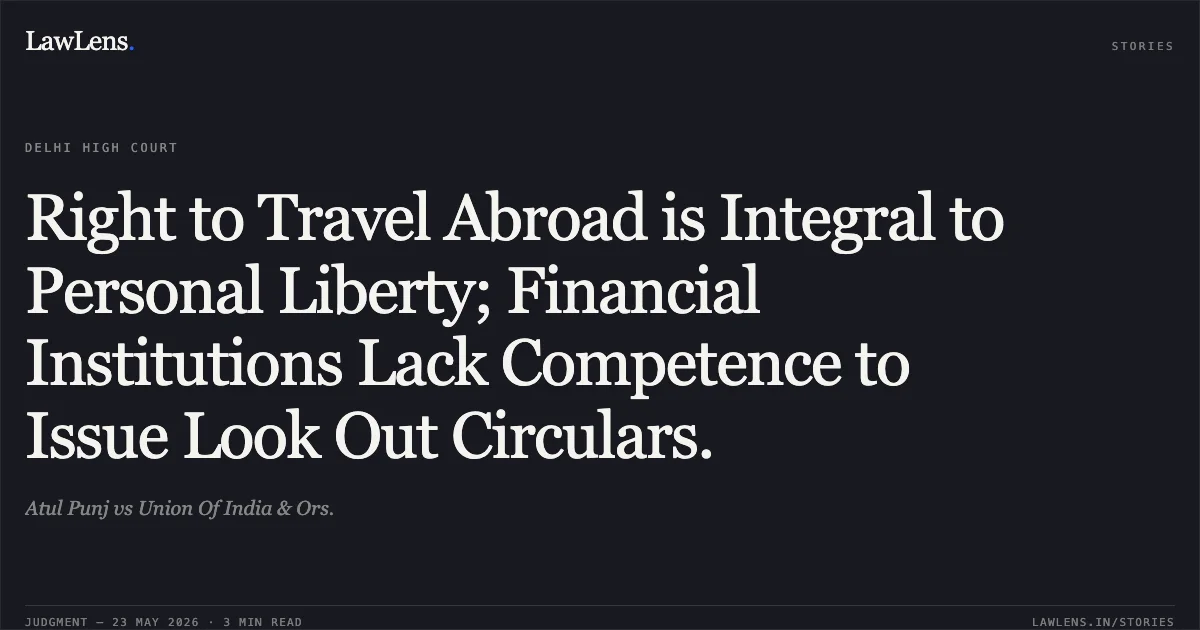
This judgment involves a batch of eight writ petitions challenging the issuance and continuation of Look Out Circulars (LOCs).
Source reference: no citationThe petitioners fall into three categories: (A) those restricted at the behest of public sector banks for loan defaults (e.g., M. Thiagarajan, who was not a personal guarantor); (B) those restricted by investigating agencies like the SFIO, Income Tax Department, or MCA despite participating in investigations or having no pending FIRs (e.g., Shivani Modi, Harmandeep Singh Kandhari, Hu Liu); and (C) those relegated to the originating forum where the factual matrix did not warrant immediate quashing (e.g., Amrit Dujari).
Source reference: p.18-19, 22-28, 34Procedurally, this judgment serves as a companion to Ritu Singal v. Bureau of Immigration, expanding on the fundamental right to travel.
Source reference: p.5Issues
1. Whether the right to travel abroad is a fundamental right under Article 21 and the scope of executive authority to restrict it via Office Memoranda
Source reference: p.7, 92. Whether public sector banks possess the legal authority to request LOCs following the quashing of Clause 6(B)(xv) of the 2021 OM
Source reference: p.10, 163. Whether an LOC can be sustained in "exceptional cases" involving economic interests without a cognizable offence or proof of evading justice
Source reference: p.10-11, 16Law Applied
The court primarily applied Article 21 of the Constitution, establishing the right to travel abroad as an integral facet of personal liberty [Satwant Singh Sawhney; Maneka Gandhi].
Source reference: p.7-8It relied on the MHA Office Memorandum (2021), noting that LOCs are coercive measures of last resort.
Source reference: p.10Following Viraj Chetan Shah v. Union of India, it held that bank officials lack the competence to trigger LOCs.
Source reference: p.10, 16The court further applied the Sumer Singh Salkan guidelines, requiring the existence of a cognizable offence and a deliberate evasion of arrest to justify an LOC.
Source reference: p.10, 16-17Reasoning
The court reasoned that executive instructions (OMs) are not "law" enacted by a competent legislature and cannot arbitrarily restrict fundamental rights.
Source reference: p.9In Class A cases (Banks), the court found that mere business failure or loan default, absent siphoning or personal complicity in a crime, does not justify an LOC, especially since the specific clause empowering bank MDs was already judicially quashed.
Source reference: p.16In Class B cases (Agencies), the court observed that where petitioners had joined investigations, were not named in FIRs, or had been granted multiple prior travel permissions by courts without defaulting, they could not be deemed "flight risks".
Source reference: p.23, 25, 28The court emphasized that "economic interest" must be of a national magnitude, not individual debt.
Source reference: p.16The court noted that the burden of proving proportionality and necessity lies solely on the State, which failed to show contemporaneous justification for continued restraint.
Source reference: p.17Holding
The court held that the right to travel cannot be curtailed through mechanical or indefinite LOCs without fulfilling the tripartite test of Articles 14, 19, and 21.
The court allowed the writ petitions for Categories A and B (Shivani Modi, Harmandeep Singh Kandhari, Samir Sharma, Hu Liu, M. Thiagarajan, and Atul Punj), quashing their LOCs on the ground that they were issued without legal authority or lacked proportionality. Petitioners are permitted to travel subject to notifying the agencies 48 hours in advance.
Source reference: p.21, 31, 36For Category C (Amrit Dujari), the court relegated the petitioner to the competent trial court/originating forum for relief.
Source reference: p.34, 37Acts & Sections Cited
6 provisions across 4 statutes referred to in this judgment. Each provision opens on LawLens.
Code of Civil Procedure, 19081
Prevention of Corruption Act, 19881
Insolvency and Bankruptcy Code, 2016.1
Companies Act, 20133
Original Court PDF
Atul PunjvsUnion Of India & Ors.
Click to open original judgment
Original judgment, available to read, download and summarize on LawLens.in


![Subsequent exoneration does not retrospectively invalidate a finalized promotion select list.. UNNIKRISHNAN M vs M/o Environment And Forests. CAT - ['Ernakulam']. LawLens](/stories/thumbnails/subsequent-exoneration-does-not-retrospectively-invalidate-a-finalized-promotion-select-li-ce80a0e84f2f4887857271e8b4341c42.webp)