Facts
Two writ petitions were heard analogously concerning rival factions of the West Bengal Trinamool Chhatra Parishad (“WBTMCP”), each seeking police permission to organise a foundation-day programme on 28 August 2026 at Mayo Road near the Gandhi Statue, Kolkata.
Source reference: para. 2–3Priyanka Adhikary applied for permission on 27 July 2026, while Sudip Raha made a similar application on 1 August 2026; both applications were followed by communications dated 18 August 2026 from the Joint Commissioner of Police (HQ), Kolkata, refusing permission for the proposed location and suggesting that the programmes be held at suitable indoor venues.
Source reference: para. 4–5The State opposed the petitions and contended that the programmes could be held separately at indoor venues.
Source reference: para. 7During the hearing, the Court referred to its earlier judgment in Derek O’Brien v. The State of West Bengal & Others, W.P.A. No. 16310 of 2026, where two factions had been permitted to hold programmes at different open-air locations in Kolkata.
Source reference: para. 8–10Issues
Whether the rival factions of WBTMCP should be permitted to hold separate foundation-day programmes at Mayo Road near the Gandhi Statue on 28 August 2026, despite both seeking the same venue?
Source reference: para. 3, 6, 10–12Whether, instead of directing the programmes to be held at indoor venues, the Court could permit them at two different open-air locations subject to appropriate safeguards?
Source reference: para. 7, 9–15What conditions were necessary to regulate the programmes, preserve public order, and ensure continued vehicular movement?
Source reference: para. 15Law Applied
The Court applied the principle that competing public programmes may be permitted at separate locations, rather than being compelled to use indoor venues, where appropriate arrangements can be made to maintain law and order and regulate public movement.
Source reference: para. 9–10The Court relied on its earlier decision in Derek O’Brien v. The State of West Bengal & Others, where two factions of the All India Trinamool Congress were permitted to observe “Shahid Diwas” at different open-air locations in Kolkata.
Source reference: para. 8–10The governing considerations were the reasonable accommodation of public assembly and expression, prevention of conflict between rival groups, protection of public order, crowd control, police security, and preservation of vehicular access.
Source reference: para. 10, 12, 15Reasoning
Since both factions insisted on the same venue and declined the Court’s proposal to organise a joint programme, permitting both factions to assemble at Mayo Road near the Gandhi Statue was considered inappropriate, particularly because a single programme had traditionally been held there in previous years.
Source reference: para. 11–12However, the earlier decision in Derek O’Brien demonstrated that rival political organisations could be permitted to hold simultaneous open-air programmes at separate locations, subject to safeguards.
Source reference: para. 9–10Accordingly, the Court rejected the State’s suggestion that the programmes be confined to indoor venues and allocated separate locations: one flank of Cathedral Road to the petitioner in W.P.A. No. 21728 of 2026 and one flank of Rani Rashmoni Avenue to the petitioner in W.P.A. No. 22205 of 2026.
Source reference: para. 13–14To mitigate risks arising from simultaneous gatherings, the Court imposed limits on attendance and duration, required prompt dispersal and removal of materials, mandated the disclosure of volunteers’ particulars, preserved one flank of each road for traffic, and directed the police to provide adequate security and assistance.
Source reference: para. 15Holding
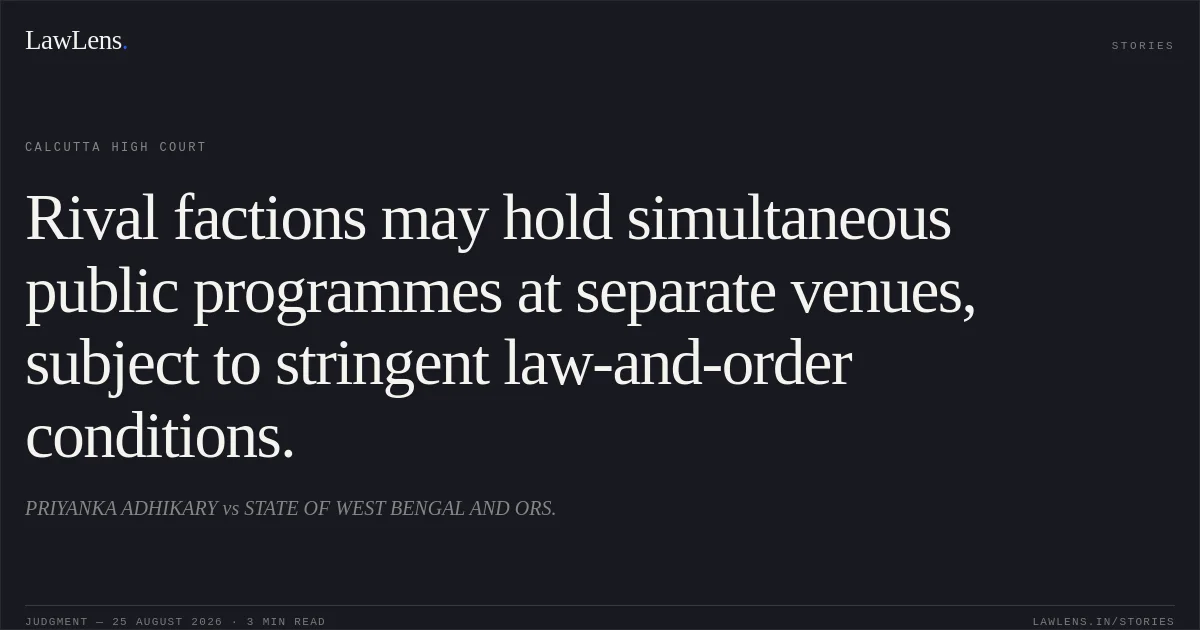
The Court declined to permit either faction to hold its programme at Mayo Road near the Gandhi Statue.
It permitted the petitioner in W.P.A. No. 21728 of 2026 to hold the programme on one flank of Cathedral Road and the petitioner in W.P.A. No. 22205 of 2026 to hold the programme on one flank of Rani Rashmoni Avenue on 28 August 2026.
Source reference: para. 13–15The programmes were subject to conditions including: limiting participation, as far as possible, to 1,500 persons per programme; holding them between 12:00 p.m. and 3:00 p.m.; promptly dispersing the crowds and removing programme materials; furnishing details of fifteen responsible volunteers from each organisation; keeping one flank of each road open for vehicular movement; deployment of adequate police personnel; and police protection for the organisers, electricians, and decorators.
Source reference: para. 15(i)–(viii)Both writ petitions and CAN 1 of 2026 were disposed of, with directions to communicate the gist of the order immediately to the concerned police authorities.
Source reference: para. 16–18Original Court PDF
PRIYANKA ADHIKARYvsSTATE OF WEST BENGAL AND ORS.
Click to open original judgment
Original judgment, available to read, download and summarize on LawLens.in
![Courts will not interfere with transfers absent mala fides or violation of statutory rules.. M Ramya vs EMPLOYEES STATE INSURANCE CORPORATION (ESIC). CAT - ['Chennai']. LawLens](/stories/thumbnails/courts-will-not-interfere-with-transfers-absent-mala-fides-or-violation-of-statutory-rules-a6845e9ca6f548fca284c51c8351957f.webp)
![Courts cannot direct one-time recruitment age relaxation absent authority in the governing rules or advertisement.. UT OF PUDUCHERRY vs M ANDAL. CAT - ['Chennai']. LawLens](/stories/thumbnails/courts-cannot-direct-one-time-recruitment-age-relaxation-absent-authority-in-the-governing-895d78fde47143e2a8ed0207c4b6a44f.webp)
![A review cannot correct an allegedly erroneous decision absent an error apparent on the record.. Ajit Kumar Jha vs RAILWAY BOARD. CAT - ['Delhi']. LawLens](/stories/thumbnails/a-review-cannot-correct-an-allegedly-erroneous-decision-absent-an-error-apparent-on-the-re-8ac952fd4eba470c92f7da20af72a220.webp)