01Facts
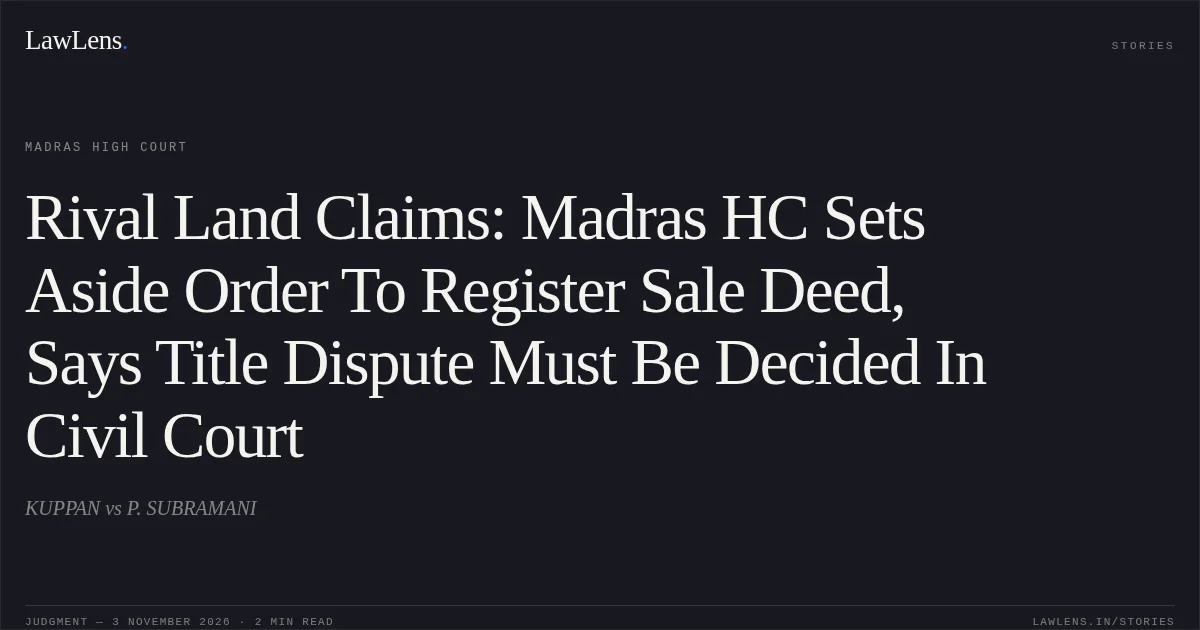
Kuppan, the third respondent in the writ petition and Sub-Registrar, challenged an order directing him to register a sale deed dated 24 September 2024 within two weeks.
pp. 2–3The first respondent, P. Subramani, had sought that direction.
pp. 2–3Kuppan claimed ownership of the land, which he said was recorded in his name under patta, and stated that he had filed a police complaint.
pp. 2–3The State submitted that the document had been returned and was not presented again for registration.
pp. 2–3The writ court had considered the parties’ asserted civil rights in directing registration.
pp. 2–302Issues
i.Whether the High Court may, in a writ proceeding under Article 226, direct registration of a sale deed where the parties’ civil rights in the property are disputed
pp. 3–4ii.Whether the claimant must pursue the remedies under the Registration Act and, if necessary, seek determination of title before a civil court
pp. 3–403Law Applied
Article 226 judicial review is directed to the legality of the decision-making process, not to adjudicating disputed civil rights or substituting the court’s decision for that of the statutory authority.
p. 4Under the Registration Act, as described by the Court, a person aggrieved by refusal of registration may seek a decision under Section 71, appeal under Section 72, and thereafter institute a civil suit under Section 77.
pp. 3–4Disputed questions of title and other civil rights requiring evidence and examination of witnesses are ordinarily to be determined in civil proceedings, not in writ proceedings.
pp. 3–4Provisions in the judgment · 3 · Linked ones open on LawLens
Registration Act, 1908 Section 71Section 72Section 77
04Reasoning
The Court considered that the parties asserted competing rights over the property and that determining those rights would require a trial-like process based on original documents and evidence.
p. 3A direction to register the deed would therefore risk prejudicing the rights of a party claiming ownership and would bypass the statutory remedies available following refusal of registration.
pp. 3–4Because the writ court had directed registration after considering the parties’ civil rights, rather than limiting its review to the legality of the registration process, the order could not stand.
p. 405Holding
The Court held that disputed ownership and title should be determined by the competent civil court, not resolved through a writ directing registration.
pp. 4–5It allowed the writ appeal, set aside the order dated 14 November 2024 in W.P. No. 34172 of 2024, and dismissed the writ petition, with no order as to costs.
p. 5Original Court PDF
KUPPANvsP. SUBRAMANI
Click to open original judgment
Original judgment, available to read, download and summarize on LawLens.in