Facts
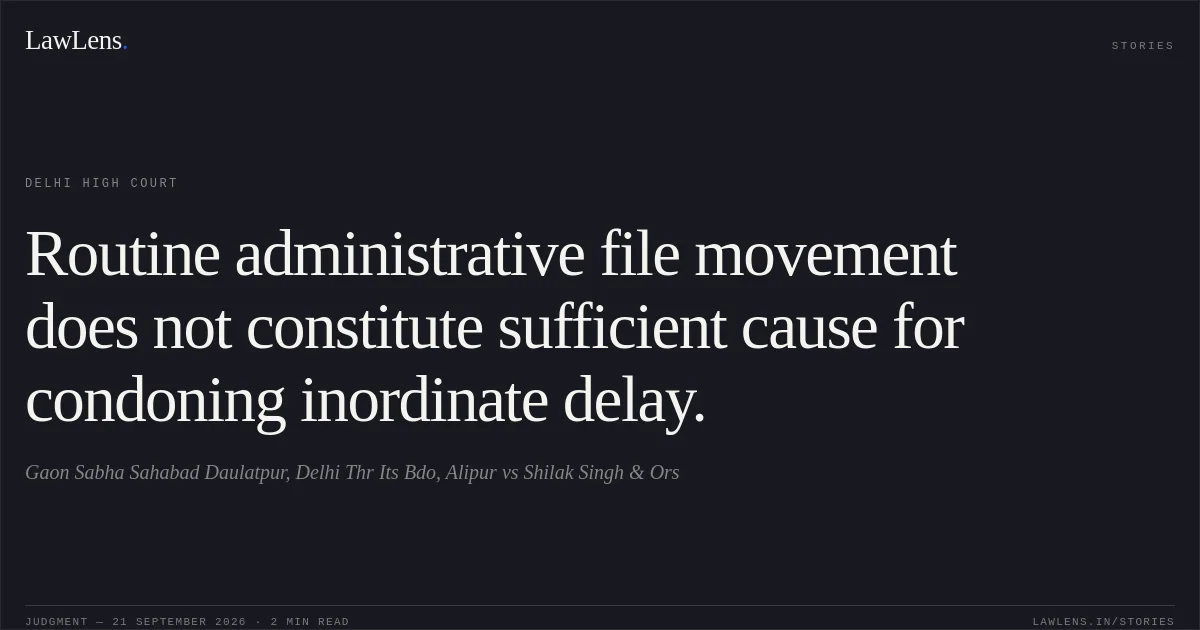
The appellant, Gaon Sabha Sahabad Daulatpur, filed an application under Order XLI Rule 3A CPC read with Section 5 of the Limitation Act, 1963, seeking condonation of a delay of 1,204 days in filing its appeal against the judgment of the Rohini Court.
Source reference: p.1, para.1The appellant attributed the delay to the absence and alleged negligence of a Village Level Worker, followed by the movement of the case file through various administrative offices, obtaining legal opinions, correspondence with counsel, receipt of certified copies, and preparation and verification of the appeal.
Source reference: pp.1–3, para.2The respondents opposed the condonation of delay.
Source reference: no citationThe High Court considered whether the administrative explanation disclosed sufficient cause for the entire period of delay.
Source reference: p.3, paras.3–6Issues
1. Whether the appellant had established “sufficient cause” under Section 5 of the Limitation Act, 1963, read with Order XLI Rule 3A CPC, for condoning the delay of 1,204 days in filing the appeal.
Source reference: p.3, paras.3–62. Whether the routine internal movement of the file among government departments, administrative inaction, and delay in obtaining or compiling records constituted sufficient cause for condonation of such an inordinate delay.
Source reference: pp.4–5, paras.7–11Law Applied
The Court applied Order XLI Rule 3A CPC, which requires an appeal filed beyond limitation to be accompanied by an application explaining the delay, read with Section 5 of the Limitation Act, 1963, under which delay may be condoned only upon establishment of sufficient cause.
Source reference: p.3, para.3Although limitation provisions should not be applied in an unduly technical manner, the Court must balance the need to advance substantial justice against the accrued rights of the decree-holder or opposing party.
Source reference: p.3, paras.4–5The Court relied on Postmaster General v. Living Media India Ltd. , (2012) 3 SCC 563, for the principle that government departments receive no automatic or separate indulgence in limitation matters and that bureaucratic file movement does not, by itself, constitute sufficient cause.
Source reference: p.4, para.8It also relied on State of M.P. v. Bherulal , (2020) 10 SCC 654, which deprecated the practice of government departments allowing files to remain pending on the assumption that courts would routinely condone delay.
Source reference: p.4, para.9Reasoning
The Court held that the appellant was required to satisfactorily explain the entire period of 1,204 days and demonstrate that circumstances genuinely prevented timely filing of the appeal.
Source reference: p.4, para.6The explanation merely catalogued the movement of the file between officials and departments, together with delays in obtaining legal advice, records, and counsel’s instructions.
Source reference: pp.1–3, 5, para.10It did not identify any continuous, unavoidable, or legally sufficient circumstance that prevented the appellant from filing the appeal within limitation.
Source reference: p.5, paras.10–11Applying the principles in Living Media and Bherulal , the Court concluded that routine administrative processing and bureaucratic inaction could not amount to sufficient cause, particularly where the delay was grossly inordinate.
Source reference: p.4, para.8; p.5, paras.9–12Holding
The Court found that the appellant failed to establish sufficient cause for condoning the delay of 1,204 days and dismissed CM Application No. 2761/2014 under Section 5 of the Limitation Act.
Consequently, LA.APP. 53/2014 was dismissed as barred by limitation.
Source reference: p.6, para.15The date fixed before the Registrar, 13 October 2026, was cancelled in view of the dismissal.
Source reference: p.6, para.16Acts & Sections Cited
1 provisions across 1 statute referred to in this judgment. Each provision opens on LawLens.
Limitation Act, 19631
Original Court PDF
Gaon Sabha Sahabad Daulatpur, Delhi Thr Its Bdo, AlipurvsShilak Singh & Ors
Click to open original judgment
Original judgment, available to read, download and summarize on LawLens.in