Facts
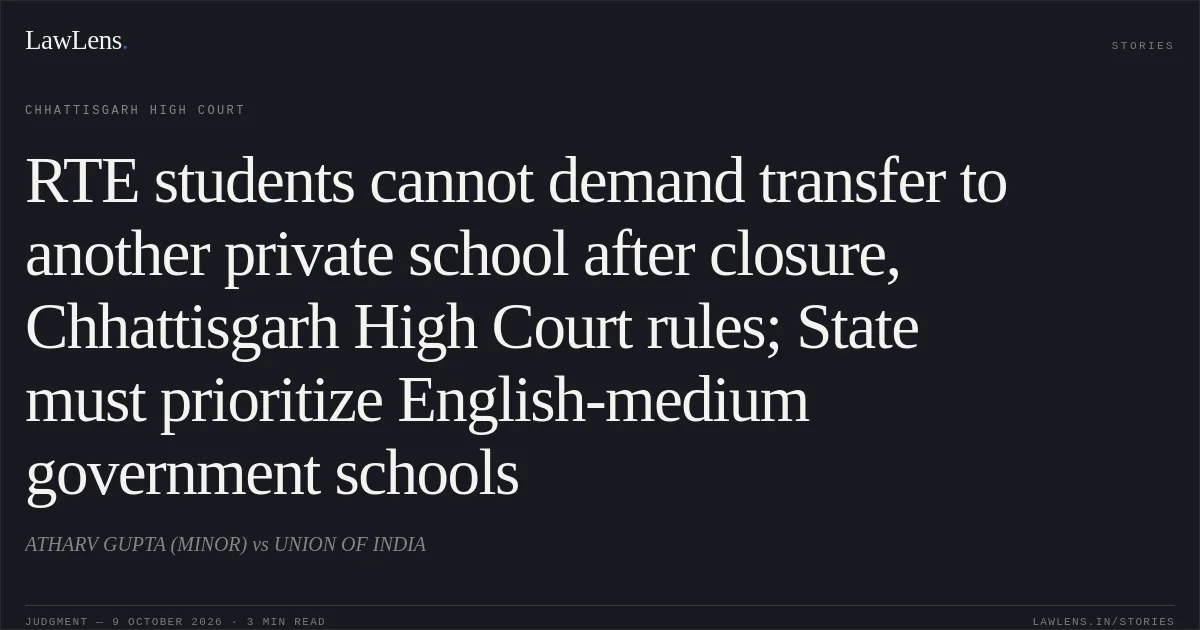
The petitioners, minor students admitted under the RTE quota at St. Xavier’s High School, Kota, challenged the District Education Officer’s order dated 16 April 2026 rejecting the school management’s proposal to merge the Kota branch with its Bharni branch and directing the students to nearby Government schools.
Source reference: paras. 1–3The management had offered to continue the students’ education at Bharni, and their guardians had consented.
Source reference: paras. 1–3The petitioners also challenged the application of a 30 March 2022 State circular providing for students of closed private schools to be shifted to Government schools. They argued, among other things, that the transfer would disrupt their education and that the statutory procedure for withdrawal of recognition had not been followed.
Source reference: paras. 1–3Issues
Whether the petitioners had an enforceable right to require the State to transfer them from a closing private unaided school to another private school, based on the management’s offer and their guardians’ consent.
Source reference: paras. 4–7Whether the DEO’s order and the 30 March 2022 circular were unlawful or arbitrary in directing the affected students to nearby Government schools.
Source reference: paras. 1, 7–8, 13Whether Section 18 of the RTE Act and Rule 16 of the Chhattisgarh RTE Rules required notice, inquiry and hearing before the school management’s voluntary closure or relocation of operations.
Source reference: paras. 4, 12Law Applied
Article 21A of the Constitution, read with Sections 8 and 9 of the Right of Children to Free and Compulsory Education Act, 2009 (RTE Act), requires the State to secure free, compulsory and uninterrupted elementary education, but does not confer an absolute right to education at a private unaided school of the family’s choice.
Source reference: para. 7The Court found no provision in the RTE Act or the Chhattisgarh RTE Rules, 2010, authorising or requiring the automatic transfer of RTE students from one private unaided school to another upon closure.
Source reference: para. 7Section 18 of the RTE Act and Rule 16 of the Rules, which concern procedures for withdrawal of recognition, apply when the State initiates penal derecognition action, not to a private management’s voluntary decision to close or relocate its operations.
Source reference: para. 12The Court also referred to Dr. Jaya Thakur v. Government of India, 2026 SCC OnLine 133, on the importance of quality education, and Dinesh Biwaji Ashtikar v. State of Maharashtra, (2026) 7 SCC 267, on the RTE Act’s neighbourhood-school framework.
Source reference: paras. 9–10Reasoning
The Court held that the management’s undertaking, parental consent and proposed internal arrangement could not, absent enabling legislation, create an enforceable public-law right to admission at another private unaided school or support a mandamus against the State.
Source reference: para. 7The State discharged its constitutional and statutory obligation by arranging places in nearby recognised Government schools, and its uniform application of the circular to the affected students did not establish hostile discrimination or arbitrariness.
Source reference: paras. 7–8The school’s appearance on the RTE portal did not establish that it remained operational or create a right to transfer; the Court also noted that the petitioners had not shown that fresh RTE admissions were actually made after academic operations ceased.
Source reference: para. 11The statutory procedure for derecognition was inapplicable because the closure or relocation was a voluntary management decision, rather than State-initiated penal action.
Source reference: para. 12Holding
The Court found no illegality, procedural infirmity or manifest arbitrariness warranting interference and declined to quash the DEO’s order.
It nevertheless directed the State to complete the students’ placement in nearby Government schools expeditiously, prioritise State-run English-medium schools where possible, and ensure a smooth transition without administrative delay in transferring records or issuing Transfer Certificates for the 2026–27 academic session.
Source reference: para. 15The writ petition was disposed of accordingly.
Source reference: para. 16Acts & Sections Cited
6 provisions across 1 statute referred to in this judgment. Each provision opens on LawLens.
Right of Children to Free and Compulsory Education Act, 20096
Original Court PDF
ATHARV GUPTA (MINOR)vsUNION OF INDIA
Click to open original judgment
Original judgment, available to read, download and summarize on LawLens.in